
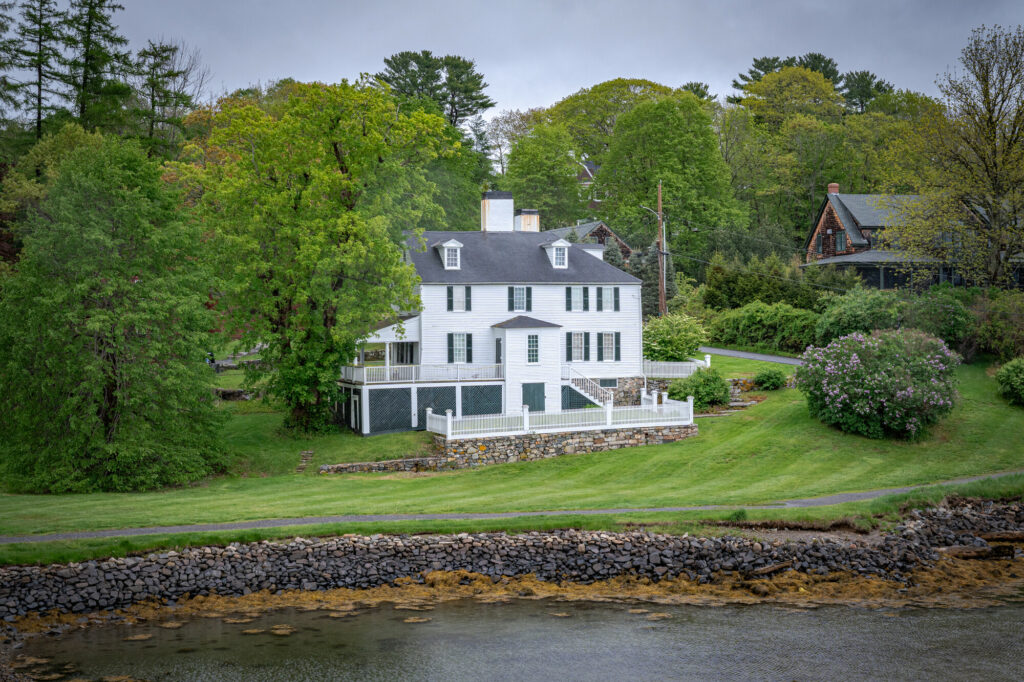
Built on the banks of the York River in York Harbor, Maine, Historic New England’s Sayward-Wheeler House (ca. 1718) is highly vulnerable to severe storms and climate hazards. The property has been impacted by intensifying precipitation patterns and sea-level rise, and we recently obtained an environmental risk assessment and recommendations for nature-based resiliency adaptations at the site. While flooding events have not yet threatened the house itself, we have established our preservation priorities at Sayward-Wheeler House with an eye toward resiliency and mitigation of the anticipated impacts of climate change—including a major restoration of the house’s rear porch, which we are completing this spring.
In repairing the porch at Sayward-Wheeler House, we sought to address two interrelated challenges: an ongoing cycle of rapid deterioration and repair, made worse by the structure’s wet environment and proximity to saltwater; and the need to design a solution compatible with flooding risk, as the porch is partially within the boundary of a FEMA flood zone.
The framing has been replaced several times over its lifespan, but the structure’s visible character-defining details were always retained or replaced in kind. Unfortunately, the materials we used at the time—primarily pine to match existing wood—aren’t well-suited to wet surroundings, and the longevity of the repairs has been poor. We recently determined that the porch frame was unsafe, which meant the porch, which had previously served as the primary visitor entrance, had to be cordoned off and excluded from public tours.
Historic New England’s Preservation Philosophy emphasizes in-kind replacement of materials and features that are beyond repair, but we recognize that the impacts of climate change may demand flexibility. With this in mind, we developed a new restoration plan for the porch that balanced anticipated public use, preservation priorities, and climate hazards with local building codes and flooding regulations.
Ensuring the preservation of the porch’s overall character was of utmost importance to our project design. We protected notable features, including the porch roof and decorative support columns, during construction. We repaired the porch rails and balusters in kind, matching materials and dimensions, and replaced the latticework enclosing the area below the porch with matching materials, dimensions, and spacing. The orientation of the deckboards was another character-defining feature, but this is where things got complicated.
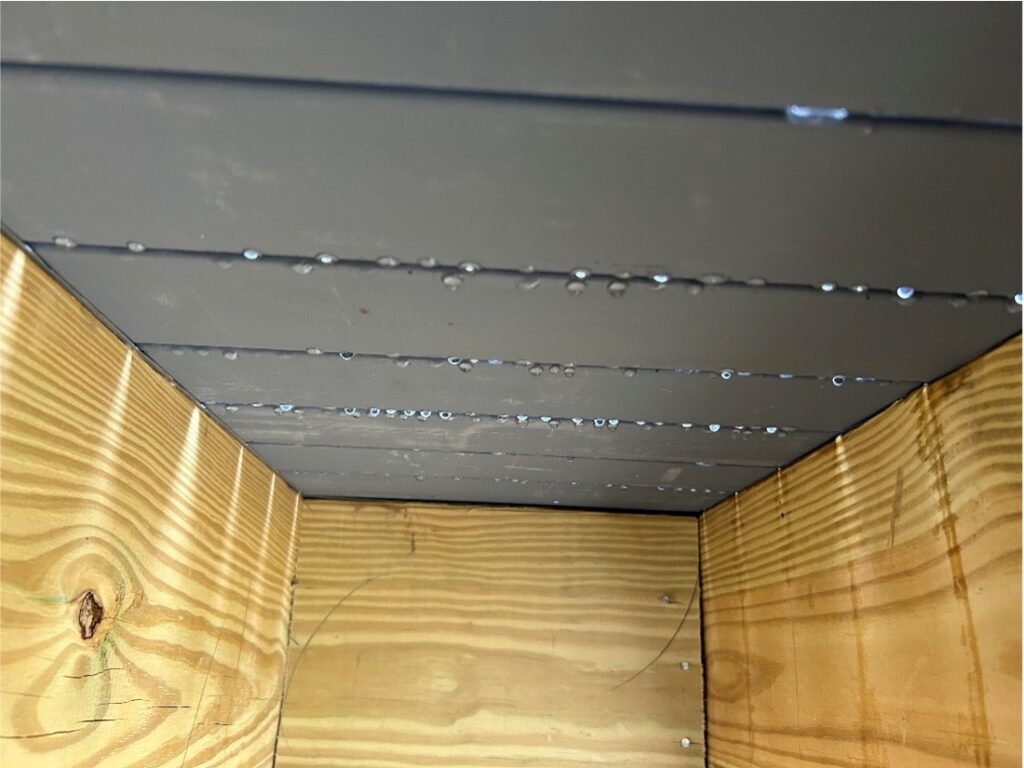
The original construction of the porch featured tongue-and-groove decking laid in multiple directions, with quirky intersections that contribute to its character; repairs over the years have always retained this pattern. Tongue-and-groove boards interlock like puzzle pieces, creating a tight seal with no gaps. The resulting look is polished and seamless, like an interior hardwood floor, but does not allow water to escape. Because only a small section of the porch is covered by a roof, most of the deck is exposed to the elements and collects standing water after every storm.
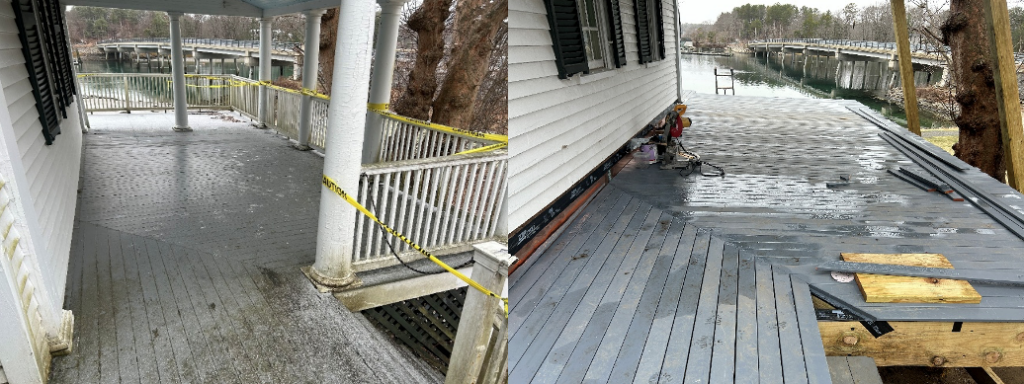
Historic New England’s institutional climate action goals emphasize our commitment to high preservation standards and instruct us to “adapt those standards to ensure resilience in the face of weather extremes and sea level rise.” Recognizing that the tongue-and-groove boards have accelerated the deterioration of the decking, columns, and railing posts, we made the decision to replace them with gapped boards to allow for drainage. The change in appearance is hardly noticeable—especially because we retained the quirky orientation of the deck boards. Water now sheds rapidly through the porch floor and does not collect on its surface.
We also retained the historic configuration of the porch’s frame, but to ensure a longer lifespan, we chose to use pressure-treated pine instead of traditional pine. This change is invisible to visitors but makes the entire structure significantly more resilient. Then, working with a structural engineer, we developed a support system that is independent of the building—a more significant modification, but an important one. Historically, the porch was attached to the house, which provided additional, load-bearing support but put both the porch and the house at potential risk. We wanted a better solution to prevent damage to the building and to safely hold larger groups of people for community events. We devised a system of concrete footings that project several feet out of the ground, adding support and elevating the wood posts out of the flood zone. This change is completely hidden by the porch’s latticework and, like the pressure-treated pine, invisible to visitors.
Rebuilding the porch at Sayward-Wheeler House strictly to match the existing construction would not have been in the best interests of the historic resource. Sensitive, thoughtful changes were designed, approved by the York Historic District Commission, and implemented to improve visitor experience and safety, restore the aesthetics of a significant historic feature, and bolster the structure’s resiliency to climate and flooding hazards. Most importantly, the porch appears as it always has, and will again welcome visitors for tours at Sayward-Wheeler House when the site opens for the season in June.
Written by Ben Haavik, Vice President, Property Care and Climate Action
Restoration of the porch at Sayward-Wheeler House was generously supported by a matching grant from Maine Preservation and the 1772 Foundation.
Sign up to our newsletter for our latest news and events