
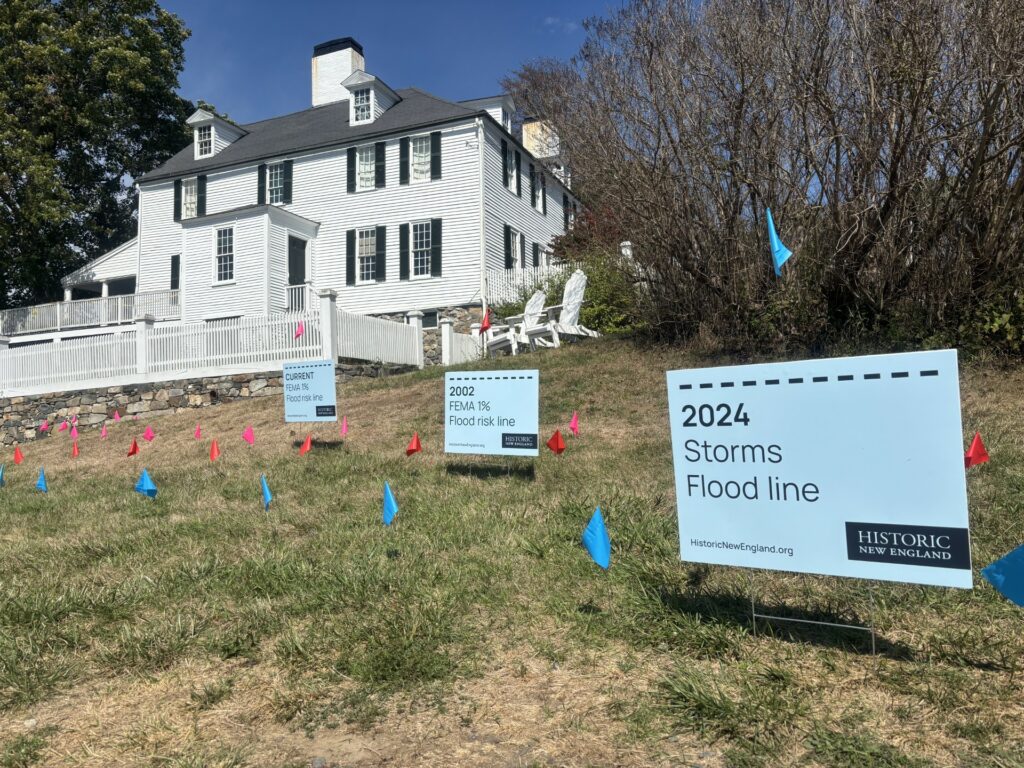
It was 8:00 a.m. on a sunny September morning in York, Maine, and I was marking contour lines on the front lawn of Sayward-Wheeler House in preparation for a community day at the site. At my side was a bag filled with brightly colored flags that I inserted into the ground about two feet apart as I moved. When I was done, there would be four lines of flags snaking across the lawn, each with a different color—white, blue, orange, and pink.
Even before I’d finished setting up the flags, passersby were approaching me to ask if what I was setting up was intended to represent flooding or sea level rise. As each person asked, I explained what each line represented:
After I finished explaining what the flags meant, people immediately began to share stories about their own experiences with flooding.
“I’ve lived here most of my life and I remember when the waves never came into the road. Now with every storm the road is flooded.”
“The January storms left my front yard full of sand and stones that the ocean washed up. I’ve never seen anything like it.”
“Yes, just a few weeks ago I was walking here, and the water was where those white flags are.”
Eventually, the flags were fully set up and the signs that explained what they meant were in the ground. There were many things happening at the Sayward-Wheeler House community day. Some of our preservation carpenters were there to talk with people about our restoration work. We had a table set up with information about becoming a member of Historic New England, and we had guides on site to offer free mini tours of the house. I was at a table with information about our climate action work and the resilience planning we were doing at the site.
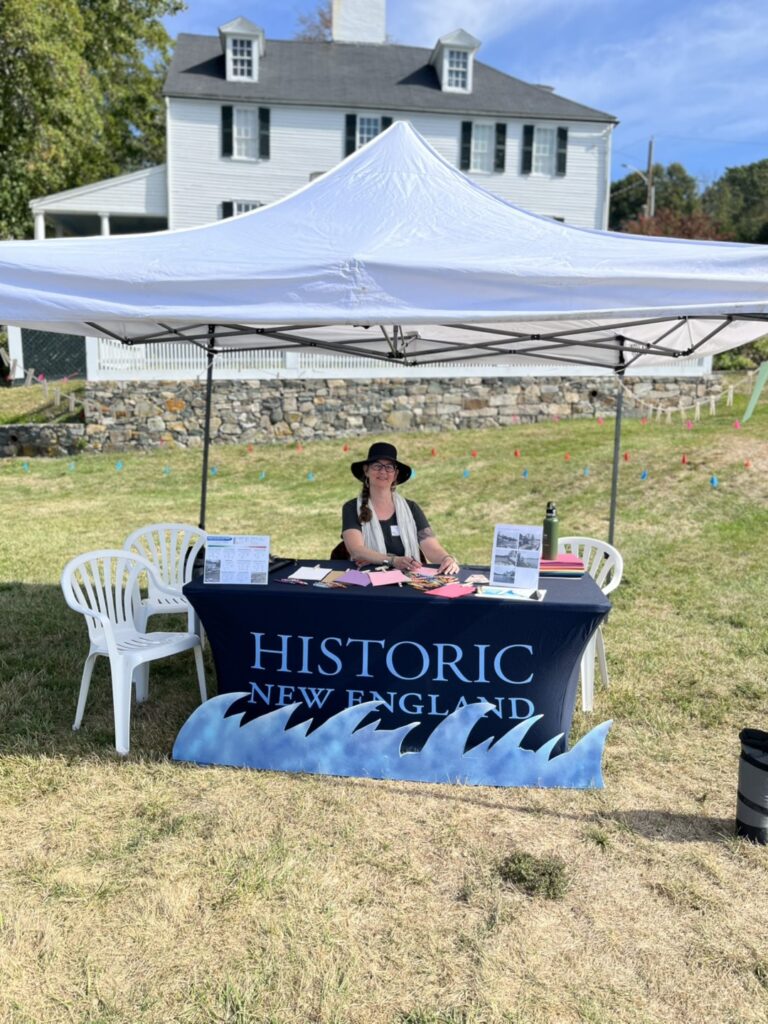
I shared the work Historic New England is doing, but flooding was what everyone wanted to talk about. Someone would approach my table and ask me about the flags or our work, and eventually they’d share their own flood story.
I talked with a man who had just moved away from Ashville, North Carolina, after experiencing the extreme flooding caused by hurricane Helene. He and his family had moved there due to its reputation as a climate haven and were shocked when the hurricane barreled through. “It doesn’t feel like any place is safe anymore,” he said.
There was the family who shared their experience with Hurricane Sandy, the repeated flooding in New York, and how they wanted to move to a place where their basement didn’t flood every time there was a major storm, but housing costs prevented them from doing so.
Throughout the day I heard stories from people around the United States who had lived through extreme flooding. I heard stories of Katrina in New Orleans, Sandy in New York and New Jersey, Irene and other flooding in Vermont, and many, many stories about the January 2024 storms in Maine. People told me they were concerned about losing their homes, about roads being blocked, about the impacts on their communities, and—over and over again—the future: If it is this bad now, what will the future hold? What world will my children grow up in?
I had started the day with intending to share the climate action work of Historic New England—and I did share it with many people—but as the day progressed, I also found myself doing a lot of listening. People needed to share their experiences and be heard.
Climate change can feel too vast and nebulous for us to tackle. If we’ve lived through its impacts, like the extreme flooding so many described, it can seem even more frightening. But when we share our stories and experiences—when we connect with others—we set in motion the kind of collective action that helps communities respond to and prepare for the challenges ahead.
Written by Joie Grandbois, Director of Sustainability
Sign up to our newsletter for our latest news and events