The week before Historic New England’s museums opened for the 2025 season, we ran an essay by longtime member William F. Schulz about his lifelong love of historic house museums. “Finding Meaning in Historic House Museums” moved our staff and readers alike. Bill mentioned he was only four Historic New England sites shy of seeing them all. We were delighted when he wrote earlier this week, just after most of our properties closed for the season, to let us know he’d visited his thirty-ninth property—and he’d written another essay to commemorate the achievement.
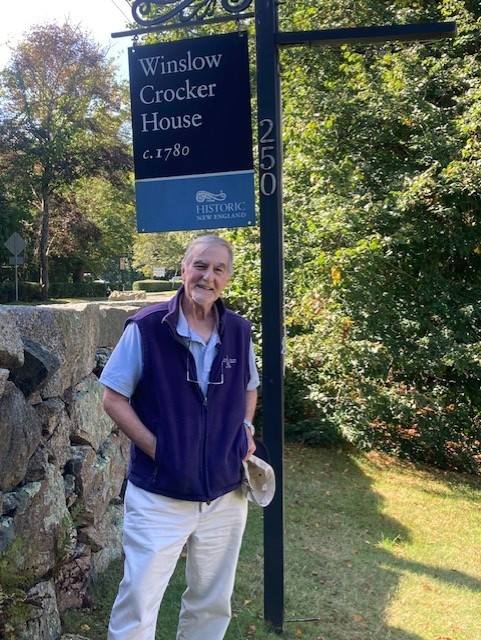
The author at his thirty-ninth Historic New England property. Photograph by Rev. Beth Graham.
A few weeks ago my wife Beth and I journeyed to Cape Cod from our home on the North Shore of Massachusetts to visit my thirty-ninth and final Historic New England property, the Winslow Crocker House in Yarmouthport. It had taken me close to twenty years to get to all of them (and Beth still has a handful to go) but there was a certain satisfaction for me in reaching closure, even though I had lost my “passport” years ago so you’ll just have to rely on my honest face to confirm that I made it to all of them.
One of the elements of satisfaction in getting to all the properties is that you practically need a spreadsheet to keep all their opening times clear: Marrett House is open the first and third Saturdays from June-October 18, Barrett House is open the second and fourth Saturdays from June-October 11, and woe be to the visitor who mixes up either their names or those dates. That I managed to solve the “puzzle” lends a certain pride.
For another I admit to being a bit compulsive about completing travel projects. I have a photo of myself standing beside a “Welcome to North Dakota” sign on the occasion of reaching my fiftieth state. (Several of that state’s residents were not overly impressed by my accomplishment. “North Dakota is everybody’s fiftieth state,” they told me.) And in the spring I expect to go to Fiji and Samoa to pick up my ninety-ninth and one hundredth countries after which I can go back to the ones I really love.
But there was something special about making it to all thirty-nine Historic New England properties beyond just the tallying up. So here are six reasons for visiting them all:
Let’s start with the mercenary. Individual membership in Historic New England costs $58 per year. Visit five or six sites in a year and it’s paid for itself; visit them all and you have practically won the lottery;
The variety of styles and structures in the properties, from the relatively primitive, like Browne House in Watertown, Massachusetts, to the elegance of Bowman House in Dresden, Maine, the quirkiness of Beauport in Gloucester, Massachusetts, or the sleekness of Gropius House in Lincoln, Massachusetts, speaks to the ingenuity of the human spirit across the generations—something that can only be fully appreciated by completing the set;
Almost every site tour now begins with an acknowledgment of the Indigenous land upon which the structure sits and, where appropriate, the role slavery played in the social and financial development of the property. To visit all thirty-nine is to understand more viscerally than ever how much exploitation played a major role in the settlement of New England;
Many of the properties are in parts of New England that Beth and I had not been to before. How many of you have set foot in New Ipswich, New Hampshire? We found that the pleasure of our outings in quest of thirty-nine often derived as much from the countryside and setting around the property as the dwelling itself;
Among the former residents of the Historic New England properties lurk a fair share of. . . shall we say, “unusual characters?” Part of the pleasure of learning the story of a new property was being entertained by the eccentricities of its legendary inhabitants.
And who doesn’t like to compare notes with companions on which sites were your favorites? Which the most memorable? Which the most touching? Since only a few folks get to them all, one last advantage to being a completist is that you can answer with some authority the question neophytes to the Historic New England experience inevitably pose, “Where shall I go first?” though, having been to them all, I can now truly say, “You can’t go wrong whichever you choose!”
Written by William F. Schulz. Schulz is a retired Unitarian Universalist minister and former executive director of Amnesty International USA. He has been a member of Historic New England since 2006 when he and his wife, Beth, moved back to Massachusetts from New York.