
I am a sucker for house museums. I have visited several hundred of them over the past sixty-five-plus years. The first that I can remember was the Custis-Lee Mansion, now called Arlington House, just outside Washington, DC. I was seven or eight years old and had started learning about the Civil War so my mother took me to Robert E. Lee’s antebellum home overlooking Arlington National Cemetery. The mansion was dazzling but what impressed me far more were the quarters of the enslaved people on the property, little more than hovels. “Did people live in these?” I asked my mother. “Oh, yes,” she said and, recognizing a teachable moment, explained the horrors of slavery.
Since then I have visited house museums all over the world, from Winston Churchill’s Chartwell outside London to poet Pablo Neruda’s La Chascona in Santiago, Chile; from spy and silk merchant Jim Thompson’s house in Bangkok to painter and sculptor Anders Zorn’s in Sweden.
Every region of the United States boasts house museums but by far the richest cache is right here in New England. That makes sense, given the length of our history and the proclivity of New Englanders to preserve it, but it also means that we lovers of historic domiciles (would that be a “domiphile?”) face real challenges getting to them all. Historic New England offers thirty-nine properties to visit and my wife, Beth, and I have been to thirty-five and are determined to get to the last four.
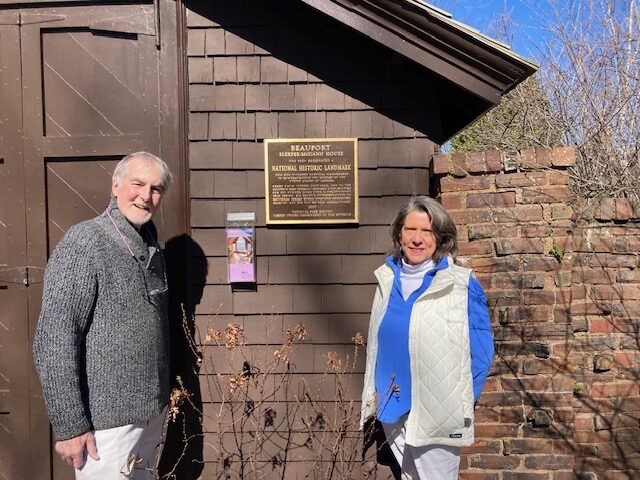
Sometimes those who are not quite as fascinated by house museums as I am ask me what’s behind my attraction to them. (They kindly refrain from calling it an obsession, at least to my face.) Of course, often it’s simply for the love of history and the desire to stand where those who made it stood (or sat or crawled). Few things can bring the past alive as readily as imagining that in this very place Emily Dickinson had her heart broken by the world and was inspired by it to write her matchless poetry.
Not all house museums preserve the living quarters of famous people, of course. Many times, the pull is that the house tells us something about the social mores of its time, whether its occupants’ names are known at all. (Beth and I have been extraordinarily impressed by Historic New England’s commitment to incorporating the stories of marginalized people into their house narratives in order to bring to life those who have too often been forgotten.) Other times, it’s the architecture, be it the seventeenth-century workmanship of Historic New England’s Boardman House in Saugus, Massachusetts, or the twentieth-century genius of Frank Lloyd Wright’s Zimmerman House in Manchester, New Hampshire, now owned by the Frank Lloyd Wright Foundation. And occasionally, it’s the just plain whimsy of the place: I’ve been trying to convince my friends for years that the Paper House in Rockport, Massachusetts, is the eighth wonder of the world—a house made out of paper!—though I haven’t made many converts. Whichever it is for you, I find that paying attention to the feelings a house evokes is as meaningful as the information its interpreters convey.
At the core of my affinity for house museums, however, is what they tell us about life’s fragility. Such places embody the distinction between creations that stay and creatures that go. If a historic home is still standing, it has managed by definition not to disappear while the people who lived in it, shaped it, took its solidity for granted, have dissolved into air. Their “stuff” remains while their “self” departs. We all are aware of our ephemerality but spend a great deal of energy trying to forget it, often by investing ourselves in things that feel solid and enduring—like houses.
Whenever I enter the home of someone from the past—homes often preserved, the curators tell us, as if the owners “had just walked out the door”—I think of their mortality and mine. Some may regard that as a bad thing or a sad one but for me it is a gift to be reminded of the fleetingness of our days. It is a piece of wisdom to cherish the moments we are given. It is a blessing to find things of interest but people precious. And to think—all that can be bestowed upon us by something as simple as stepping over the threshold of a historic home.
Written by William F. Schulz. Schulz is a Unitarian Universalist minister living in Gloucester, Massachusetts; the former head of Amnesty International USA; and an almost twenty-year member of Historic New England.
Sign up to our newsletter for our latest news and events