
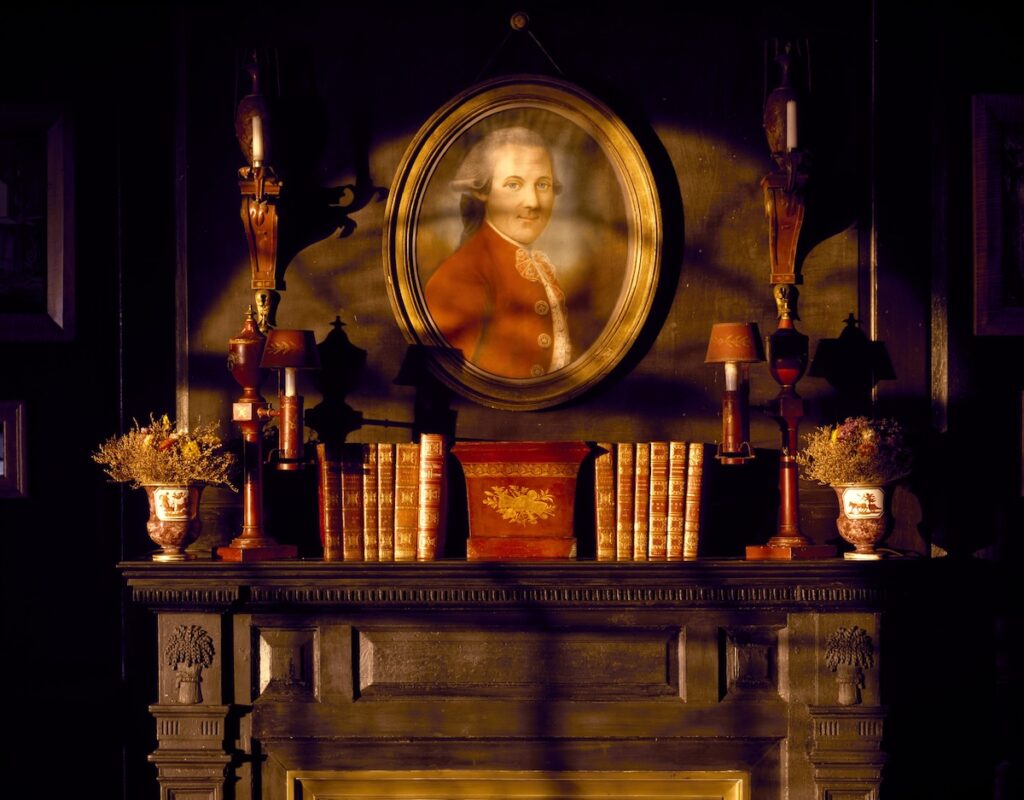
On the morning of August 24, 1824, after much anticipatory fanfare, a remarkable scene unfolded on Boston Common. It was the arrival and ceremonial greeting of the Marquis de Lafayette, who was returning to the United States fifty years after his involvement in the American Revolution to celebrate and be celebrated by an adoring population of New Englanders. His entrance was recorded in the diary of twenty-six-year-old Eliza Susan Quincy, whose father, Josiah Quincy, was then the mayor of Boston. Eliza’s diary, which follows Lafayette’s 1824–1825 visit, is close to four hundred pages long and is held in the collections of the Massachusetts Historical Society, together with a scrapbook she kept of similar length.
Through her own writing and hundreds of newspaper clippings, Eliza chronicled Lafayette’s travels through the New England states, where he was feted on a scale never before seen in the United States, as illustrated by her lengthy account of his greeting in Boston:
“Boston presented a most animated scene, crowds of people in their best drapes were already moving through the streets, the military maneuvering on the Common and an immense cavalcade of citizens on horseback, among whom were 200 buckmen draped in their white frocks, who made a fine appearance. A barouche drawn by 4 white horses had previously been sent out to the government’s seat for the general.” Eliza marveled at the pageantry of Boston’s welcome procession as it passed through, reporting that a long train of carriages carrying city officials wound through the decorated streets toward the Common, arriving at nine o’clock. “Punctual to the appointed moment,” she wrote, “they there met the General Lafayette, attended by his suite, and the Mayor, standing up in the barouche in which he rode pronounced the following address.”
In the center of the Common, Mayor Quincy welcomed Lafayette. Eliza recorded in her diary that he said, “In your youth you joined the standard of three millions of people, raised in an unequal and uncertain conflict. In your advanced age you return and are met by ten millions of people and their descendants, whose hearts strong, hither to greet your approach and to rejoice in it.” Lafayette responded with the warmth and enthusiasm that so endeared him to Americans, replying, “I beg of you all, beloved citizens of Boston, to accept the respectful and warm thanks of a heart which has for nearly half a century been particularly devoted to your illustrious city.”
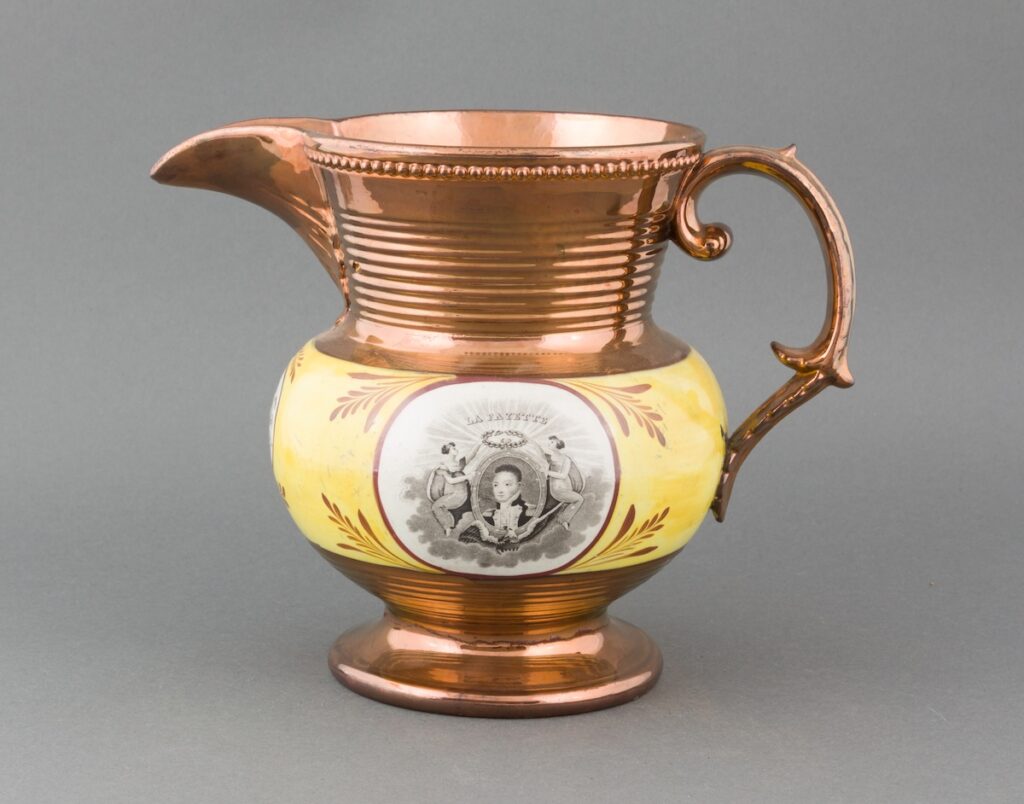
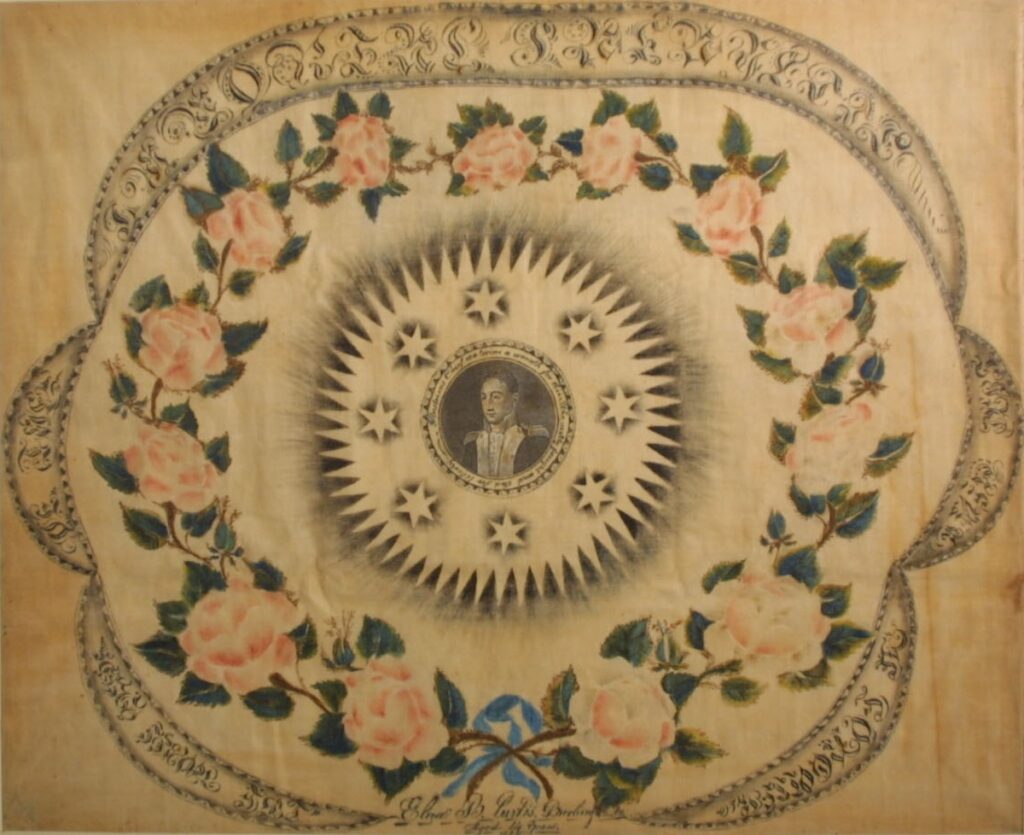
Eliza and her family watched these remarks with great interest, as the Quincys were central to Lafayette’s Boston itinerary, and they would soon have the chance to meet him at their home on Hamilton Place. Immediately following his appearance on the Common, however, Lafayette was whisked away to a grand reception at the State House. The city was festooned in flowers and banners to welcome the hero of the American Revolution, and Eliza described Boston’s mood as one of irrepressible jubilation, with people cheering and ladies waving handkerchiefs from every window as Lafayette’s procession passed. Men climbed the sides of the General’s carriage to shake hands with him as it moved, and hundreds of schoolchildren lined up on the Common wearing white satin ribbons stamped with his portrait. These ribbons were just one example of the many commercial souvenirs bearing Lafayette’s image that were made for his visit. Ladies’ fans and gloves, men’s canes, chinaware, and crockery were only some of the items manufactured on a huge scale to commemorate the iconic marquis’ return.
After his public reception and a dinner, Lafayette quietly told Mayor Quincy that he wished to make an unplanned stop at Hamilton Place, sending the family into a frenzy of last-minute preparations, which Eliza noted, writing, “We received the message and had only time to invite a few of our own nearest relations and friends to make a few preparations, and light up our rooms, when the shouts of the populace announced the approach of our expected guest.” She was charmed upon meeting him and remarked, “he retains much of the animation and vigor of youth. His countenance is expressive of great benignity, and benevolence of character, and his address and appearance is simple and unassuming.”
The following day, the Quincys attended commencement exercises at Harvard University, where Eliza’s brother, Josiah Quincy IV, gave the valedictory address. From her family’s well-situated bench at the front, Eliza observed Lafayette’s dramatic entrance: “The instant the Marquis appeared he was saluted by a shout which seemed as if it would tear the roof asunder. The audience rose and remained standing until long after the procession entered. The ladies welcomed the General, by waving their handkerchiefs, the gentleman by a thunderous applause. The scene was indeed one never to be forgotten.”
Before leaving Boston, Lafayette visited President John Adams at his home in Quincy, and he stopped at the mayor’s nearby country house to greet the family again. In the weeks and months that followed, Lafayette crisscrossed twenty-four states, attending more than six hundred balls, banquets, parades and other ceremonies. Like a true celebrity, he was adored wherever he went. On June 17, 1825, the fiftieth anniversary of the Battle of Bunker Hill, Lafayette returned to Boston and the Quincy family accompanied him to the cornerstone-laying ceremony for the Bunker Hill Monument. A crowd of more than a hundred thousand people turned out to honor one of the last living generals of the American Revolution. Eliza, who was a talented artist, had already presented Lafayette with her own token of respect; before his first departure from Boston, she gave him a drawing (perhaps similar to this one) she had made depicting President John Adams’ home in Quincy, “with a distant view of the city of Boston as it appeared on the 24th of August 1824, when it was the happiness of the citizens of Massachusetts to welcome General Lafayette’s return.” Lafayette accepted it gratefully and later signed his letter of thanks to her as, “Your Most Sincere Friend, Lafayette,” which she of course recorded in her diary as a testament to the warm and sincere relationship the Quincys formed with the Marquis during his historic visit back to a grateful Republic.
Join us this summer for special Lafayette-focused tours of Quincy House in Quincy, Massachusetts; dates will be posted on our events calendar in the spring.
Written by Eleanor Martinez-Proctor, Study Center Fellow
Sign up to our newsletter for our latest news and events