
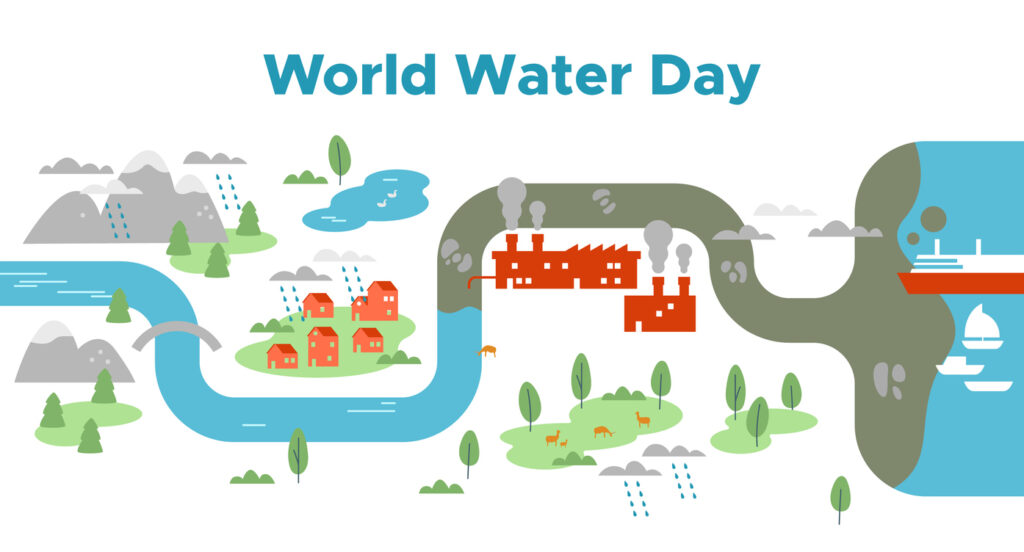
In 1993, the United Nations declared March 22 World Water Day. It is a day to draw attention to the more than two billion people around the world who live every day without access to safe water. In the United States, about two million people lack running water or indoor plumbing, and thirty million rely on water systems that do not meet federal drinking water standards.
Many of us give little thought to our water or where it comes from. As long as the water comes out of the faucet when we need it, and then flows readily down the drain after, we just go about our day. Whether your water comes from a well or a public water supply, the water that you drink, wash with, and flush your toilet with takes quite a long journey before it arrives at your faucet. This journey is called the water cycle.
The water cycle begins with water moving from a liquid to a gaseous state. This can happen in a few ways. Evaporation occurs when the sun heats bodies of water, turning some of the liquid into gas. Sublimation is similar, but in this case, snow or ice transforms directly into gas, bypassing the liquid stage. Plants also contribute by releasing water vapor from their leaves and stems in a process called transpiration.
Water rises into the atmosphere until it encounters cooler air and condenses back into a liquid to form clouds. These clouds move with the wind until eventually they release the water back to the Earth, often many miles from where it began its journey. When water falls from the clouds as rain, sleet, or snow, it may flow across the ground into rivers and lakes as runoff, soak into the soil to reach underground water reserves, or be absorbed by nearby plants.
Along the way, water comes into contact with a variety of other substances. It can pick up sulfur dioxide and nitrogen oxides, both by products of burning fossil fuels, which can create acid rain. When water moves across the surface of the earth as runoff it can pick up soil, fertilizer, pesticides, animal waste, and other contaminants. All of this can eventually make its way to the rivers, lakes, reservoirs, and aquifers we draw our drinking water from. With thirty million Americans relying on tap water that sometimes fails federal standards, it’s important to know what’s in your water.
When nine out of ten Americans turn on the tap, the water that comes out is from a public water supply, while the rest generally obtain their water from privately owned wells. Public water systems are required to test the water at their facilities regularly and share the results. One easy way to find out where your water comes from and see the most recent test results is to go to the website of your provider. Most will publish their most recent test on their website. If you’d like to take a deeper dive, you can take a look at the EPA’s Drinking Water Mapping Application to Protect Source Waters (DWMAPS). By typing in your address, you can see the water supplies in your county, the watershed your address is located in, and potential sources of contamination in your area. If your water comes from a private well on your property, you may need to contact a private company to conduct testing on your well.
Only 2.5 percent of the Earth’s water is fresh and the rest is salt water. What can we do to help protect this vital resource? Here are a few actions you can take:
Whether your water comes form a well on your property or a public water supply, keeping that water safe and clean is something that is of great importance for all of us.
Written by Joie Grandbois, Director of Sustainability
Sign up to our newsletter for our latest news and events