
Starting my architectural conservation career working at the SPNEA Conservation Center (one of the preeminent architectural conservation centers from the 1970s through the 1990s) at the Lyman Estate was foundational because I had the opportunity to work with Brian Powell and Susan Buck on a number of paint analysis projects. I was incredibly fortunate to be mentored by two of the most experienced and accomplished paint analysts in New England, because mentoring is key to building a visual reference encyclopedia for the interpretation of paint cross sections. After the Conservation Center closed, I had the good fortune to continue working with Susan Buck over the years, including collaborating with her on the paint analysis for the Eustis Estate shortly after Historic New England acquired that property.
Historic paint analysis uses scientific methodology and microscopy techniques to identify historic paint materials, but the interpretation of microscopy findings and the application of that information to a historic site are made possible by studying archaic painting materials and techniques, along with the site-specific history of the building and its occupants. Paint analysis is best understood as an archaeological study of a building’s finishes. It should begin with well-defined questions, an understanding of the building’s history and evolution, and on-site investigation of how it was constructed and where evidence of built-up finishes remains.
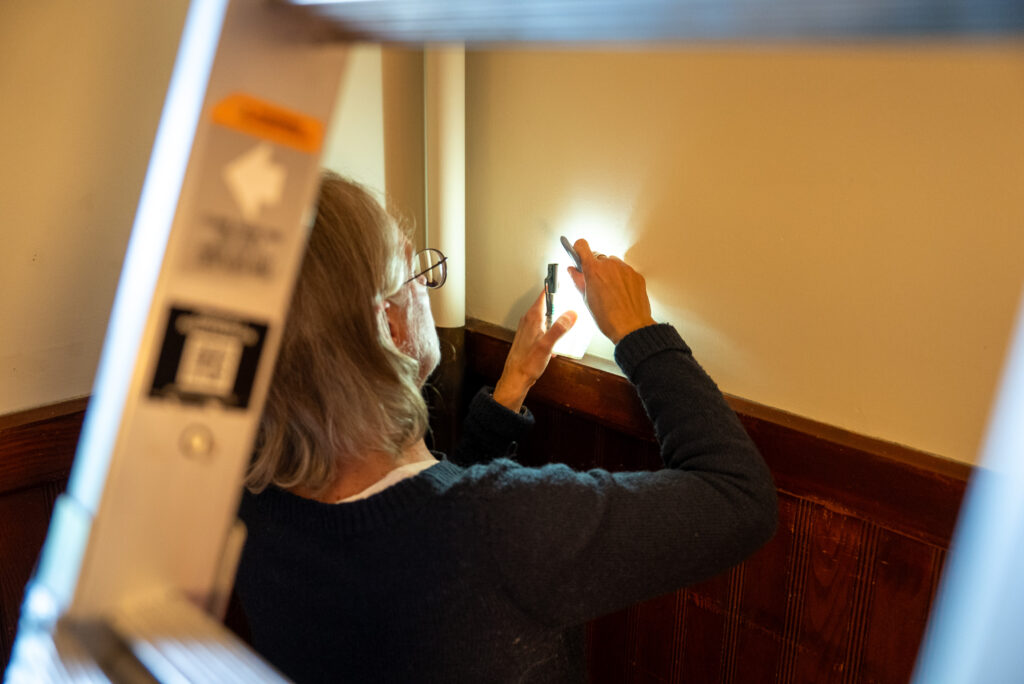
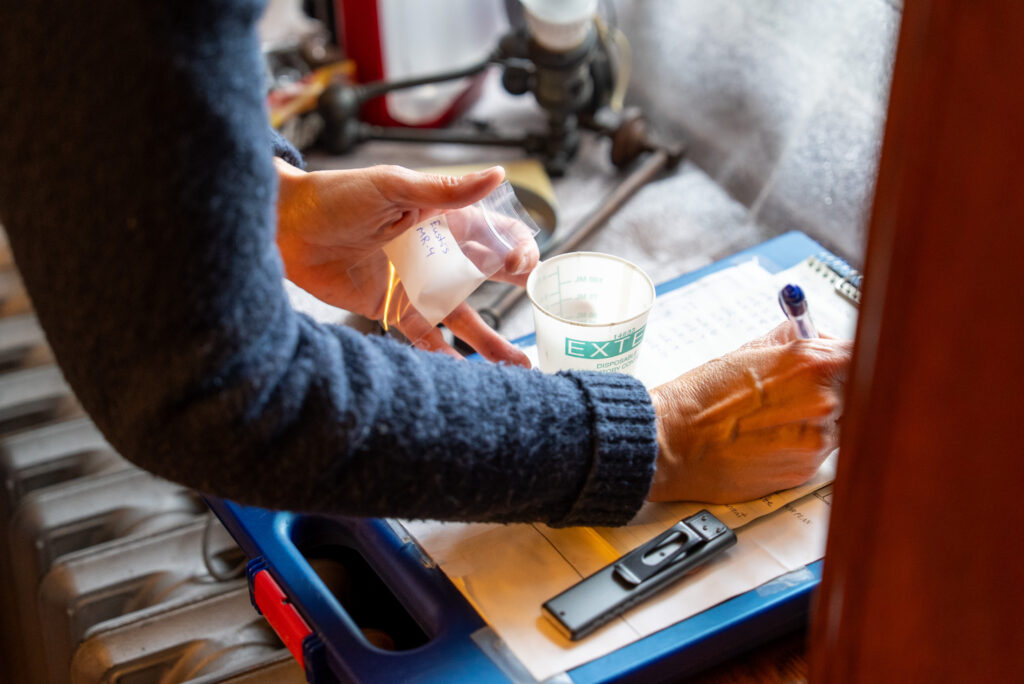
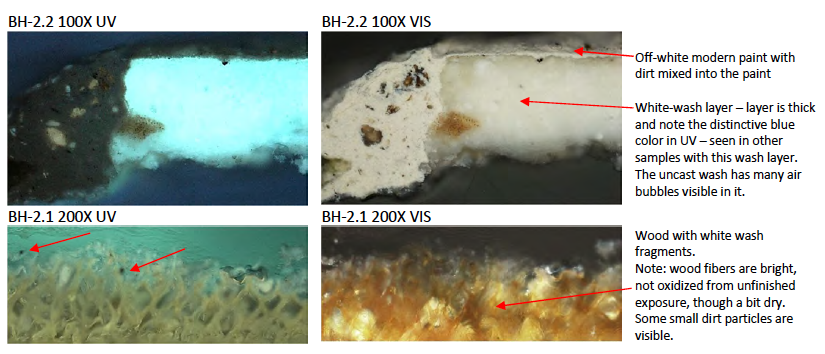
Small samples of paint are carefully removed from locations with well-preserved accumulations of finishes, from areas that can serve as benchmarks for known (and suspected) alterations, and from locations where overlapping wall and trim paints can help identify which layers were applied as part of the same paint scheme. The samples are studied in the lab to select the best pieces for cross-section casting, pigment identification, and color matching. Cross-section samples are cast in small polyester resin cubes, which are then cut down, polished, and analyzed at 100×–400× magnification in reflected visible and ultraviolet light. High magnification and multiple light sources are necessary to distinguish the many layers of finishes, such as the primer versus the finish coat or, in the case of decorative finishes, the ground, figure, and varnish layers, as well as pigmented glazes built up over metallic finishes. Pigment identification is generally carried out using polarized light microscopy techniques. This level of detail is necessary to fully understand the materials and methods historically employed in finishing and decorating a historic house, in order to conserve or accurately recreate those finishes for an authentic visual experience.
Abbott Lowell Cummings and Nina Fletcher Little documented and catalogued important observations about early plain and decorative finishes in their seminal books, Framed Houses of Massachusetts Bay and American Decorative Wall Painting, 1700–1850, as well as in other published articles. It has been fascinating to follow in their footsteps and begin addressing the questions they noted in their footnotes, questions that paint analysis can now help confirm and expand.
What I am finding is that these houses share similarities in their paint histories in terms of the progression of materials, colors, and application techniques, but they are all missing significant portions of their finish histories due to losses from later redecorating and, in the early and mid-twentieth century, restoration work. Fortunately, their collective histories—because of material and stylistic similarities—help fill in those gaps and broaden our understanding of early finishes in seventeenth- and early eighteenth-century houses.
Historic New England’s Boardman House, of course, stands out for the survival of the seventeenth-century crease-mold chimney walls, along with moldings and doors in the two chamber rooms and upper stair hall, as well as what appears to be an original seventeenth-century attic stair and reused original stair parts in the cellar. The extremely important early finishes in the two chambers have only been partially studied and should yield additional insights with further analysis.
The focus of last year’s study was the spotted decoration in the stair hall. While this decoration was referred to as sponge painting in the twentieth century, on-site study indicates that the spots were actually applied with a round brush—the traditional paintbrush used well into the nineteenth century and still used today by craftspeople working with historically accurate methods. Cross-section analysis confirmed that this decorative paint scheme is the first and only painted finish on those boards and that it may have been refreshed once or twice. The analysis also confirmed that the spotted decoration remained exposed until it was covered by wallpaper in the nineteenth century. The date of that first wallpaper, a fragment of which is visible in the staircase, has not yet been established.
It is important to note that while the spotted decoration is the earliest painted finish on the walls, this does not necessarily mean it dates to the original construction. However, the clean appearance of the wood beneath the paint in cross section suggests that the space was not left unpainted for an extended period.
Another interesting finding is the widespread use of black paint on interior woodwork in the late seventeenth and early eighteenth centuries. While its use on framing members has been well documented by Cummings, its application on other trim elements and even entire fireplace walls appears more common than previously understood and is an area I am continuing to investigate.
The first analysis project identified the original decorative finishes in the primary spaces of the house. I could talk for days about that scheme—the finishes are subtle but highly sophisticated, a mesmerizing blend of textures and colors that unify the architectural spaces. In this recent project, it was especially rewarding to return to the small parlor and identify the original wall finish. That discovery completes what is truly a jewel of a room, and its restoration would reestablish the visual harmony between the large and small parlors.
This project also identified the second-generation paint scheme in what was called the “Man’s Room” on the original plans, corresponding to the early twentieth-century interpretive period, when the Eustises’ majordomo Charles H. Bowie used it as his office. The analysis confirmed that the use of a colored ceiling rather than a white one continued in this later scheme, consistent with the original finishes. While seemingly minor, this detail is important for maintaining an authentic historic interior, as white ceilings were a later twentieth-century convention in this house.
I will be continuing analysis at the Narbonne House and at the Peabody Essex Museum’s Ward and Crowninshield-Bentley houses over the coming year. There is an enormous amount to learn from these buildings. I have also been invited to deliver a lecture on the history of architectural paint at the North Bennet Street School, which I am especially looking forward to. It is essential to share this knowledge with the next generation of students.
An edited and condensed version of this interview appears in the Summer 2026 issue of Historic New England magazine.
Sign up to our newsletter for our latest news and events