
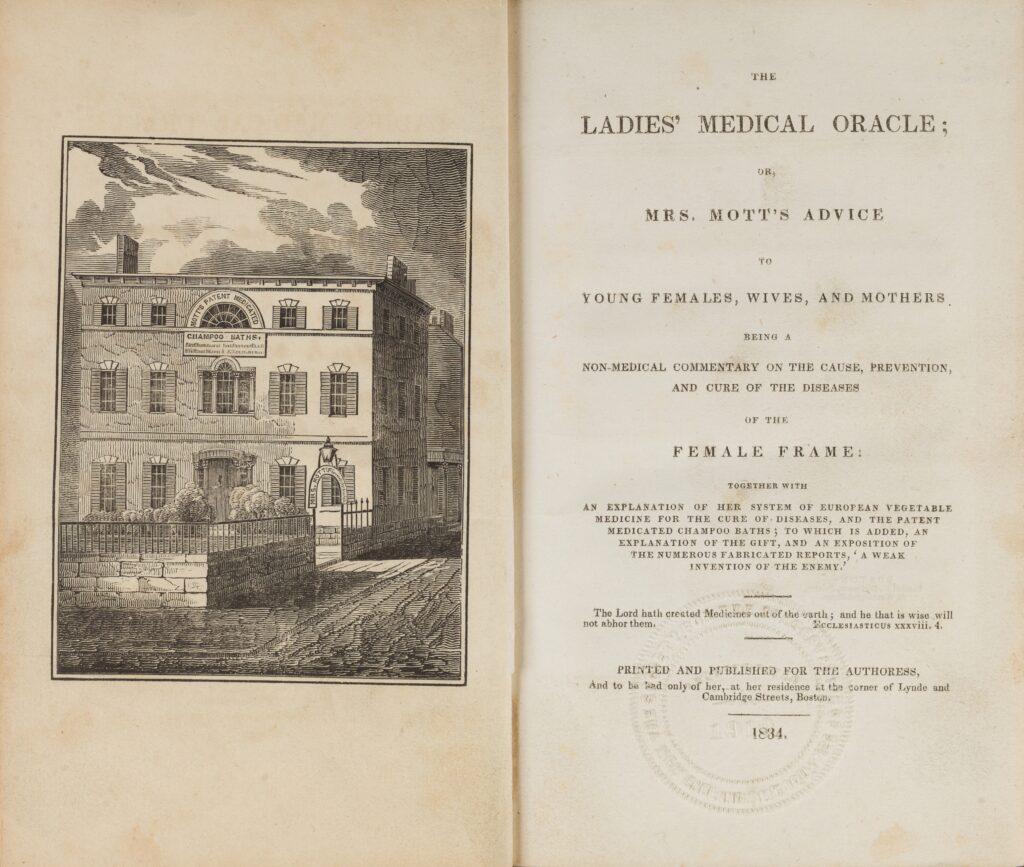
On any given morning in 1834, women of all ages could be seen coming and going from Otis House on the corner of Lynde and Cambridge streets in the Beacon Hill neighborhood of Boston. What had once been the home of Harrison Gray Otis was now split into two rental units. Physician Elizabeth Mott was a tenant in half of the brick house, from which she operated a thriving medical practice that offered her patients privacy and understanding and carved out a space for female medical authority years before women could formally enter the profession. “Every female is allowed to see me,” she wrote in her 1834 book, The Ladies’ Medical Oracle; Or, Mrs. Mott’s Advice to Young Females, Wives, and Mothers. If women wanted to seek her care, all they had to do was stop by the home.
Elizabeth and her husband, Dr. Richard Mott, moved from England to Boston in the early 1830s. In 1833, Richard patented a medicated “champoo bath” that pumped vapors infused with herbs and oils into a closed stall where the patient would sit. When Richard died two years later, Elizabeth continued to promote the patented bath. She advertised directly to women and promised that the medicated baths could cure everything from ringworm to asthma to “female weaknesses.”
The practice and theory of medicine in the United States in the 1830s were complex. Most trained doctors were “heroic” practitioners; they believed that illness was caused by an imbalance of humors that could be fixed through therapies like bloodletting or cupping. However, these treatments did not always work and could be painful. This was also the Jacksonian Era, a period defined by President Andrew Jackson’s anti-elite rhetoric that encouraged skepticism of established institutions, including the medical and scientific communities. As a result, some people turned to herbal and other less conventional medicines. Practitioners like the Motts, who promoted natural treatments, were part of the popular health zeitgeist.
Another factor in Elizabeth’s success was that she tailored her business to women and their children. In The Ladies’ Medical Oracle, she argued that seeing a male practitioner threatened a woman’s modesty and virtue. In the early 1830s, no medical schools in the United States admitted women, so there were no licensed women doctors. There was a long tradition of women medical practitioners, such as midwives, who provided their services from their homes and those of their patients. Elizabeth wanted more women to have the ability to care for themselves at home or among other women.
Elizabeth’s practice also inspired some of her patients to study medicine. Another Bostonian, Harriot Kezia Hunt, sought the Motts’ services when her sister Sarah became sick and did not improve with mainstream treatments. Harriot wrote in her autobiography that seeing Elizabeth was the first time she realized women could become physicians. Harriot and Sarah Hunt were so moved by their experience with Elizabeth that the sisters moved into Otis House to train under the Motts.
Elizabeth offered her medical services through the late 1840s. She occasionally traveled around the Northeast to reach new audiences. Her advertisements for herbal cure-alls appeared in New York, New Hampshire, and Rhode Island newspapers. The end of one 1844 advertisement is particularly revealing. The final line reads, “No connection whatever with the Misses Hunt her former pupils.” By this point, Elizabeth and her protégée Harriot Kezia Hunt had stopped speaking because Harriot no longer agreed with Elizabeth’s approach. This clearly affected Elizabeth because she included in several advertisements that she was not associated with Harriot and Sarah Hunt. Despite this professional falling out, the Hunt sisters visited Elizabeth on her deathbed three years later.
Elizabeth was both a healer and a saleswoman at a time when few women held either role. Male doctors—and later some of her former students—may have dismissed her methods, but she met a real need in Boston, and women continued to seek her care. Her work showed that women could claim a place in medicine long before the profession officially opened its doors to them.
Written by Rebecca Lo Presti. Lo Presti is a PhD student at the University of Massachusetts Amherst and interned with Historic New England’s Study Center in 2025.
Beginning summer 2026, Otis House will offer walking tours about Beacon Hill’s nineteenth-century medical history. Keep an eye on Historic New England’s Events Calendar for dates and times, which will be announced this spring.
Sign up to our newsletter for our latest news and events