
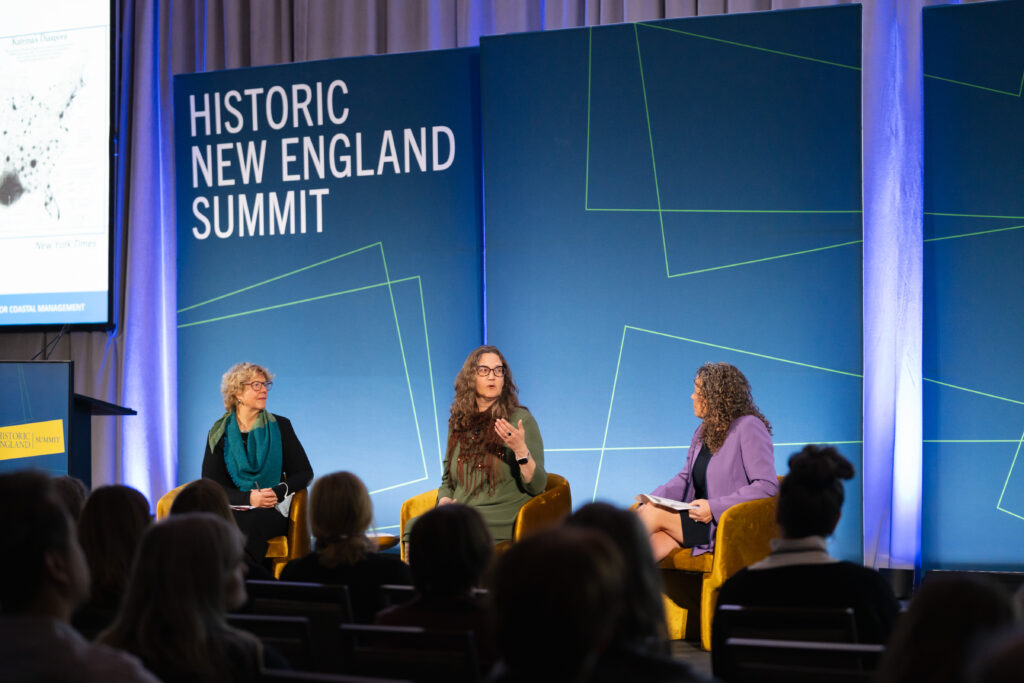
I struggle a bit to answer this question because caring for the natural world is something that was an inherent part of my upbringing. There wasn’t just one moment where I said, “I want to do work that makes the world a more sustainable place to live.” It was something my parents instilled in me, not by talking about it, though they never shied away from talking about important issues at the dinner table, but also in the way they lived. I grew up with parents who cared about and spent a lot of time in nature. My family did a lot of hiking, walking, and camping around New England. Closer to home, my brother and I were given the freedom to explore our own backyards. I loved learning about the creatures and plants I found in my explorations. The more I learned, the more I fell in love with the world around me and the more I wanted to do my part protect it.
I also experienced the impacts that environmental legislation could have. The Clean Air Act came into being about a decade before I was born, followed by the Clean Water Act and the formation of the US Environmental Protection Agency. New England was particularly hard hit by the impacts of acid rain and pollution from industry in our rivers. The Clean Air and Water Acts were instrumental in the recovery of our forests and rivers over the next few decades and I witnessed that firsthand. While my formal sustainability education came much later, my upbringing had a huge role to play in my not only wanting to live lightly upon the earth, but to also work to heal the damage that had been done.
While New England definitely has its challenges that are specific to location, I think we face the same challenge as everyone else: we are not doing enough, fast enough to mitigate the problem. We are feeling the impacts of climate change now and current reports indicate that we will surpass 1.5 degrees Celsius of warming in the next five years. This gives us the double whammy of having to deal with those impacts AND work to mitigate the underlying cause of emissions. Many towns with already limited resources are having to decide which to focus on, and most often that will mean focusing on impacts like flooding, coastal erosion, managing drought, and the like. We need to find regional/cooperative ways to do both, or the problem will just continue to worsen.
You may have heard the phrase, “the greenest building is one that is already built.” When we make anything, from a toy car to a building, there are resources that need to be extracted and energy that is expended. Much of that energy comes from the burning of fossil fuels, which creates emissions. If a building is demolished to build something new, the remains of the building often end up in a landfill, and additional energy is expended to create the new building. If we can keep an existing building, even if we have to retrofit it for another use, we are extracting fewer resources, creating fewer emissions, and keeping the demolition waste out of our landfills. The other part of this is the change over time preservationists are able to document through our buildings, our collections, and our archives. Climate scientists are well equipped to track emissions, temperatures, etc., but who is best equipped to document the less tangible things, like cultural losses or stories of personal impacts? And there is a lot of inspiration to be found in the past. The environmental movement is not new—people have been working to protect the natural world for centuries and we can thank the historians for the preservation of their stories.
People have a great deal of trust in cultural institutions in general, which gives these organizations a platform to talk about climate issues. I think preservation organizations have a special place in that we can demonstrate that energy transition and decarbonization can involve older buildings. We don’t have to start from scratch or build something new. In addition, we can very easily talk about these issues with visitors without even having to use the world climate. Just by talking about changes over time, we can raise issues that many people face and open up the possibility of broader conversations.
Seek out others who are doing this work. If you do some quick internet searching, there are quite likely organizations in your area doing their own climate action planning. Most of us in sustainability and climate related roles are more than happy to chat with others, as we want as many people and organizations involved in this work as possible. There are some great resources out there for cultural institutions who are seeking get started. The Climate Toolkit is an organization that is made up of 250+ cultural organizations around the world that support one another in this work. Climate Resilience Resources for Cultural Heritage is another great place to start ,as it offers free resources to get you on the path of doing your own climate action planning.
Several New England states have some of the strongest climate action plans in the United States, but where I see the most effective work being done is in areas that have taken on regional planning. Maine, where I live, has the Community Resilience Partnership program, which encourages communities to join together to plan regionally. This allows people to share resources and work together on issues that are impacting multiple communities. In Massachusetts, some folks are coming together on their own to begin to work collaboratively, such as the Essex County Community Foundation which is bringing together people from local organizations to do more regionally focused work.
On the surface this may not seem like it is related to sustainability, but any time people are able to come together to build community, they are taking action.
The biggest distraction right now is that too many people think that other people don’t care about climate. The Yale Program on Climate Communication has done a lot of research about people’s opinions on climate change and what they are doing about it. The data shows time and again that the majority of people (64 percent) are concerned about climate change and want to do something about it, but most of these same people (61 percent) underestimate how much others care about it, and so they don’t talk about it because they are operating under the assumption that others don’t care. It can be really difficult to do something about a problem you never talk about. In addition, many people believe that individual action doesn’t make a difference, but individual action taken collectively can have a huge impact. I like to point out that thirty years ago, finding organic food in a traditional supermarket was pretty rare—you had to go to a natural food store or farmers’ market. Today, conventional supermarkets are the primary place people buy organic food. That happened because the public wanted to have that option and asked for it—and they did that without being particularly organized about it.
I facilitate climate communication workshops, which help people learn to talk to each other about climate change. Every time I lead one of these workshops, people come in feeling pretty down about the state of things, but leave feeling empowered to talk to people in their communities and start to take some sort of collective action. I think you just have to open people up to the possibility of their collective power. It is very easy to feel alone about a lot of things in the world right now, including climate change, but it is pretty rare that any one of us is the only person who cares about, or is taking action on, any particular issue. When people seek out and connect with others who are concerned about the same issues, it builds and strengthens both hope and possibility, which makes people more likely to act.
There are definitely issues with how we talk about climate change. It is an overwhelming issue that can prompt a lot of fear for people, and that can be paralyzing. People are very much aware of the dangers of climate change, and many places are already experiencing the impacts right now with bigger storms, increased flooding, and wildfires. We know that most people are concerned about climate change and want something to be done, but they don’t hear the people in their daily lives talking about it, which can leave them feeling very isolated, as though they are the only one who cares. We need to be talking about it in our daily lives and doing so in a way that builds connection and inspires action.
The thing that gives me hope right now is seeing how many people are taking action in their own communities. I had a conversation with a friend recently who talked about the twice-yearly repair cafes they hold in their community and how well attended they are. I’ve seen people come together to do massive amounts of dune grass planting on beaches to help make those beaches more resilient to storms.
Sign up to our newsletter for our latest news and events