
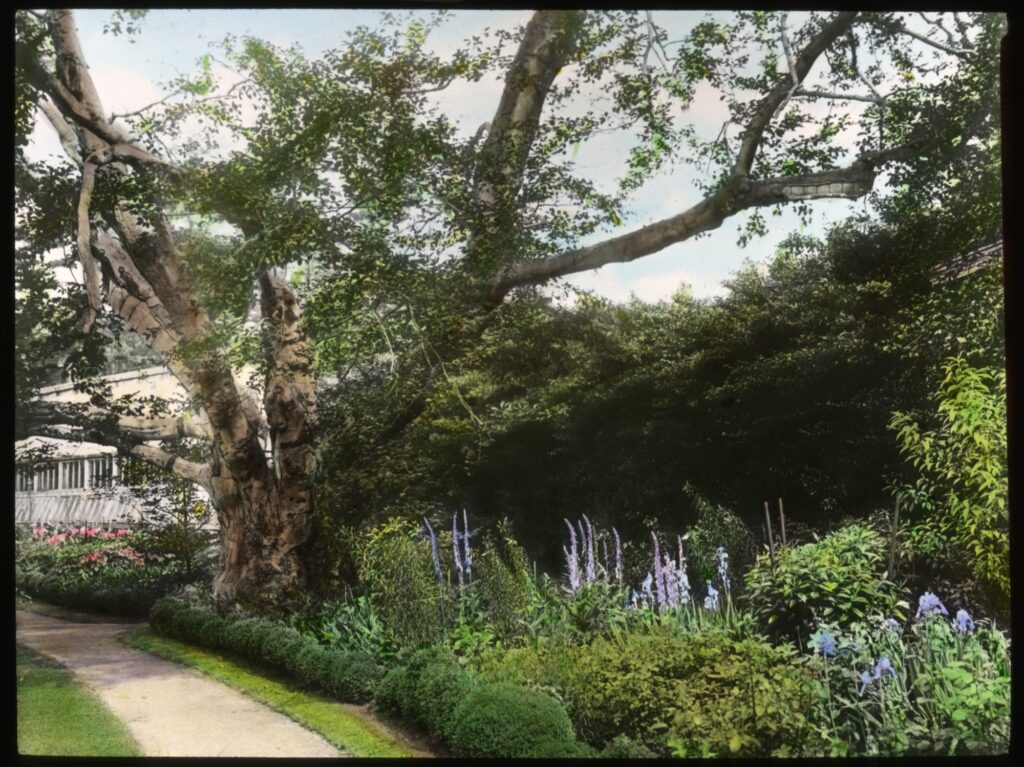
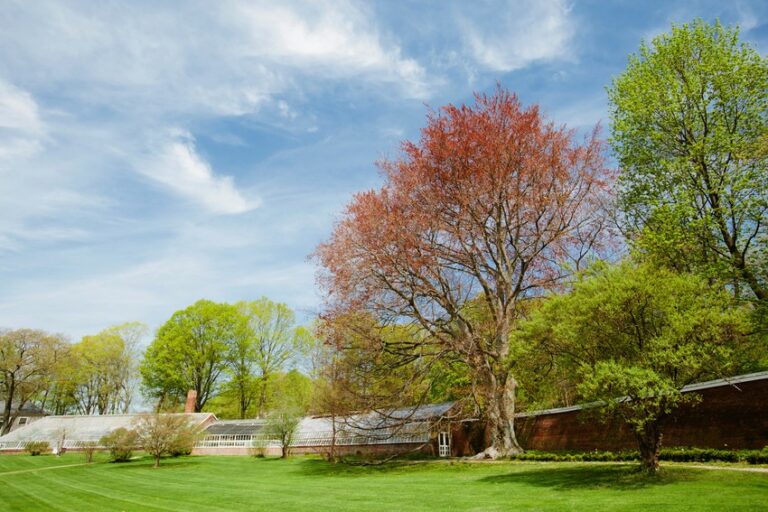
Historic New England’s landscapes, like the buildings they surround, are dynamic systems shaped by environmental pressures. Today, invasive pests, pathogens, and climate change are accelerating their evolution, threatening two common New England tree species: beech and ash. In historic landscapes, these losses carry added significance because individual trees often define a landscape’s character. Their disappearance raises both ecological and cultural challenges, requiring difficult choices about preservation, adaptation, and interpretation. In response, Historic New England is taking a long-term approach to stewarding its cultural landscapes and reexamining assumptions about landscape preservation.
Tree loss is not new; the speed of current changes may be striking, but they are part of a longer trend of forest transformation. Over the past century, New England has seen the decline of several species. American elms, once defining features of town greens and roadways, were largely eliminated by disease. Chestnut and hemlock populations followed similar trajectories due to pests and pathogens. Beech, too, had declined significantly—from roughly 22 percent of northeastern forests to about 6 percent—even before the latest threats emerged.
Beech trees are among the most recognizable species in New England. American beeches form dense forest canopies with smooth gray bark, while European and copper beeches are often focal points in designed landscapes, valued for their shade and visual presence. Beech leaf disease, first identified in Ohio in 2012, has now spread throughout the Northeast and poses a serious threat. The disease affects leaves, causing curling, thickening, and discoloration, which reduces the tree’s ability to photosynthesize. Over time, this weakens the tree, leading to decline and death within two to ten years. The rapid progression creates risks not just for individual trees but for entire collections at historic sites.
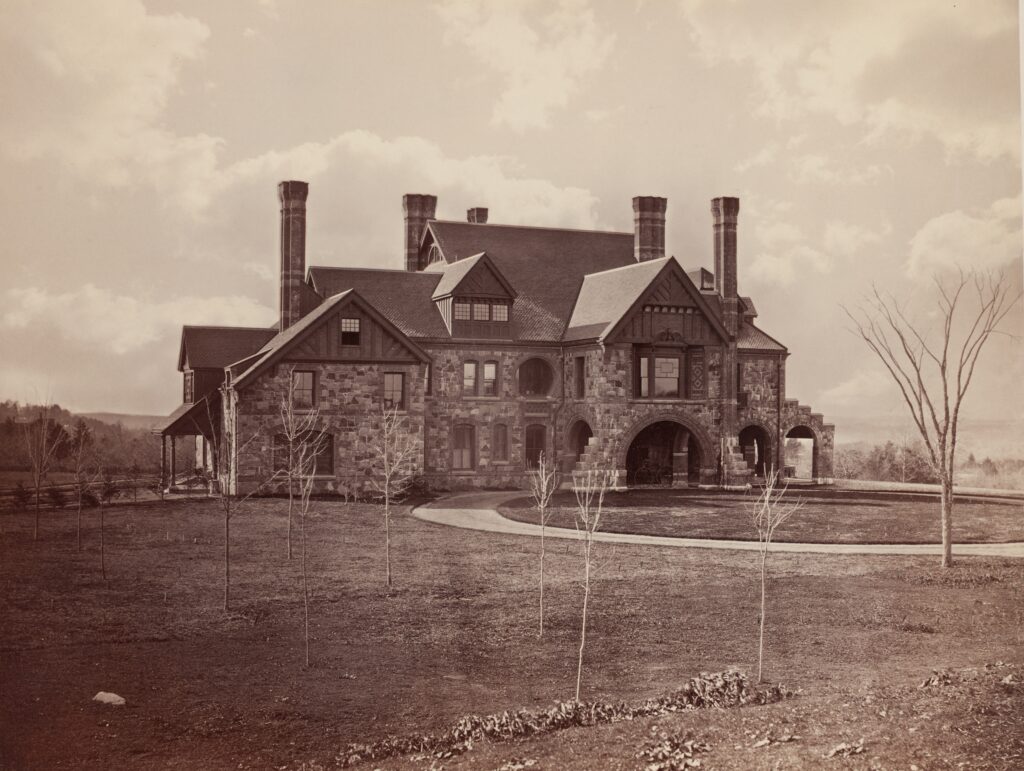
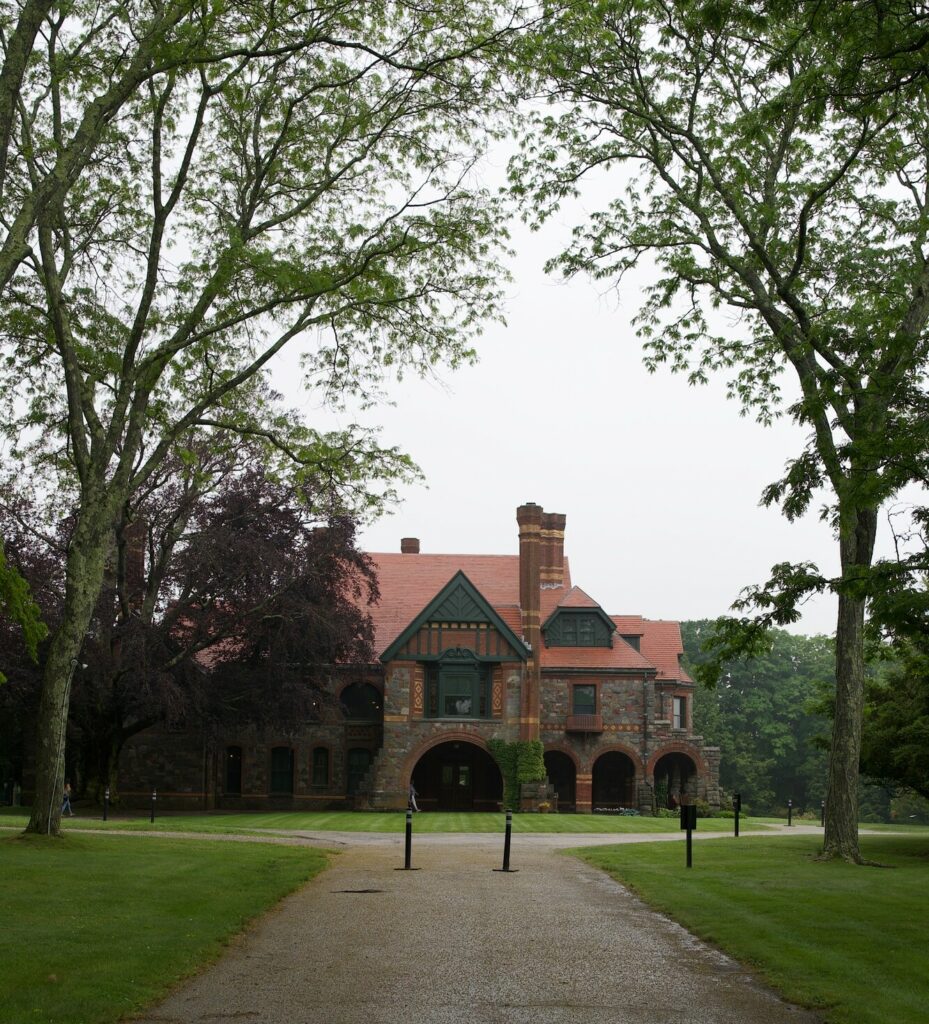
We found beech leaf disease at Historic New England’s Eustis Estate in Milton, Massachusetts, in 2023, and subsequently at five additional sites. In response, our landscape team is using targeted treatments, including foliar sprays designed to control nematodes, the microscopic organism responsible for the disease, to slow its spread. These treatments are not cures and may require repeated applications during the growing season. Maintaining overall tree health is also important, because trees in good condition are better able to withstand stress and disease. This involves ensuring adequate soil moisture, protecting root systems, and maintaining healthy soil structure. Routine maintenance also addresses secondary issues such as cankers or root damage that could further weaken the tree.
While the situation with beech trees is still unfolding, ash trees present a more immediate challenge. Ash trees are facing two major threats, and together they have proven especially difficult to manage. The first is the emerald ash borer, an invasive beetle that damages trees from the inside out. It cuts off the tree’s ability to move water and nutrients, often before there are obvious signs of disease. The second is a fungus known as ash yellows, which weakens trees over time and has no known cure. Because of this combination, ash trees have become one of the most vulnerable tree types in North America. In many cases, once a tree is affected, it cannot be saved.
With ash trees declining so quickly, the question becomes what to plant in their place. Ash trees are found at twenty-four Historic New England properties, and many have been lost in recent years. Six sites have had diseased ash trees removed, and at the Codman Estate in Lincoln, Massachusetts, more than two dozen ash trees are now dead or in steep decline. In the past, our goal would have been to replace them with the same species. Today, that is not feasible—there are no widely available, disease-resistant ash trees that can take their place.
In historic landscapes, tree loss creates practical and philosophical challenges. At Historic New England, when we replace building materials that have deteriorated, we match the original materials. Traditionally, we applied the same approach to landscape elements; however, in the face of irreversible plant disease, we’ve shifted to a more flexible strategy that prioritizes form and function over species. We research the historical significance of a tree or woody shrub to confirm it fits the site’s period of interpretation. If it does, we aim to replace it in kind with the same species. Next, we determine whether the tree is significant or uncommon. If it is, we might propagate it to replant the same genetic stock. When disease has decimated a species, we may instead select a disease-resistant variant. In the case of ash trees, we are looking at alternative species that may match the original’s defining characteristics, including growth patterns, size, and canopy. A key part of our approach is increasing species diversity. Where we have significant loss of ash trees, for example, we will consider planting a mix of trees to create a more resilient landscape and reduce the risk that a single pest or disease could cause widespread loss in the future.
The loss of beech and ash trees is part of a larger pattern affecting forests and landscapes across the region, and a stark reminder that even long-standing features may not be permanent. All is not lost, however. While the loss of elm, chestnut, and now ash and beech trees is significant, efforts to preserve and reintroduce these species are ongoing. At Historic New England, we use disease-resistant elm trees, cultivated over decades, to replace lost elms at our sites. At the Eustis Estate, we are working with the American Chestnut Foundation to reintroduce chestnut trees. In Maine, the Wabanaki people are working with the state to quarantine infested areas and harvest seeds from healthy ash trees, because ash wood remains integral to their cultural traditions as basket makers. Through this kind of careful management and thoughtful collaboration, it is possible to guide historic landscapes through change while preserving what makes them meaningful. Sometimes the trees may change, but the character of the landscape can endure.
Written by Ben Haavik, Vice President, Property Care and Climate Action
Sign up to our newsletter for our latest news and events