
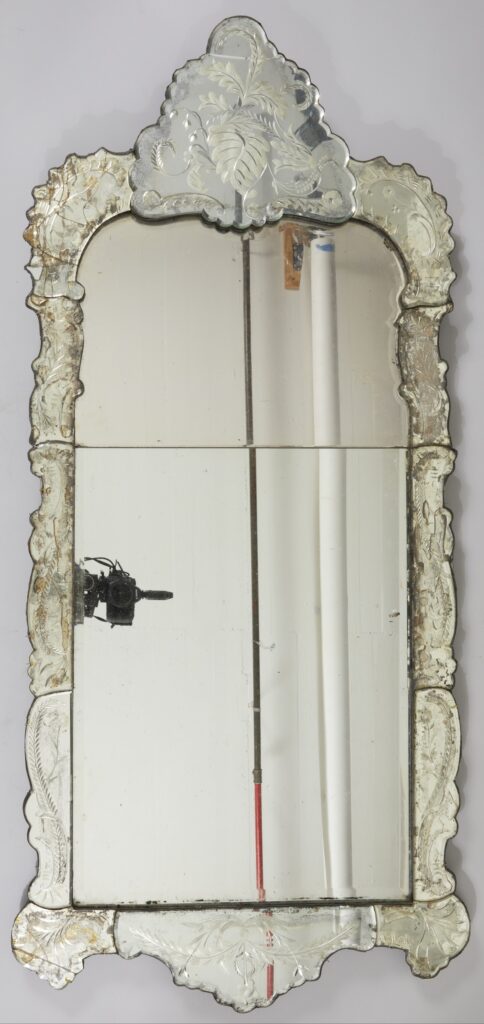
Last year, I was approached by a donor who had an extraordinary object in her home: a large looking glass with a scrolled and etched mirrored frame. The central portion is composed of two large sheets of mirror with a one-inch bevel (slanted edge) around the perimeter. This is typical of mid-eighteenth-century looking glasses, or what is commonly referred to as the Queen Anne style (ca.1740-60).
This piece instantly drew my curiosity, for a few reasons. Foremost was its magnificent size and elegant details, such as the leaf and floral engravings along the twelve mirrored and scalloped sections of the frame. I wondered if it was made in Venice, Italy, where specialized glassmakers in Murano had produced highly coveted looking glasses since the fifteenth century. Perhaps it was British and made in the Venetian style?
Country of origin aside (for now), this was a form and style for which we had nothing remotely similar in our collection. In fact, I could not find a single comparable example in other American museums. This appeared to be an uncommon survival from the colonial era.
Which begs the question, how did this object end up in New England?
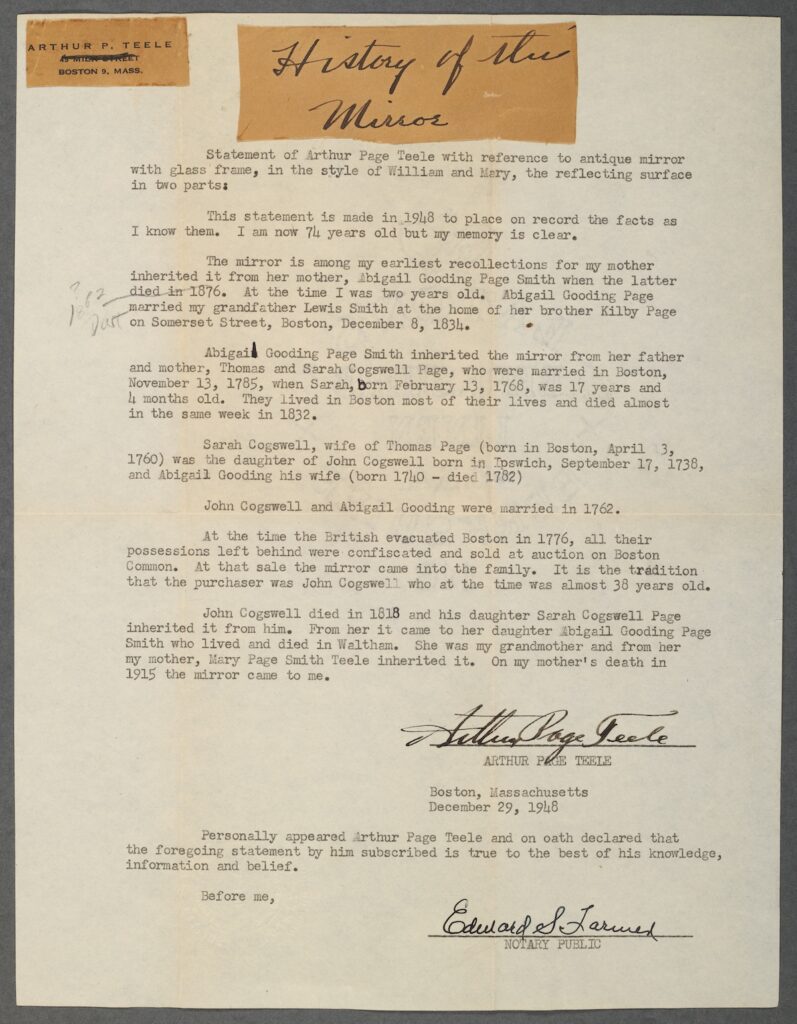
According to the donor, the looking glass descended in the family of her late husband, with a record of ownership going all the way back to his ancestors, John Cogswell (1738-1818) and Abigail Gooding (1740-1782) of Ipswich, Massachusetts. If the name Cogswell sounds familiar, it’s because John Cogswell was first cousin to Jonathan Cogswell (1740-1819), who owned Historic New England’s Cogswell’s Grant in Essex, Massachusetts.
A notarized statement from 1948 accompanying the object by the donor’s great-grandfather documents its provenance: “At the time the British evacuated Boston in 1776, all their possessions left behind were confiscated and sold at auction on Boston Common. At that sale the mirror came into the family. It is the tradition that the purchaser was John Cogswell who at the time was almost 38 years old.”
This story hooked my interest, particularly because of the context. Throughout the eighteenth century, looking glasses were among the most high-valued items in a household inventory; colonists who could afford such objects imported them from London. Historic New England has examples of looking glasses produced during this same period, including some notable pieces, such as an elaborately carved looking glass in the Rococo style purchased by Nathaniel Barrell of York, Maine, in 1763.
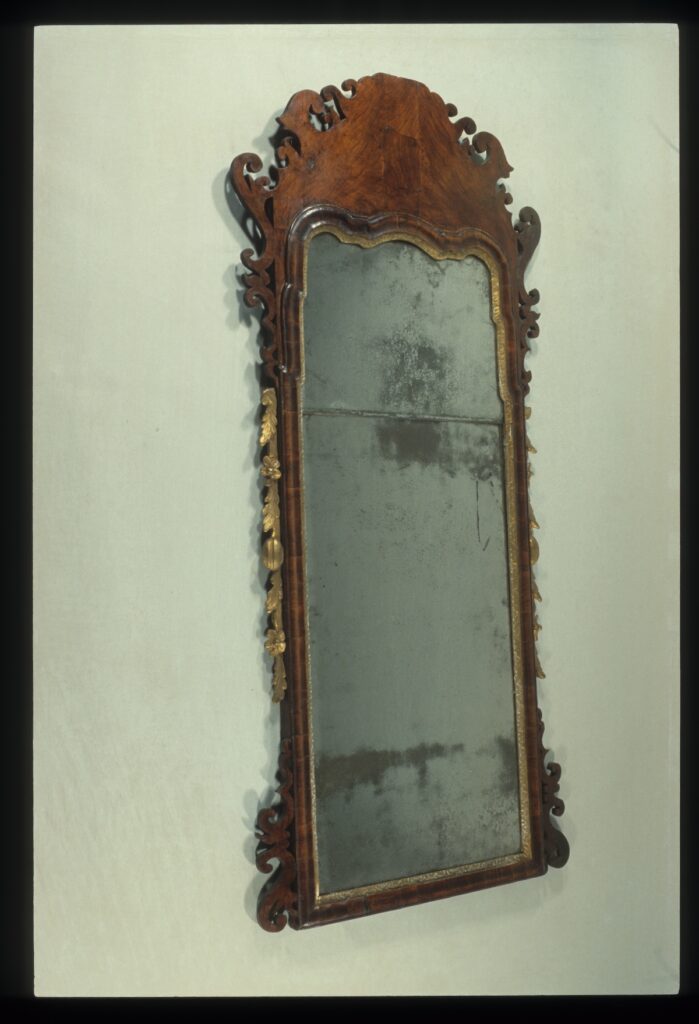
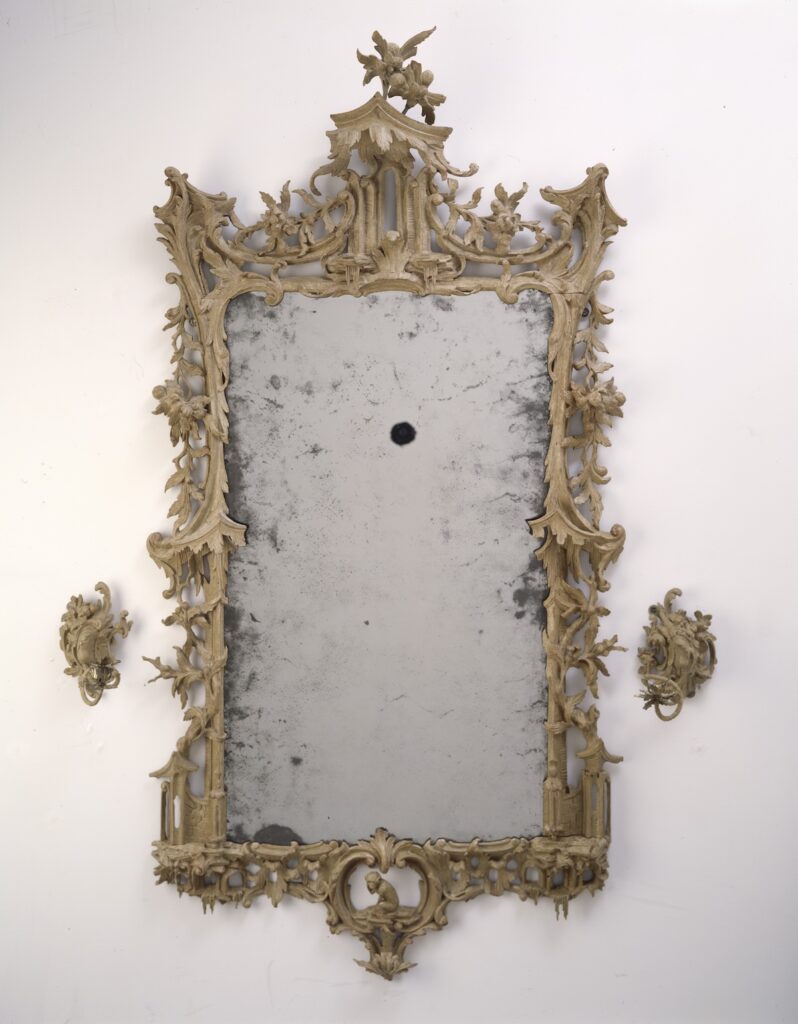
The size and style of our new looking glass, with its mirror glass paneling, suggest its original owner was someone with tremendous wealth and influence to transport such a fragile and expensive item to New England.
Was it a British officer, as the notarized statement claims? The British army occupied Boston as early as 1768 to quell colonial unrest after the passing of several unpopular acts by Parliament. They evacuated the colony in March 1776 after the Siege of Boston. Could this have belonged to someone like General Thomas Gage, royal governor of Massachusetts from 1774 until 1775?
To be honest, I am more inclined to think the looking glass belonged to a Loyalist, perhaps a wealthy merchant or colonial official, like former Massachusetts Governor Thomas Hutchinson, who fled to England in exile in 1774 and left behind a substantial looking glass of his own. His goods and property were confiscated in 1775, so there was precedent for the incident described in the letter.
Massachusetts passed further laws after 1776 to seize goods and properties from exiled Loyalists who fled to England or Canada. The Boston Gazette advertised an auction held on June 17, 1777, of “All the furniture and other movable effects, left in the Town of Boston, by those Persons who fled from thence with the Enemies of this state.”
Rather than being held on the Common (as the letter claims), the sale was at the Sherrif’s Office in Cornhill, now City Hall Plaza in Boston. There are also records of Loyalists petitioning the courts for the return of said property, which provide helpful inventories of the kinds of looking glasses in their former households. As of yet, I have found no direct match in those records to the looking glass in question, although the lack of standardized period terminology for looking glasses makes that a challenge.
With this history in mind, I knew this looking glass would be a great fit for the collection and a fantastic piece to feature in our exhibition. The only issue was its condition, and it would need to undergo treatment by our conservators.
I wouldn’t realize just how appropriate this looking glass was to the themes of “myth and memory” until we brought it to the conservation lab for examination and discovered a few curious features that challenged and deepened our understanding of this object.
Read part 2 and learn what the conservators found.
Written by Erica Lome, Curator of Collections
Exhibitions like this are made possible by the generous support of Historic New England’s members and friends. Support Myth and Memory and help preserve our shared stories.
Sign up to our newsletter for our latest news and events