
Read Part 1 of Through the Looking Glass
Lydia Wood
When the looking glass came to the conservation lab, my goal was two-fold. First, carry out any research and tests that could corroborate the purported origin date of pre-1776, and second, stabilize the piece so it can be on display for Myth and Memory.
The first clue to investigate was the remarkable condition of the mirroring underneath the glass. If the looking glass was made before 1776, it would have been produced through a process called tin-mercury amalgamation, the standard for making mirrors until 1835. This process involves pressing a flat piece of glass over a thin sheet of tin foil covered with mercury. Over time, the mercury and tin bond, or amalgamate, to create a reflective surface. Tin-mercury looking glasses will deteriorate over years or decades, depending on the environment. The liquid mercury slowly drips to the bottom of the looking glass and amalgam breaks down to give the glass a characteristic sparkly, but non-reflective, appearance. If our looking glass was made before 1776, it would be severely degraded and likely wouldn’t have any reflectivity left. Instead, our looking glass only has interruptions in its mirroring where there have been breaks and repairs to the glass, or where adhesive has caused the mirroring to break down.
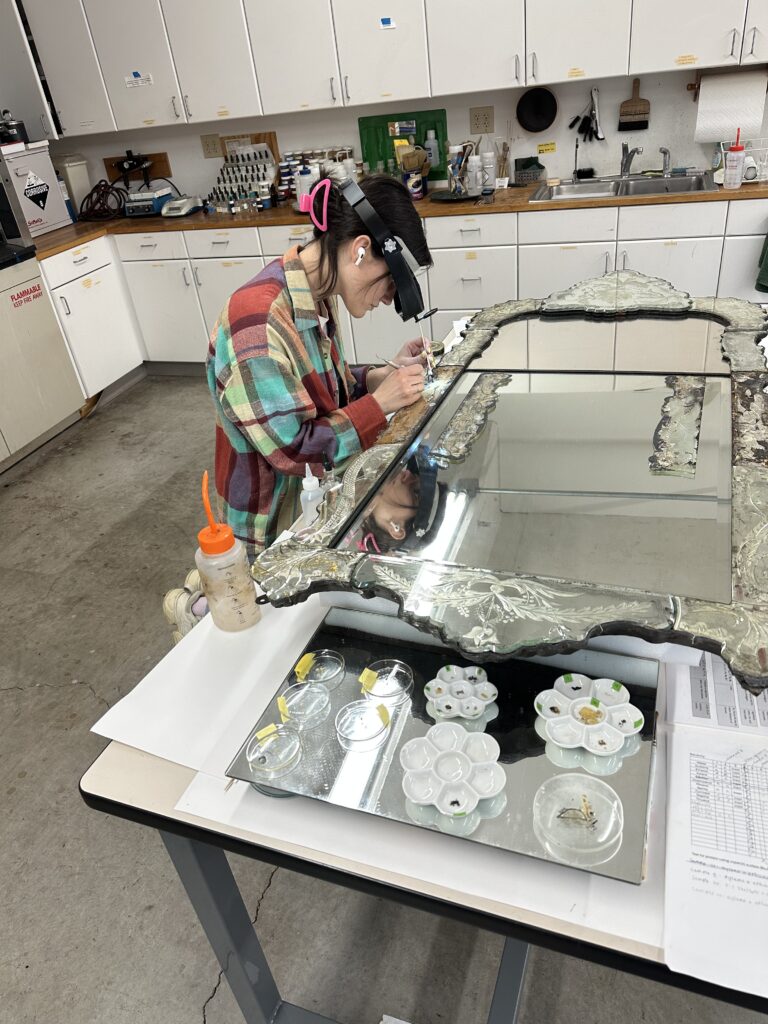
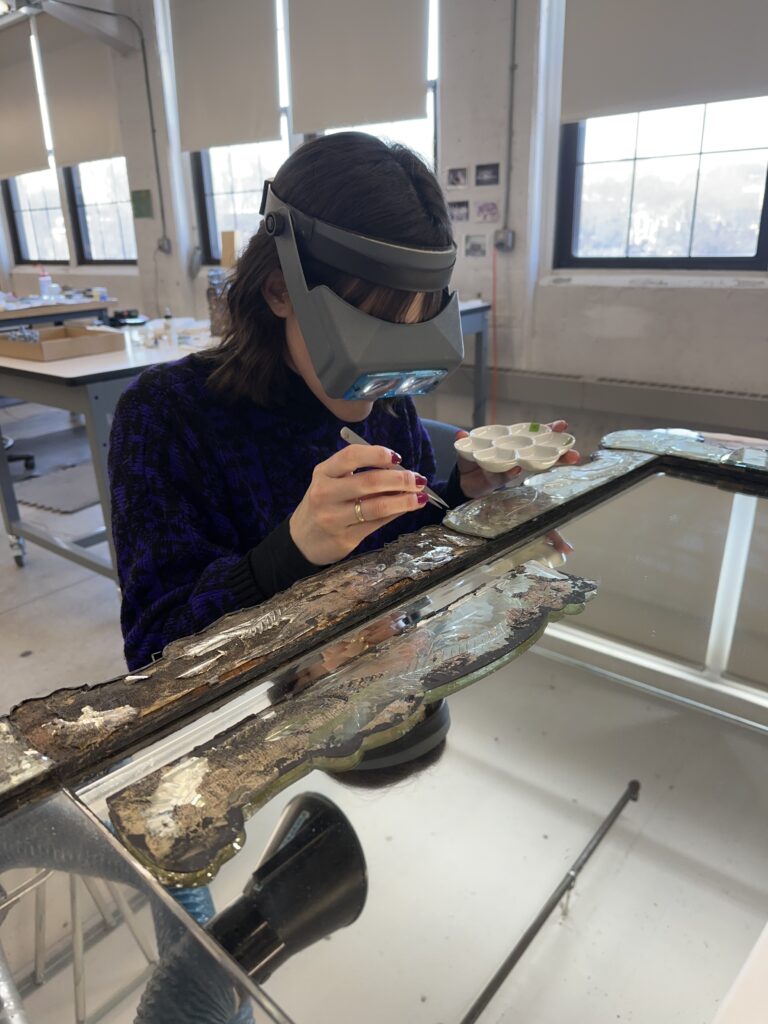
Instead of a tin-mercury amalgamation looking glass, I suspected this looking glass was silvered, a technique created in 1835 and still in use today. To confirm this suspicion, I performed a chemical spot test with potassium dichromate, which showed positive results for silver. This led to two possibilities: Either the looking glass was made after 1835, or it was made before 1776 and had been stripped of its tin-mercury amalgam and later re-silvered. To further confirm the presence of silver, Jess Chloros, an objects conservator at the Isabella Stewart Gardner Museum in Boston, performed a non-invasive analysis using a portable X-ray fluorescence machine. This tool measures the elemental composition of materials in place, without removing samples. Chloros conducted tests on several areas of the looking glass to verify the metallic content of its reflective surface.
The construction of the two central mirror panes also gave a clue about when the looking glass was made. There are two separate panels of glass, with the upper pane laid and fixed in place on top of the lower pane. The technique for making large single panes of glass was not invented until the late seventeenth century, so larger looking glasses were frequently made of two smaller panes of glass placed together. This could mean that the looking glass was, indeed, manufactured before 1776 since it utilizes the two-pane method to create the illusion of a larger piece of glass.
To identify the wood on the frame, we took a small sample and sent it to Randy Wilkinson, of Fallon & Wilkinson furniture conservation, to be examined microscopically. He identified the wood as basswood (called limewood in Europe), a material commonly used in non-English European furniture of the eighteenth century.
The looking glass is very heavy and has fallen off the wall several times, which led to many rounds of conservation treatment over the years. Several of the mirrored border panels were broken and repaired with various adhesives that have yellowed significantly. The bottom central mirror pane has been replaced and staples were added around the perimeter to provide extra support to the glass border panels. When the looking glass arrived at Historic New England, two of the twelve border panels were detached and several were loose. The two detached panels had unsightly gaps in the silvering material due to adhesives used during previous treatments.
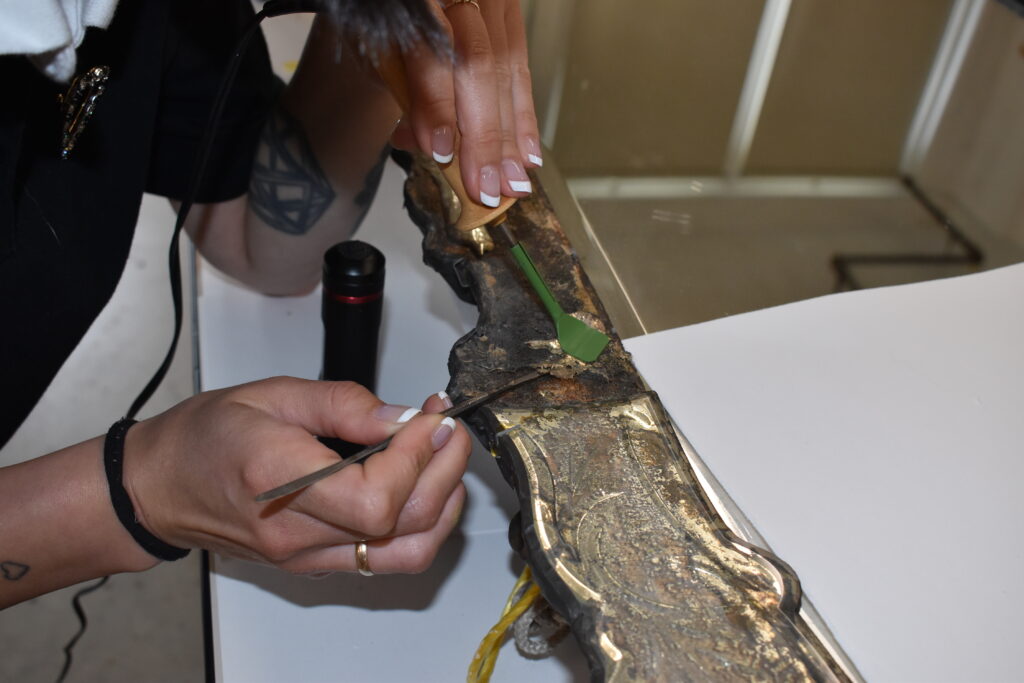
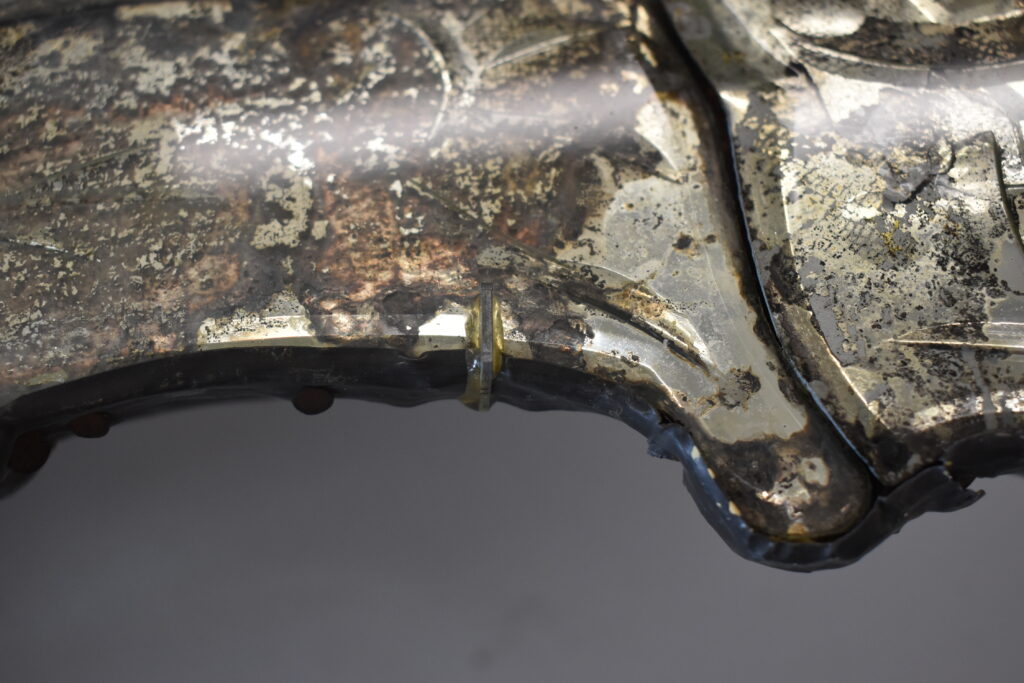
The first detached panel revealed the method used to affix the glass border to the wood frame when it was re-silvered. A fabric gauze was dipped in adhesive, laid on the wood face, and the mirrored border panel was pressed on top. The contact with the adhesive-soaked gauze is what created the alligator-like pattern visible on each border panel. The failure of this unique adhesive method is what caused the need for multiple future treatment campaigns with various adhesives, including hot glue.
My conservation work started by addressing the two detached border panels. When the two panels came loose during its latest fall, the hot glue peeled off the silvering from the underside of the glass panels and created large gaps in the mirroring. Luckily, the paper-thin pieces of silvering that were pulled off were still attached to the hot glue. After carefully separating the pieces of silvering from the hot glue using a small, heated spatula, I adhered them to the underside of the glass using a conservation grade adhesive.
My treatment plan going forward is to secure the loose panels back onto the wooden frame, using a mechanical attachment method instead of adhesive. For the outer perimeter, the adhesive holding the staples was severely yellowed, and the metal was dark in color. I’ll make modifications to improve the look of the staples with acrylic paint and replace the yellowed adhesive. For the inside edge of the border, I devised U-shaped brackets out of 3/4 inch strips of lead that slip above and below the glass and wooden frame. I’ll color the lead with silver gilding along the top and black acrylic paint along the sides. After shaping the lead to the correct size and toning, I’ll adhere the bracket to the inside edge using conservation adhesive.
The goal of this treatment is stabilizing the looking glass for exhibit while maintaining the visual evidence of its age and life story.
Erica Lome
Lydia’s conservation assessment and ongoing treatment challenged a few of my initial assumptions about this looking glass, primarily that this was an English looking glass made in the Venetian style. I reached out to several decorative arts experts, including curators at the Victoria & Albert Museum in London, who agreed with me that the proportions and style are right for the eighteenth century, but they could not find a comparable looking glass in their collections.
We reached out to Adam Bowett, a renowned English furniture historian, to get his take. He verified that the limewood used for the frame is not used on English looking glasses and shared his curiosity about the frame itself. The frame is double layered, meaning separate boards were used in its construction, possibly as reinforcement. The frame is lap joined (a technique to join pieces of wood), which is standard practice in eighteenth-century English furniture, and pegged, which is not standard English practice. The frame is painted or stained black, also unusual. The mirror backboards are oak, which is another uncommon feature for English looking glasses, which are typically made from “deal” softwood lumber.
All of this helped us to conclude that this is not an English looking glass, and instead likely European. This widened my scope of inquiry, and eventually I did find similar examples in European collections or sold at auction that were attributed to Germany, and specifically Spiegelmanufaktur Lohr am Main, a glass manufacturer in the Spessart region of Germany, active from 1698-1806.
This could very plausibly be a German looking glass produced in the eighteenth century, with numerous repairs and restorations throughout its nearly 250 years of history. This makes it a somewhat paradoxical object, akin to the Ship of Theseus, which according to ancient philosophers had every part of it replaced over time by Athenians seeking to preserve the object for commemoration. If nothing original remains, is it the same object?
Of course, this looking glass retains original features and materials, but it holds a thematic resonance with the broader exhibition, which seeks to question and challenge our broader assumptions about the American Revolution by way of looking closely at objects and other primary sources in our collection.
Many questions remain, such as the identity of the original owner, who clearly took great pains to bring this rare and magnificent piece across a continent and ocean to their home in New England. Do other mirrors like this survive in private collections? Hopefully, a visitor to the exhibition recognizes this piece and helps us learn more about their history.
Written by Erica Lome, Curator of Collections and Lydia Wood, Mellon Conservation Fellow
Exhibitions like this are made possible by the generous support of Historic New England’s members and friends. Support Myth and Memory and help preserve our shared stories.
Sign up to our newsletter for our latest news and events