
Ati Gropius Forberg Johansen, who died in 2014, would have turned 100 on December 19, 2025. She was the only child of Bauhaus founder Walter Gropius and his wife and collaborator, Ise. Ati had an outsized personality; an artist and educator, she was smart, opinionated, and a fierce protector of her parents’ legacy. She transformed the way Historic New England came to understand Gropius House—her childhood home in Lincoln, Massachusetts, and one of her father’s masterpieces—and how to present its story to the public. To mark the occasion of her centenary, Peter Gittleman, now Vice President, Visitor Experience, reflects on nearly thirty years of working with Ati to ensure Gropius House remains true to her parents’ design intent and the way they lived in their home. This is the second installment in a two-part series; read part one here.
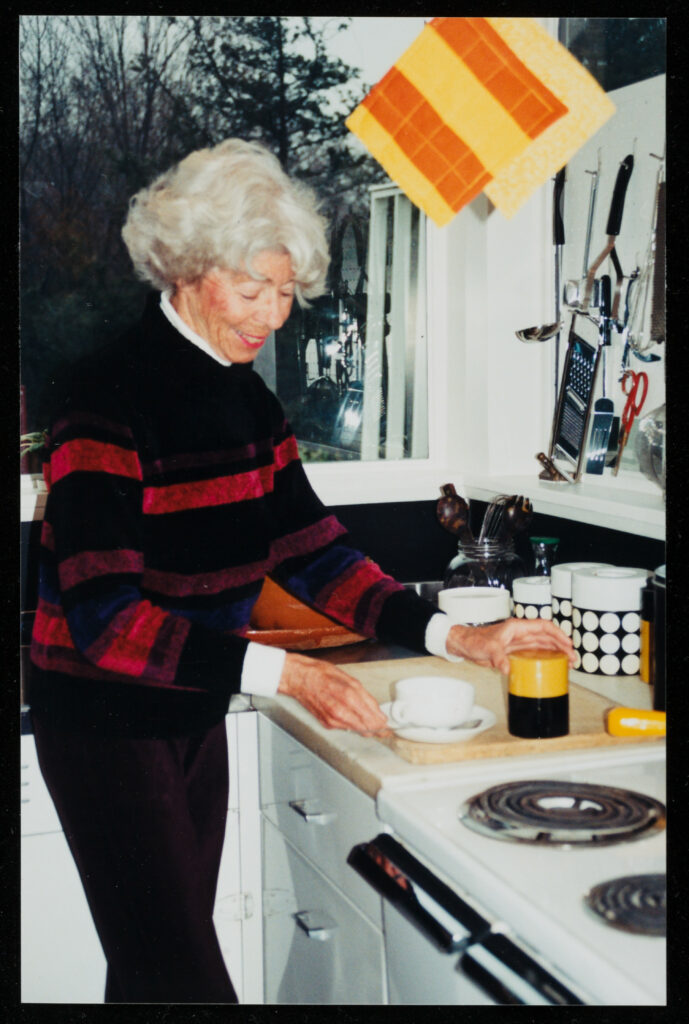
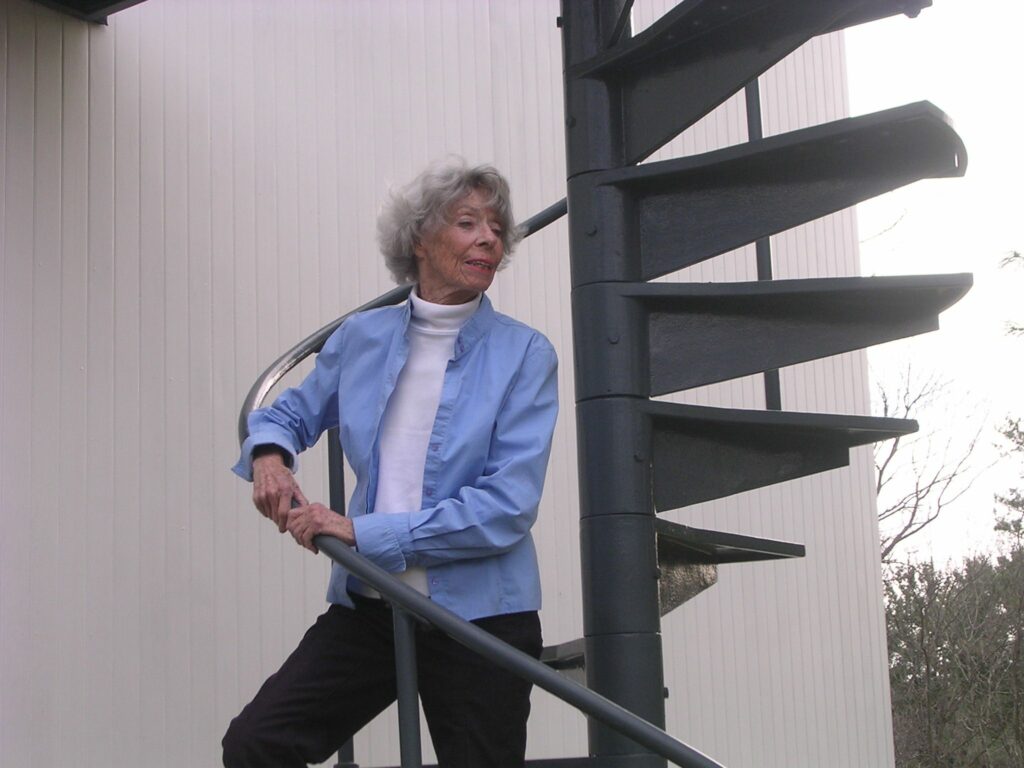
Once Ati Gropius and Historic New England reached an understanding over the presentation of Gropius House, she set out to teach our staff what “modern” really meant. Beginning with that fateful first visit in 1986, Ati worked tirelessly with curators, researchers, fabricators, and experts in the field to find the right materials to show Gropius House as true to its 1960s appearance as was possible. It will probably come as no surprise there were periodic clashes when our “museum approach” and her “modern approach” came into conflict.
One memorable battle occurred when Ati decided that the white fiberglass curtains in the living room and dining room were too discolored to remain on view and needed to be replaced. Our curators were determined to keep them in place because, in the museum world, showing an original object was more important than its aged appearance. Ati was incredulous. She argued that we were so focused on “the elephant’s toenail” that we paid no attention to the fact that it was an elephant. To her—and she assured us that her parents had felt the same way—it was the design intent that was important, not the original object. When something no longer served its visual or practical purpose, Walter and Ise replaced it, and Ati believed Historic New England should, too. Fiberglass was no longer available as inexpensive, mass-produced material, so Ati wanted us to use another synthetic fabric, something new and low-priced that her parents would have chosen if they had been alive.
When she was met with blank stares, it became clear to her that we all needed a lesson in what she called the “core tenets of the Modern Movement.” For years, Ati had been teaching classes on this exact subject. She first learned about what she called “modern thinking” at Black Mountain College in the 1940s. At the experimental liberal arts school near Asheville, North Carolina, Josef Albers used similar lessons to change the way his students understood the natural and manmade world. Albers had been a teacher at the Bauhaus until its closure by the Nazis in 1933, and when Ati attended Black Mountain College as a young woman, she was transformed by Albers’s Bauhaus-inflected lessons about the way design influences daily life. And that was the transformation she wanted to see in the Historic New England staff’s understanding of her parents’ home. She arranged to come to Boston and present a day-long workshop for our museum and curatorial staff based on Albers’s teaching. She called it “The Awakened Eye,” and it included a series of slide presentations and workshops. “Turning an assembly of antiquarians into modern thinkers may yet be my life’s greatest challenge,” she sardonically confided in me after the workshop.
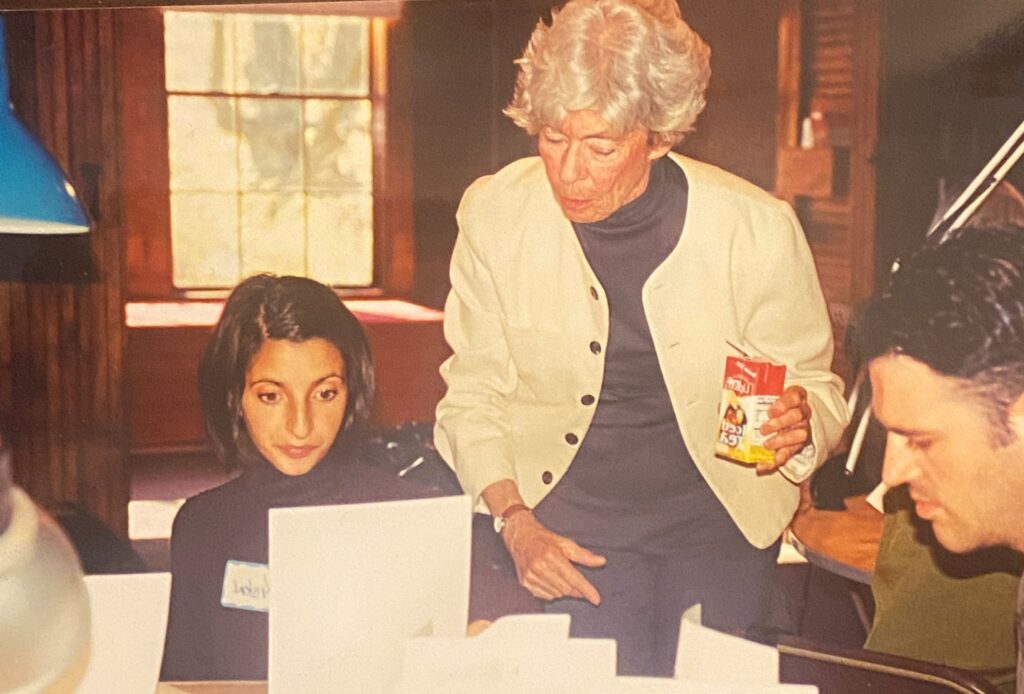
For some, Ati’s workshop was truly inspirational. As a staff, we came to understand that modern thinking meant looking for “elegant solutions to design problems.” In her parlance, the word “elegant” meant economy, function, and beauty. The Bauhaus and the modern thinking that came from it was a living philosophy, not a formula or some dogma to be adhered to. In fact, she forbade us to ever use the term “the modern style,” “modernism,” or “modernist.” Once an approach was fossilized into a style or an “ism,” she explained, it lost its ability to evolve and was relegated to the past.
Ati urged us to keep modern thinking at the forefront of every curatorial decision we made at Gropius House. That meant understanding when an object, like a curtain, should be replaced (ultimately, she won that argument, and we swapped out the dingy fiberglass curtains for a set made in modern white polyester fabric that had an identical weave.) There were many times when we did not agree with her recommendations. In these cases, Ati wrote letters to staff decisionmakers pleading her case. In those rare instances when she was entirely overruled, like the time she wanted to strip and rechrome the 1925 Bauhaus furniture in the living room, she documented her reasoning for the museum files in case the idea was revisited—even if it was decades in the future. We recorded hours of oral history interviews with her on every subject we could think of, capturing her memories about food, holidays, gardening, entertaining, and family evenings at home. Ati worked with us on tour themes and how best to illustrate the elegant solution her parents found for their design problem—how to build a house for modern living for a family of three on a windy hill in a New England village. She needed to be sure the “antiquarians” got it right.
From 1986 until her death in 2014, Ati made regular visits to the Lincoln House to advise, fine tune, and improve its presentation. She has touched every aspect of the site, from paint colors to the arrangement of jewelry and perfumes on her mother’s dressing table to a landscape plan that ensured her parents’ vision for the grounds would be preserved. Although she claimed the idea of freezing a house in time was antithetical to modern thinking, Ati came to understand and appreciate why her mother had left the house to Historic New England to become a museum. And it is due to Ati Gropius, that the house today feels less like a museum and more like a home where the occupants have just stepped out of sight.
Sign up to our newsletter for our latest news and events