
Historic New England’s Library and Archives includes a large carte de visite collection. Cartes de visite are small photographs, often portraits, which were popular until the late 1870s. Within Historic New England’s collection are portraits of African American individuals. While these cartes de visite have been in the collection for almost a century, little information has been collected about most of individuals in the photographs. Collecting, preserving, and presenting black history was not an early priority of many historical institutions. Due to a prior focus on the “great men” of American history, locating and understanding black stories within archives is sometimes a difficult task. While many census, marriage, and death records are available online, spelling of names and birth years of African American individuals are often inconsistent. These inconsistencies make the research more challenging, as the narratives are buried in records written by, and focused on, white, often wealthy, men and women. Additionally, many early histories of African Americans are outdated; they usually focus on a paternalistic relationship between black and white individuals. While it may be more challenging to locate black narratives in archives, it is important that we do so, as we look to a more inclusive and all-encompassing understanding of our past. As a part of our celebration of Black History Month, the Library and Archives decided to do some research to learn about the interesting lives of these individuals in our carte de visite collection.
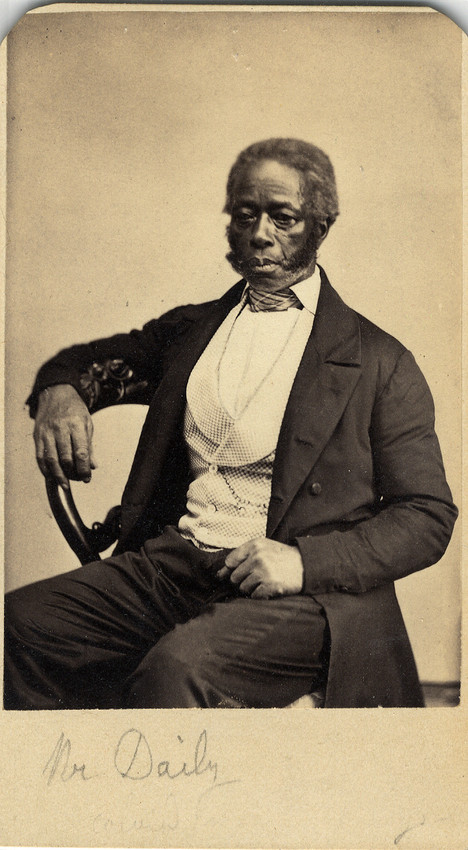
Robert Daley (Daily/Dailey) was born in 1801 in New Hampshire. He later moved to Salem, Massachusetts, where he worked as a porter. Robert married Mrs. Hannah Munroe, possibly a widow, on September 25, 1842. Hannah and Robert continued to live in Salem, where Robert labored as an expressman, which may refer to anyone who has the duty of packing, managing, and ensuring the delivery of cargo and goods. The inscription on the carte de visite notes that Robert was also a choirman at J.R’s from 1850 to 1860. In 1865, Robert is listed as a legal voter in the Massachusetts State Census. Robert died of dropsy at the age of 66 in 1867.
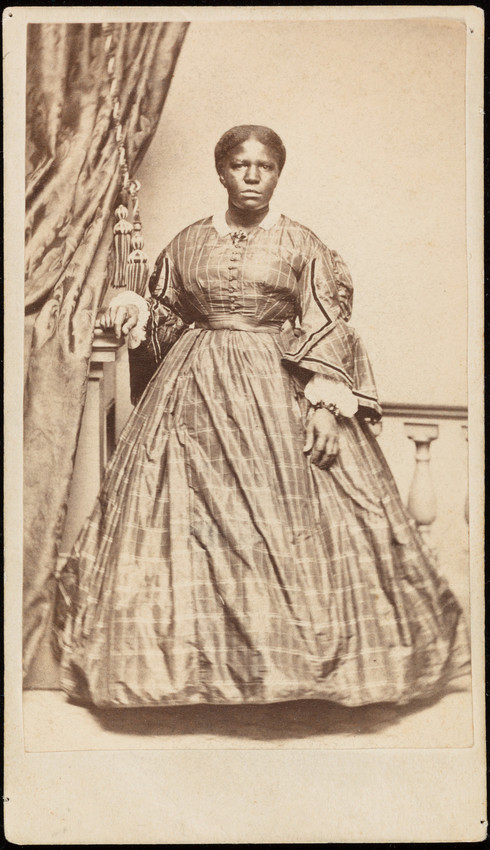
Sarah Baro Colcher was born in Africa between 1835 and 1840 and was captured by slave dealer Don de Mer when she was a child. Although the United States outlawed the international slave trade in 1808, according to an article in the October 1925 issue of Old-Time New England, de Mer traveled on Magadala, a ship operated by Captain Austin Dodge of Massachusetts. De Mer died while on the voyage, and Captain Dodge took Sarah to his sister, Elizabeth Conant who lived in Topsfield, Massachusetts with her husband, Nathaniel. Although the Old-Time New England article states that Colcher was educated and well taken care of within the Conant household, her true status in the home remains unknown. By 1860, Colcher is living in Boston, with John McLellan, an auctioneer, and his wife, Catherine. While Colcher’s occupation is not listed in the 1860 census, it is likely that she was boarding in the McLellan household and was employed as a domestic worker. According to the Old-Time New England article, Sarah worked as a cook in the home of Mrs. Gordon Dexter, of Boston and Beverly Farms, Massachusetts. The article also states that Sarah became ill while working for Mrs. Dexter, and was brought to the Cabot-Lee-Kilham household in Beverly, where she was cared for by Miss Henrietta Kilham. Miss Henrietta Kilham donated the carte de visite to Historic New England, then the Society for the Preservation of New England Antiquities, in November 1925. Sarah died in 1882, and is buried in the Conant family plot in Topsfield.
Throughout this research process, we noticed many inconsistencies with the primary sources. Robert Daley was labeled as “Robert Daily” on the carte de visite, but records have him listed as Robert Dailey, Daly, and Daley. Sara Baro Colcher is listed as being twenty years old in both 1855 and 1860. Additionally, early biographies of Sarah are now outdated. For example, the 1925 Old-Time New England article uses very neutral language when saying, “Sarah Baro Colcher was given to Captain Dodge, who brought her home to his sister, Elizabeth Dodge Conant.” Without any first-hand documentation, Sarah’s social and legal status remains unknown.
Works Cited:
“African Princess in Topsfield,” Topsfield Historical Society. Retrieved from topsfieldhistory.org/stories/index
Massachusetts. 1841-1915 Death Records. Retrieved from Ancestry.com
Massachusetts. 1855 State Census 1855. Retrieved from Ancestry.com
United States. 1860. Federal Census. Retrieved from Ancestry.com
United States. 1870. Federal Census. Retrieved from Ancestry.com
“Sarah Baro Colcher.” Old-Time New England, Vol. XVI, No. 2. October 1925.
Sign up to our newsletter for our latest news and events