
Last month, I wrote about Mary Fleet’s needlework and the idea of reading the “negative space” of a piece of material culture—examining what is not depicted, but is essential to an object’s meaning and form. I wrote about how we should seek to understand Mary’s needlework within the context of her family’s enslavement of many people, among them Peter Fleet. Peter was a skilled printer and engraver and he left a will behind; my previous post discussed the contents of this remarkable document. His writing is a sign of his work to direct his own life and possessions. It asserts his agency in a system that sought to dehumanize him.
Thomas Fleet enslaved many people, advertised the sale of enslaved people in his newspaper, and even conducted auctions from his home on Water Street.[1] By the time of Thomas Fleet’s death, in the 1759, he enslaved five people. He willed them all to his son, Thomas Fleet, Jr.—the same Thomas to whom Peter Fleet left 5 shillings in his will. The five people named in the estate inventory are Venus, a 33-year-old woman; Abram, a 3-year-old boy; Jenny, a 6-year-old girl; Pompey, a 14-year-old boy; and Cesar, an 11-year-old boy. Peter died before Thomas Fleet, so he is not named. None of the children named were born by the time Peter wrote his will. I can only hypothesize about their connections. But Peter clearly cared for Venus—he named her twice in his will.
Robin (who Peter Fleet named in his will as “my Robin”) did not appear in the inventory and neither did a man named Newport. Fleet’s paper records Newport’s name multiple times; he liberated himself from the Fleet household in July of 1745 and Thomas Fleet reprinted a notice calling for his return several times over the next year.
I don’t know what happened to Newport, who was about 20 years old at the time and who escaped in his “Cotton and Linen shirt and striped homespun Jacket and Breeches,” but Fleet warned readers that “he will endeavour to get off by Sea.”[2]
The repetition of the advertisement and Newport’s absence in the estate inventory suggest that he did, in fact, free himself. As with all documents written by enslavers, we have to read between the lines and against the grain.
Pompey and Cesar, mentioned in Fleet’s estate inventory, may have been Peter’s sons. But Thomas Fleet’s practice of imposing his last name on people enslaved in his household makes it challenging to verify kin relationships. They certainly worked with Peter in the print shop, likely learning the craft of setting type and perhaps even engraving at his side. Peter and Newport would have known one another. It makes me wonder if Peter later told stories of him to Pompey and Cesar, born after Newport’s departure. Pompey worked to free himself later, seeking to get off by Sea. Perhaps he thought of Newport making his way thirty years earlier.
I want to trace some of Pompey’s journey, looking especially at what information about material culture can offer us.
Pompey emerges in several records that we have to read against the grain. The first is an advertisement placed by Thomas Fleet, Jr. in the Boston Evening Post on June 6, 1774. The record says that Pompey “lately broke out of Bridewell” in the first months after British troops arrived in Boston. Bridewell was the town jail. Pompey was likely taking advantage of the ensuing chaos in Boston to secure his own freedom. Thomas Fleet, Jr. described Pompey in the advertisement. He noted that Pompey “has had the SmallPox, the Marks of which appear very distinct in his Face, being much darker than the other Parts of his Skin; is about 5 Feet 6 Inches high; had with him a good dark brown Coat, white Breeches and Stockings… and often has his Wool dressed in the Maccaroni Taste.”[3]
This advertisement, though written by Pompey’s enslaver, gives us a glimpse into some of the ways that Pompey expressed himself in the world. Other scholars have written helpfully on decoding these challenging documents. The “Maccaroni Taste” that Fleet refers to was associated with English dandies and a culture of expressive masculine fashion. This style was often lampooned in print, as these caricatures demonstrate.
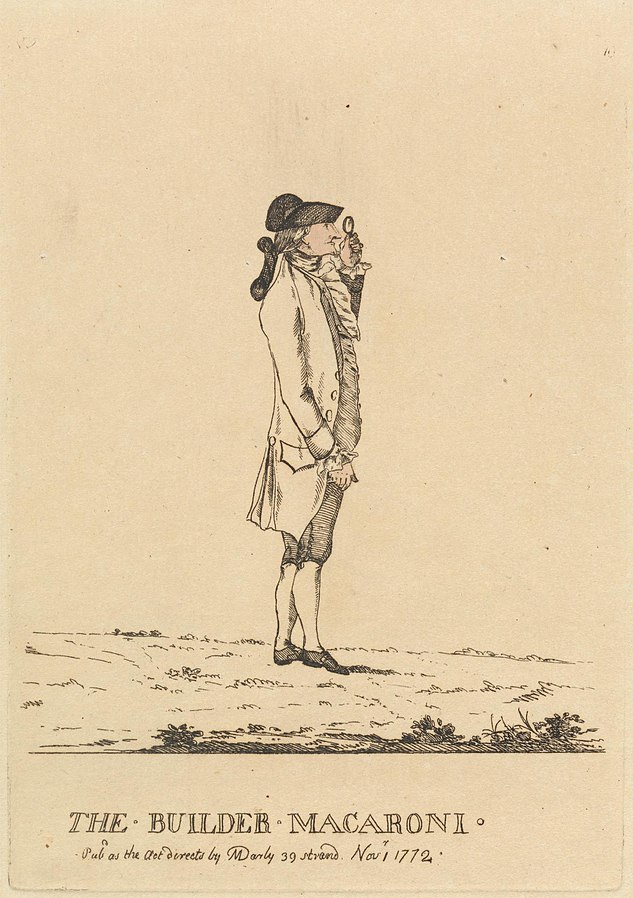
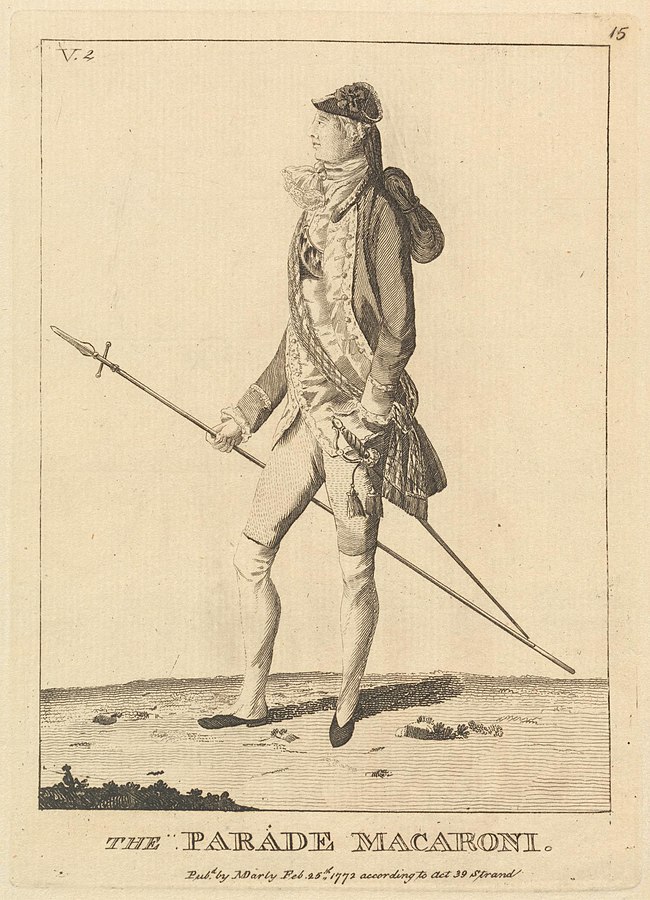
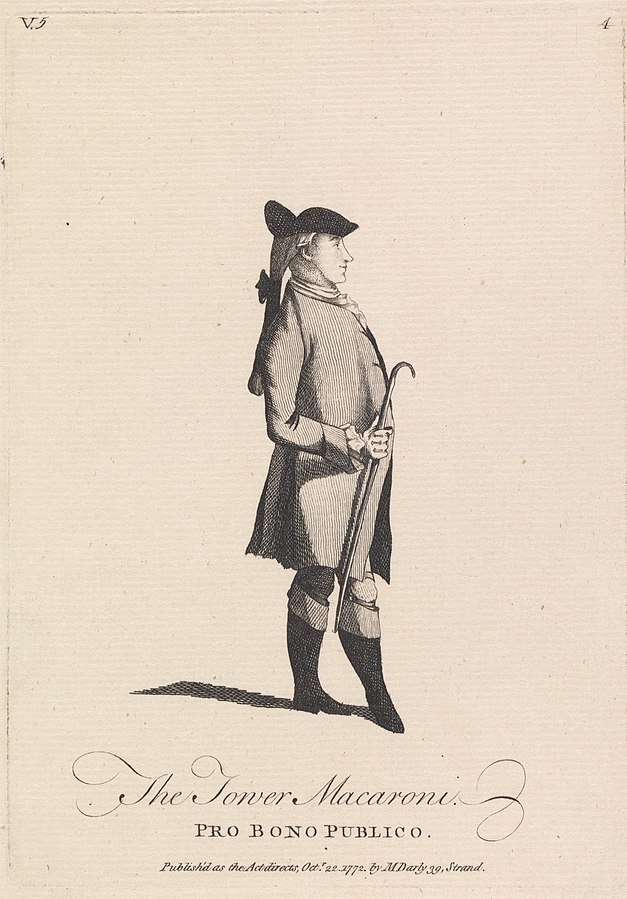
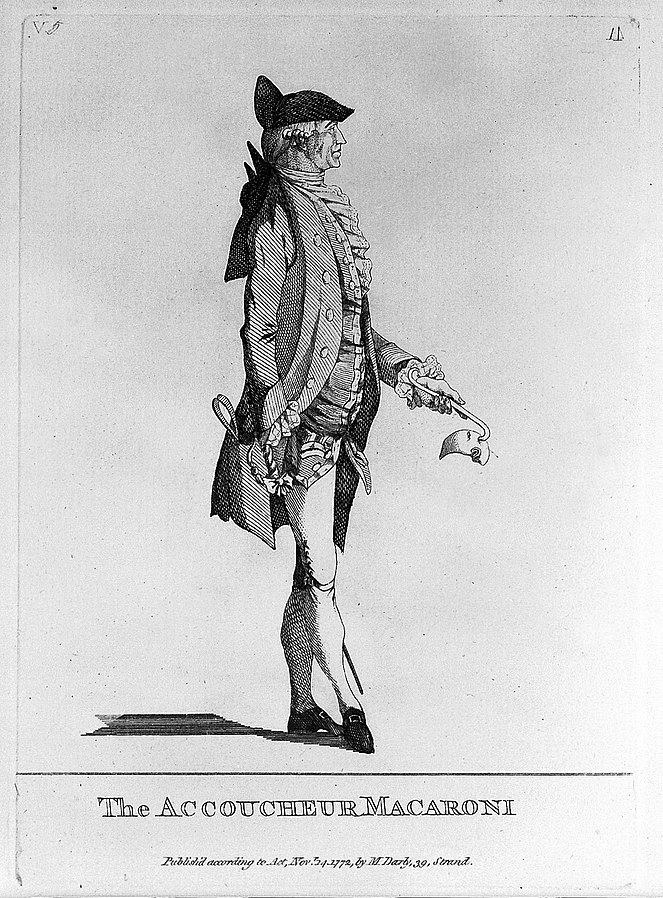
In Richard Thompson Ford’s words, “in eighteenth-century English slang, a ‘Macaroni’ was an especially—to many, scandalously—fashionable man who wore costly imported clothing, often acquired while on a grand tour of Italy.”[4] For a Black man to adopt this style in Boston was to overtly challenge the social system around him, to use self-presentation to communicate his refusal to comport with the logic of enslavement. It is difficult to know exactly what Fleet’s description meant: he may have been describing the manner in which Pompey styled his hair or aspects of his dress. But to use this term suggests that Fleet perceived Pompey’s style as a challenge to the hierarchies of enslavement.
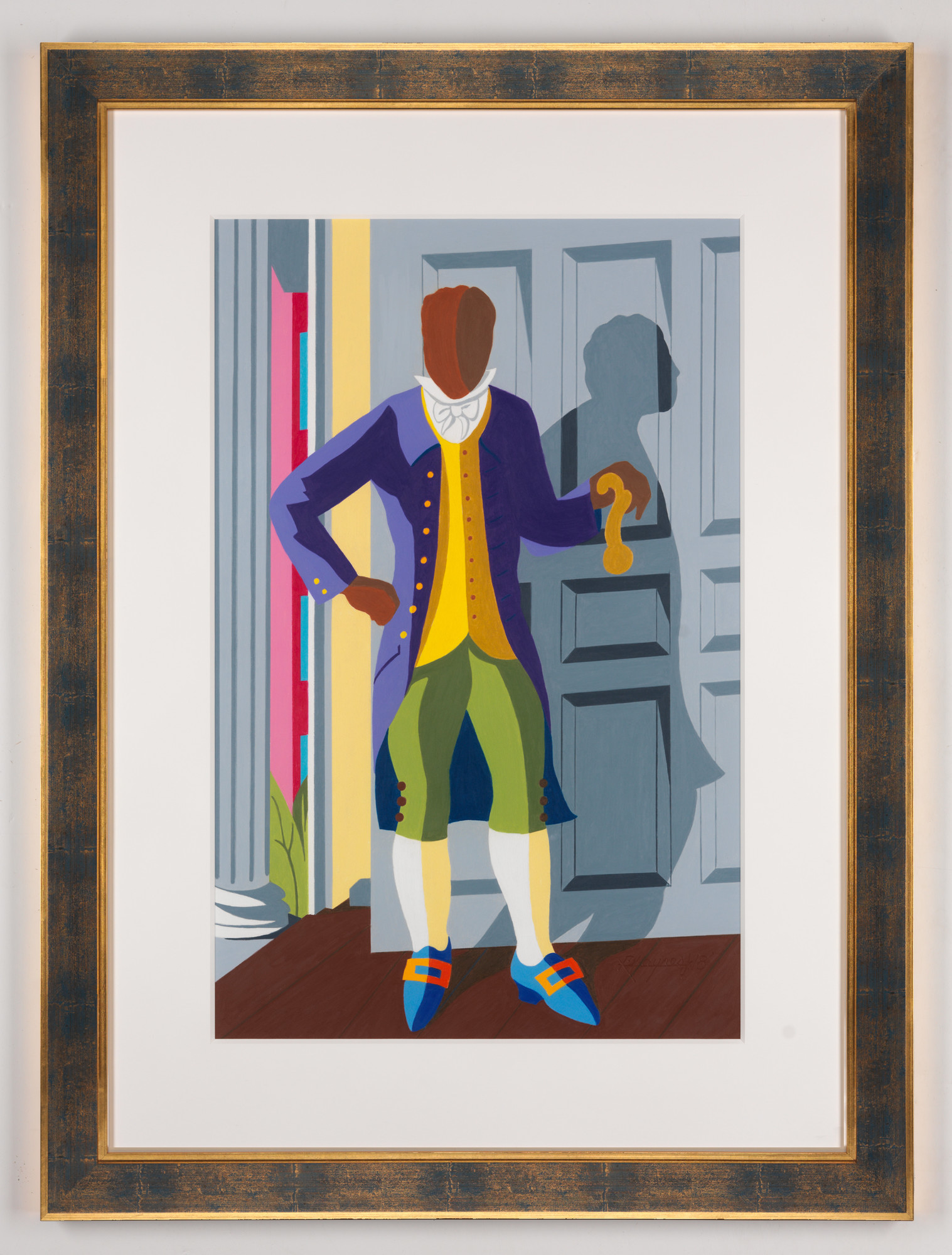
There were important models that Pompey may have been thinking of. Julius Soubise was a free Black man in England and companion to the Duchess of Queensbury. He was known for his macaroni style in the 1760s. Other free and enslaved men adopted this “dandy” style. They sometimes did so in the face of sumptuary laws that governed how enslaved people dressed in the American South. While fashion can be a means of control, it can also be a means of self-expression. Scholar Monica L. Miller calls Black dandyism a “creative, self-defining art form,” a refusal to comport with the strictures governing Black masculinity.[5] These men used their clothes to refuse to be reduced and to destabilize systems of control and hierarchy around them.
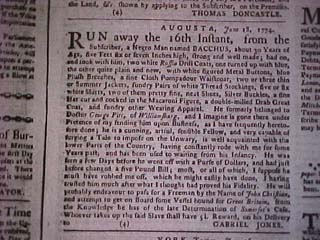
In 1774, the same year that Pompey freed himself, there is another record of an enslaved man liberating himself from a South Carolina plantation. This man, Frank, was described as having “the wool of his head…[worn] in the maccaroni taste.” [6] Also in 1774, a man named Bacchus freed himself from a Virginia plantation. He was described as having a “fine Hat cut and cocked in the Macaroni figure.”[7] His enslaver, Gabriel Jones, worried that he would present himself as a free man and make his way to England, where he might argue for his freedom. And in fact, as the American Revolution began, enslaved people did take advantage of the ensuing disruption of existing hierarchies and norms and to claim their freedom by positioning themselves as Loyalists. It’s possible that Pompey’s style foreshadowed his later means of “getting off by Sea,” as Thomas Fleet described Newport.
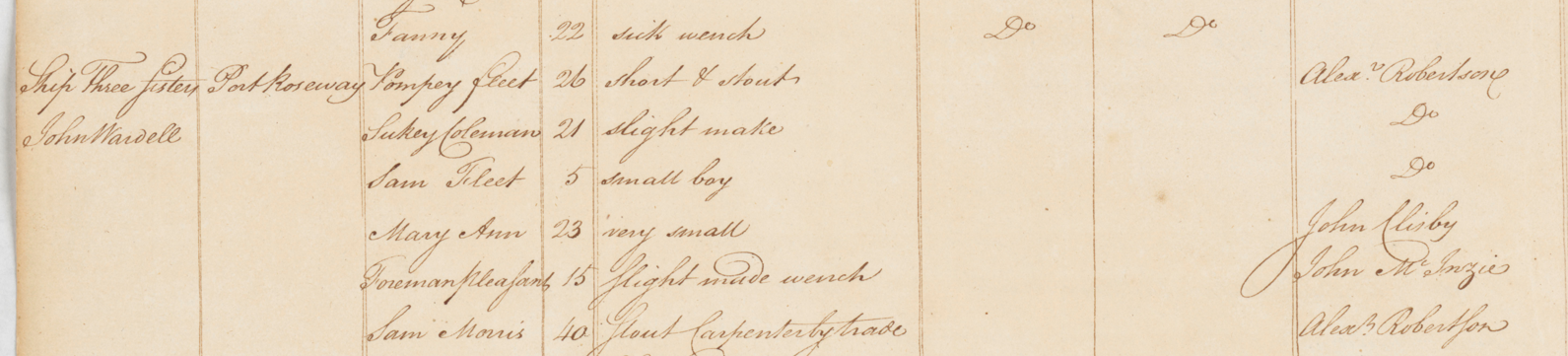
Pompey emerges in the historical record again in 1783, this time in the New York Inspection Roll of Negroes. This compendium was written by British officers overseeing a Loyalist evacuation from New York. Pompey Fleet is listed as free and a British Loyalist in this compendium. In the sparse record, a British officer conveyed Pompey’s enslavement by Thomas Fleet. It noted that Pompey “left him at the evacuation of Boston.” Pompey boarded the Three Sisters ship with Sukey Coleman, a young woman of “slight make” who was enslaved by a Mr. Teaboult in Philadelphia, and Sam Fleet, a “small boy,” just 5 years old.
What had Pompey been doing in the intervening 9 years between his escape from Bridewell and boarding the Three Sisters? Sam is almost certainly his son. This suggests that Pompey and Sukey had made a life together for at least 5 years. They likely made their home in New York with others who had liberated themselves from enslavement. They formed a community within the British zone for the duration of the war. And it seems as though Pompey continued to practice his trade as a printer. Like many emigrants, Pompey’s name is listed with a sponsor. His was Alexander Robertson, a Scottish printer who co-published the Royal American Gazette in New York and later in Nova Scotia. That’s likely how he met Pompey. Pompey may have argued that his skill as a printer would be useful in Nova Scotia.[8]
Together, Pompey, Sukey, and Sam made their way north with almost three thousand other Black emigrants. It was a varied group, among them Harry Washington, who had been enslaved by George Washington.[9] These emigrants made their way to Nova Scotia, settling in Black communities there. Pompey and Sukey made their home in Birchtown, the largest of these Black settlements. Birchtown was just across the harbor from the city of Shelburne. In 1784, Pompey Fleet is listed in the “Muster Book of Free Blacks” as a head of household in Birchtown. He is also recorded in local tax assessments in 1786 and 1787. Alexander Robertson and his brother established a print shop in Shelburne. They carried on printing their paper, The Royal American Gazette. It is almost certain that Pompey worked there.

Although there was a robust Black community in Birchtown, life was not easy for Black residents. The climate was rough. White residents of Shelburne engaged in systematic, anti-Black violence. The provincial government failed to fulfill its promises of land, supplies, and support. A group of Black Nova Scotia residents petitioned the British government, arguing that their situation was untenable and seeking redress. In 1791, Pompey, Sukey, and Sam became three of approximately 1,200 free Black emigrants moving from Nova Scotia to the settlement of Freetown in Sierra Leone, after negotiations with the British government and Sierra Leone Company. Jared Hardesty has suggested that Pompey opened the first printing press in Sierra Leone, as the first press was established there soon after Pompey’s arrival in 1792.[10]
Tracing these stories reveals just some of the sources in which enslaved and formerly enslaved people’s stories are recorded. These sources, including estate inventories, passenger lists, runaway advertisements, and tax assessments, need to be read against the grain. They were not written in the voice or interests of the people whose stories they document, but they are a record. Looking to those records of material culture (“Maccaroni taste,” a homespun jacket, a cocked hat) described can offer glimpses of the ways that people fashioned their own lives. And tracing the way that Pompey leveraged his trade as a printer helps us grasp the ways that he directed his own life. And this is just one story that we can trace from the Fleet household out into the world. These narratives of enslavement and the pursuit of freedom are central to the New England story, if we look.
[1] Justin Pope, “A Slave at the Press Peter Fleet and Reports of Slave Unrest in the Boston Evening-Post, 1735–1758” Slavery & Abolition (2021).
[2] Advertisement in the Boston Evening Post, July 19, 1745. Reprinted at least through May 12, 1746; ; transcribed in Antonio Bly, Escaping Bondage: A Documentary History of Runaway Slaves in Eighteenth-Century New England, 1700–1789, (New York: Lexington Books, 2012), 158.
[3] Advertisement in the Boston Evening Post, June 6, 1774; transcribed in Antonio Bly, Escaping Bondage: A Documentary History of Runaway Slaves in Eighteenth-Century New England, 1700–1789, (New York: Lexington Books, 2012), 52. See also Jared Hardesty, Black Lives, Native Lands, White Worlds: A History of Slavery in New England, (Amherst: University of Massachusetts Bright Leaf, 2019), 133.
[4] Richard Thompson Ford, Dress Codes: How the Laws of Fashion Made History, (New York: Simon & Schuster, 2021), 160
[5] Monica Miller, Slaves to Fashion: Black Dandyism and the Styling of Black Diasporic Identity, (Durham & London: Durham Press, 2009), 7
[6] See, for example, Charleston South-Carolina Gazette and Country Journal, August 30, 1774 (Windley, comp., Runaway Slave Advertisements, III, 696).
[7] Ford, 159
[8] For more on Pompey’s life and travels, see J.L. Bell’s excellent blog post: “The Travels of Pompey Fleet,” April 2014, https://boston1775.blogspot.com/2014/04/the-travels-of-pompey-fleet.html
[9] Joanna Brooks, American Lazarus: Religion and the Rise of African-American and Native American Literatures, (Oxford: Oxford University Press, 2003), 90
[10] Jared Hardesty, Black Lives, Native Lands, White Worlds: A History of Slavery in New England, (Amherst: University of Massachusetts Bright Leaf, 2019), 134
Further reading: J.L. Bell has written an excellent blog post series on Peter, Pompey, and Cesar Fleet
Mariah Gruner, Ph.D. is the Recentering Collections Curatorial Fellow.
Over the course of her IMLS grant-funded fellowship, Mariah Gruner will work with the collections services team to draft a new collecting plan and develop a body of research that explores marginalized and suppressed stories within Historic New England’s existing collections. Mariah will share monthly updates about the collecting plan and her research.
This project was made possible in part by the Institute of Museum and Library Services.

Sign up to our newsletter for our latest news and events