
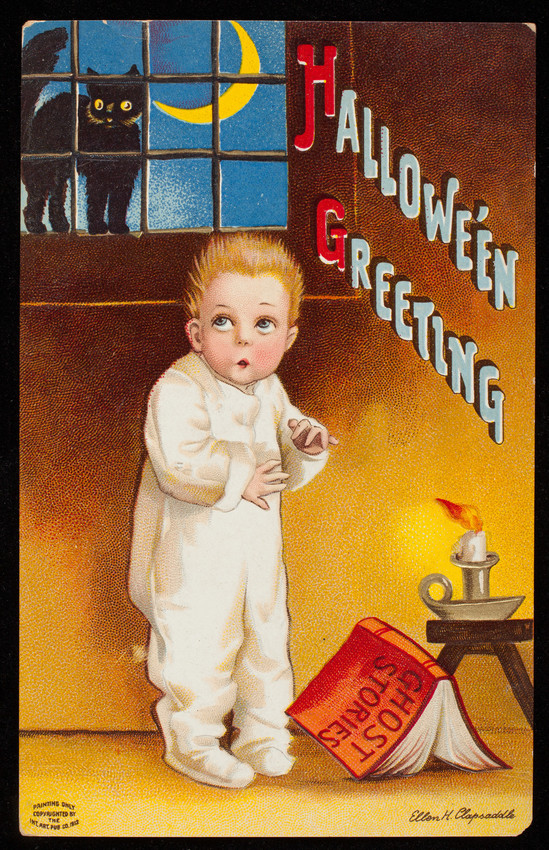
Many of the objects from the early history of Halloween celebrations in the U.S. relate directly to women and the home. As Halloween evolved into a popular holiday around the turn of the twentieth century, parties were often held at home and an increasing variety of decorations, postcards, and other items became commercially available for the Halloween season.
Women and children feature prominently in the imagery of early Halloween postcards. One of these postcards in Historic New England’s collection was created by American artist Ellen H. Clapsaddle. Clapsaddle was a successful commercial artist and designed many Halloween and other holiday postcards in the early twentieth century. This postcard depicts a frightened child, blond hair standing on end. They have been reading a book of ghost stories by candlelight. Outside the window is a black cat and crescent moon. The postcard proclaims a “Hallowe’en Greeting” to the recipient. The International Art Publishing Company manufactured this postcard around 1912.
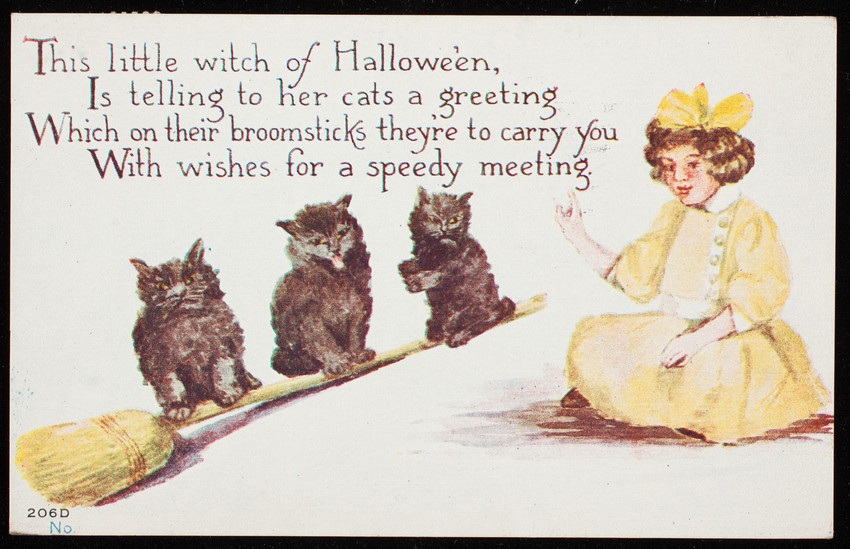
Another postcard, this one from the 1920s, portrays a young woman dressed in yellow seated next to a broom with three grumpy looking black cats. The postcard reads:
“This little witch of Hallowe’en/Is telling to her cats a greeting/Which on their broomsticks they’re to carry to you/With wishes for a speedy meeting.”
It presents a romanticized idea of witchcraft that is nonthreatening yet still recalls historical beliefs about witches’ nocturnal flights and animal familiars. Manufactured by the F. A. Owen Company, Miss Lydia Chace received this postcard from her family in Providence, Rhode Island.
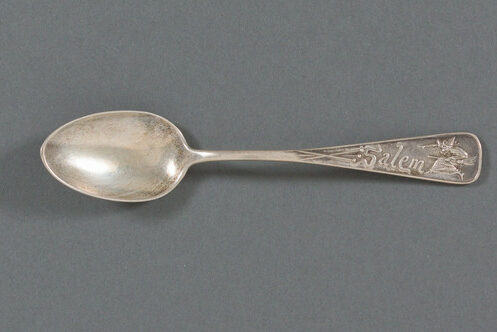
This silver spoon was one of the first souvenir objects created to capitalize on the history of witch trials in Salem, Massachusetts. It also commemorated the two hundredth anniversary of the trials in 1892. Manufactured by Daniel Low & Company in Salem, this spoon depicts a witch with a broom and three straight pins. Wearing a pointy hat and holding her broom, the woman gestures accusingly down the handle. The three pins represent the violence and terror of the witch trials, when court testimonies described witches pricking their victims with pins.
Low was certainly ahead of his time; today you can find hundreds of souvenir objects for sale in downtown Salem. This souvenir spoon belonged to Frances Marrett of the Marrett House in Standish, Maine.
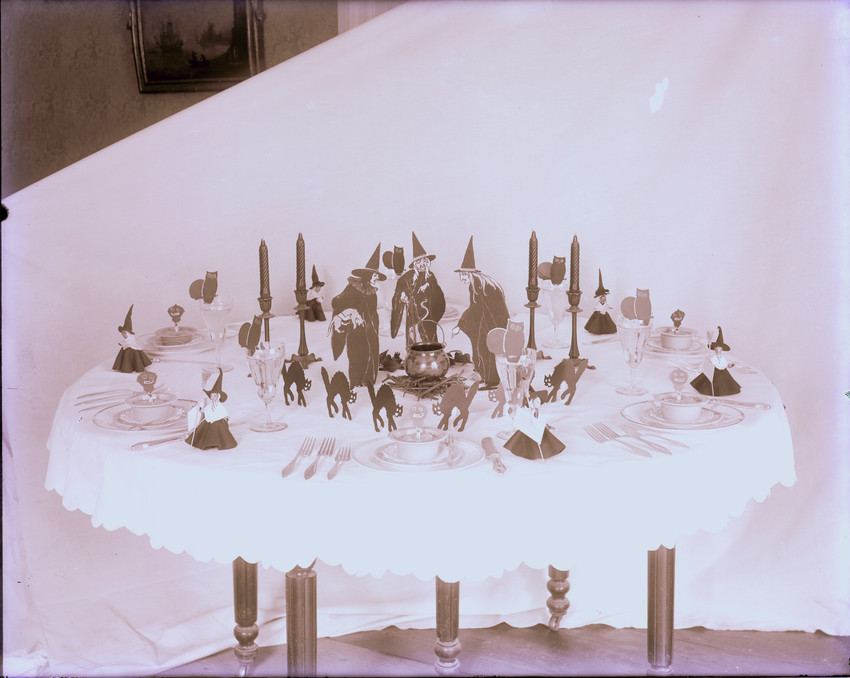
A photograph from the Mary H. Northend Photographic Collection shows a table laid out with Halloween decorations. Northend was a writer and photographer from Salem who documented New England life in the early twentieth century. The table in her photo displays black candles, cutouts of black cats and owls. The centerpiece features a cauldron atop a pile of sticks surrounded by three witches in black robes with pointy hats. This centerpiece recalls the three witches in Macbeth: “double, double, toil and trouble/fire burn and cauldron bubble.”
These decorations were likely manufactured by the Dennison Manufacturing Company in Framingham, Massachusetts. In the early twentieth century, Dennison published yearly guidebooks for hosting parties with their products and the 1920 Dennison’s Bogie Book illustrates a similar table design to the one in this photograph. The book also described how to throw “The Business Girl’s Hallowe’en Party” with suggestions for easy refreshments (apples, potato chips, and doughnuts) and tips on planning for the busy working woman. In addition, the instructions for “a lively home party” are also directed to the “hostess.” This suggests that women, whether married or single, were expected to throw Halloween parties complete with food, games, and festive decor.
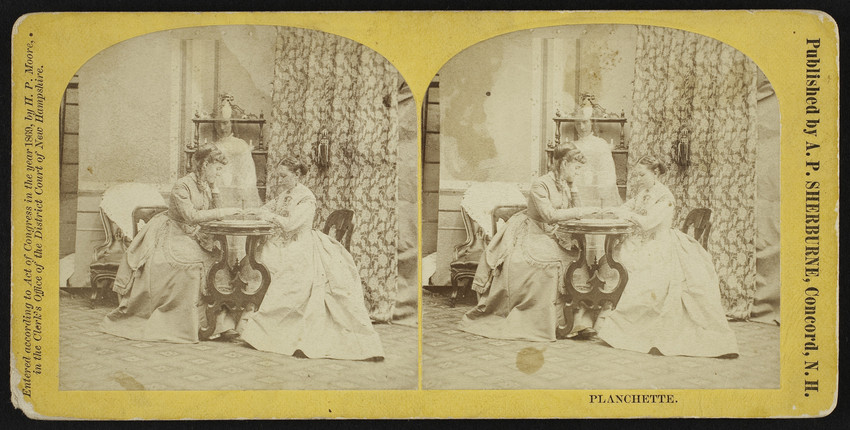
A stereograph shows another kind of domestic scene. Two women seated at a parlor table use a planchette (a small device that moves around the board and points to answers) and spirit board, tools for communication with the spirits of the dead. Both women have their hands on the planchette and stare intently at the board.
The first commercial spirit board, branded as the Ouija Board, was offered for sale in 1891. This image, with a diaphanous ghost hovering above the table (an early photography trick), implies that the women’s attempt at communication with the spirit world was successful. These women were likely practitioners of spiritualism, a movement that began in the mid-nineteenth century and was largely led by women. Fortune telling games and communication with spirits were often part of Halloween celebrations at home.
Since witchcraft was historically a crime associated with women and the home, it is interesting to consider that long after the threat of witch trials disappeared from New England, women were still closely connected to a holiday that celebrates witches and magic.
Tricia Peone, Ph.D. is the Interim Curatorial Fellow.
This project was made possible in part by the Institute of Museum and Library Services.

Sign up to our newsletter for our latest news and events