
In the early twentieth century, industrial workers in Haverhill, Massachusetts, had small amounts of extra leisure and money for the first time. This created new opportunities for the city’s restaurant industry, which responded to the growing spending power of the middle class by creating dining options for workers and tradespeople who had only short breaks during long shifts. A variety of eateries flourished near Haverhill’s factories, serving quick and affordable meals to their workers.
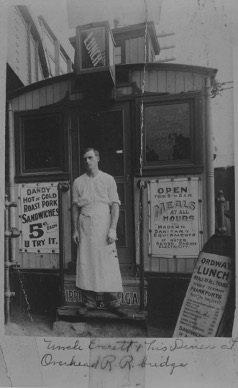
Lunch wagons were among the most efficient and affordable dining options, becoming a crucial part of many workers’ daily routines. A photograph of Everett Ordway in front of his lunch wagon near a railroad bridge in Haverhill contains a wealth of information about what was available to workers at the time. Open from 6 a.m. to 2 a.m., Ordway’s business hours reflected the overlapping shifts of the workers he served, promising “meals at all hours” and “modern sanitary equipment of water, sewer, gas and electricity.” His menu featured standard American fare such as lamb chops and beef stew alongside German “Frankfurts, best in the city,” which would have appealed to European immigrants looking for the comfort food of home. None of his dishes cost more than twenty cents, and his five-cent “dandy hot or cold roast pork sandwich” was likely one of his most popular offerings for hurried workers.
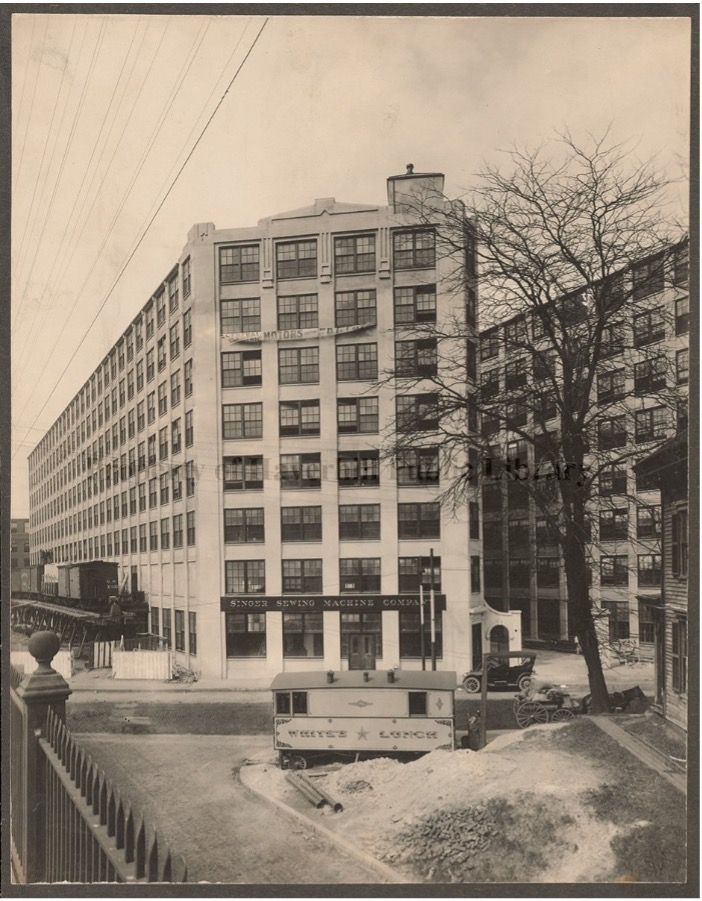
Workers in the shoe factories on Essex Street—now part of Historic New England’s Haverhill Center campus—had a convenient lunch wagon directly across the street: White’s Lunch Wagon, a mobile lunchroom George Washington White opened around 1913. White was born May 26, 1856, in Marlborough, New Hampshire, to farmers Lorenzo and Avila White. By 1860, the couple had seven children, and though George attended school for a time, he was working as a farm laborer by age fourteen. By the 1880s, as industrial work called many young people away from agriculture, George left farming to work in a local wool mill. At that time, he was several years into his first marriage, and he and his wife Georgianna had a son named James. The marriage didn’t last, however, and the pair divorced in 1884.
The following year, George married Carrie Smith. Their daughter Alma was born in 1888, and the family soon moved from Marlborogh to the town of New Durham, close to the Maine border, where George found work as a knife grinder. This likely put him in proximity to the grocery or catering industry. In 1902, George’s second marriage also ended in divorce. In 1908, George married his third wife, Clara Fitzgerald, who brought with her a young son, Ralph. The couple began their married life in Farmington, New Hampshire, but soon moved to Haverhill, where George began his long career running lunchrooms and supplying Haverhill’s workers with convenient and affordable food.
George’s first lunchroom, in 1909, was located at 20 Vine Street, on the edge of an immigrant neighborhood known as “The Acre.” It was most likely a homespun affair run out of the couple’s own kitchen. By 1910, George had moved his operation to 15 Emerson Street, closer to the rows of homes and businesses along the river. In this iteration of the lunchroom, his wife Clara was listed as the cook, and the Haverhill City Directory registered it as an official restaurant.
By 1913, the family rented a home at 36 Pleasant Street and George’s “lunch” appeared in city lists at 152 Essex Street for the first time. This large, elaborate version of a lunch wagon most likely included a small counter with stools inside, making it a precursor to the classic American diner. George’s stepson Ralph worked as a waiter, and the lunch wagon employed a cook while Clara remained at home. The location was a wise one, providing a steady stream of tired, hungry workers eager to buy food on their brief shift breaks.
When White died, obituaries called him a “luncheon proprietor and automobile dealer,” suggesting that his success in the lunchroom business had allowed him to expand into other areas, as well. The single surviving photo of White’s Lunch Wagon is not just a record of a business, it is a reminder of the role White played in the daily lives of the workers he served, and of the ways that food can bring people together, bridging differences, sustaining traditions and nourishing communities.
Written by Eleanor Martinez-Proctor, Study Center Fellow
Sign up to our newsletter for our latest news and events