
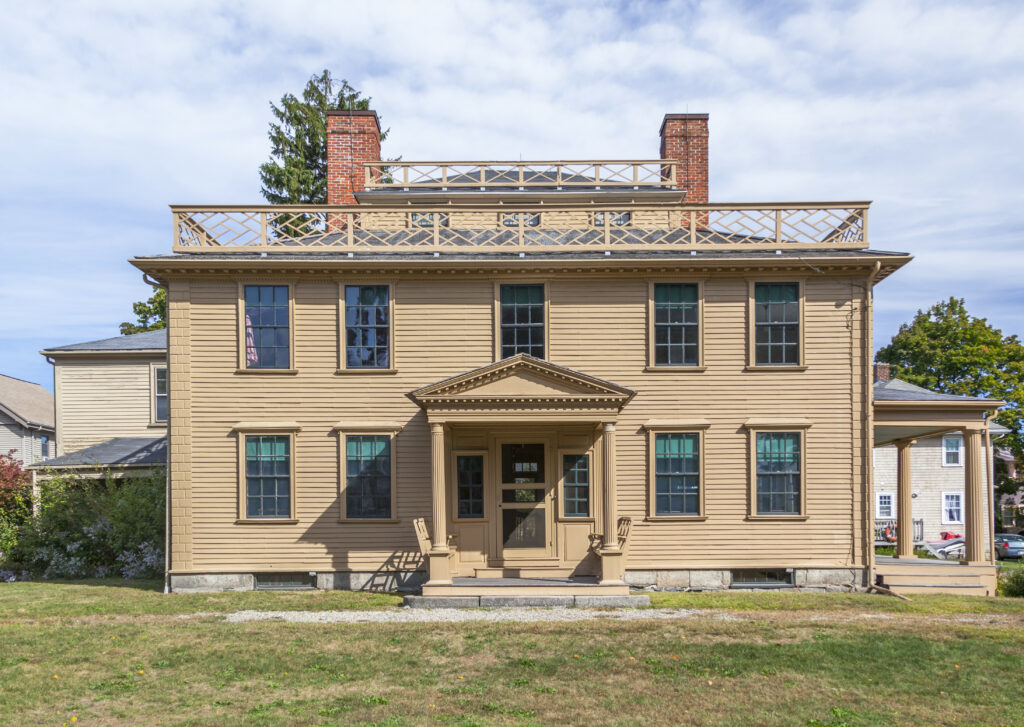
In 1770, Colonel Josiah Quincy built a fine home in what is now Quincy, Massachusetts, away from the center of town and close to the shoreline, perched at the top of a hill with a view of the bay. In nearby Boston, the strains of the last decade were starting to show as protests against the government grew more frequent. The Boston Massacre took place on March 5, 1770, when British soldiers fired into a crowd, killing five people and escalating the conflict in the colony. Perhaps it was with these tensions in mind that Quincy built an unusual monitor attic on his new house; the windows looking out on every side would be perfect for keeping an eye on the ships in the harbor.
Hostilities had been escalating for years in Massachusetts, resulting in strong, often violent, resistance by the colonists to the British bureaucrats and soldiers trying to maintain control. In 1774, Quincy’s son Josiah Jr. embarked on a secret mission to England to try to negotiate an agreement that would keep the colonies from a full war. He was returning with confidential news for the Sons of Liberty, but died of tuberculosis within sight of shore on the return voyage in April 1775. Josiah didn’t even know that the shots had already been fired at Lexington and Concord, igniting the war shortly before his death. Colonel Quincy was shocked by what he was seeing around him and it further confirmed his support for the cause. As he wrote to his friend and neighbor, John Adams, after the Battle of Bunker Hill in June 1775, “Good God! what savage Barbarity! Let us no longer call our Selves Englishmen but free born Americans.”
The Colonel, so-called for his role in the Suffolk Regiment as a young man, was too old to join the military action but he was anxious to help in whatever ways he could. His grand house with its commanding view of the harbor had a distinct advantage as a lookout point. Quincy grabbed his spyglass and climbed the narrow staircase to the monitor, an attic space that likely housed the servants. From the windows he could see across farm fields and marshland down to the water where British ships sailed by on their way in and out of Boston Harbor beyond. He started to record all that he saw and wrote letters to key players: John Adams, who was serving in the Continental Congress; his long-time friend from Philadelphia, Benjamin Franklin; and to the man himself, General George Washington, who was encamped in Cambridge during the Siege of Boston. As he wrote to the general, “Would to God my abilities were equal to my inclinations, for then I would endeavor to render myself worthy of that honor by eminent public services in defence of my injured country. But, alas!”
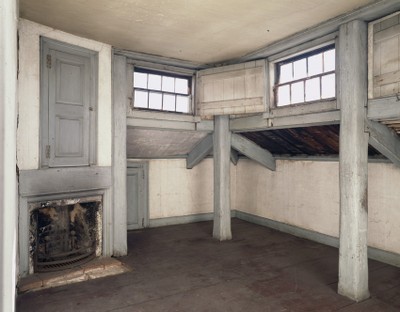
Colonel Quincy formulated plans on how to blockade the Boston harbor access. One can imagine it was a welcome distraction from his personal tragedies to map out a plot to close off the harbor and route the British. He wrote to John Adams of the plan and how it would be “forcing our Enemies to ask our Leave to return home.” We know that Benjamin Franklin visited soon after and dined with the Colonel; no doubt he was pulled upstairs to peer through the spyglass for a bird’s eye view. Franklin encouraged Quincy to tell Washington of the plan and how it might be executed.
Colonel Quincy was at his post to see the ship of Governor Thomas Gage sailing home toward England. This would have seemed like a decisive victory for the colonial army: the crown’s governor and military leader sent packing. Colonel Quincy was so moved he recorded the event, not only in his log or a letter but on the glass itself. The pane says: “Governor Gage sail’d for England with a fair wind. October 10, 1775” This was faithfully preserved by the family until today and remains in the Quincy House collection.
Quincy continued to observe and report on the activities in the harbor and played host to many illustrious figures of the era. One of Benjamin Franklin’s more quotable lines comes from a letter to his good friend Colonel Quincy after the end of the war in 1783: “May we never see another War! for in my Opinion there never was a good War, or a bad Peace.”
Written by Karla Rosenstein, Site Manager, Eustis Estate and Quincy House
Sign up to our newsletter for our latest news and events