
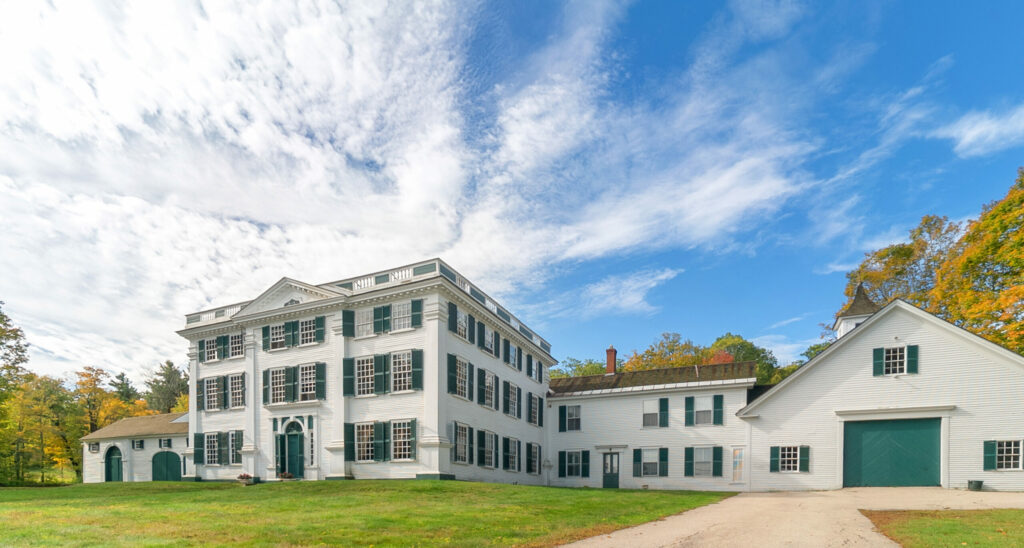
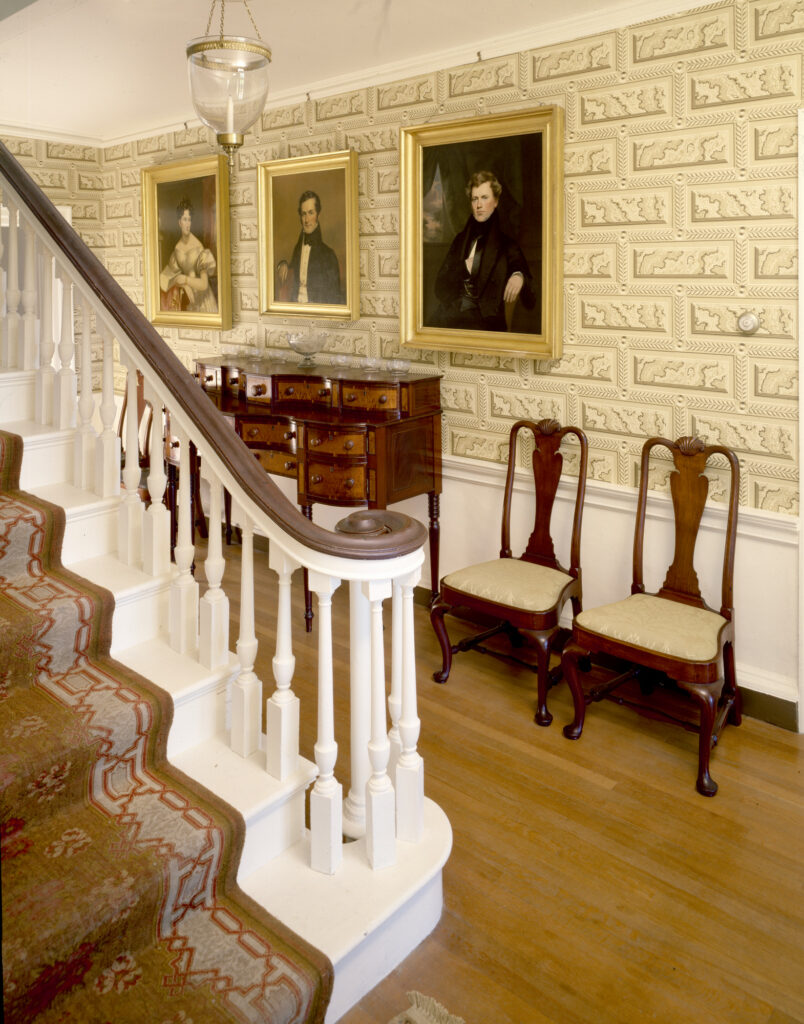
Barrett House, originally known as Forest Hall, was built ca. 1800 by Charles Barrett Sr. as a wedding gift for his son Charles Jr. and daughter-in-law Martha Minot on the occasion of their marriage. Martha’s father encouraged the house’s grand scale, and he promised to furnish it in as lavish style as Barrett senior could build it. The elder Barrett, a mill owner, farmer, and land speculator, elected to have the house built in the Federal style—the height of taste and refinement at the time—securing his family’s place among the local elite of New Ipswich. Not to be outdone, Martha’s father, a wealthy merchant from Concord, Massachusetts, ordered some of the finest furnishings available on the eastern seaboard, including sideboards, chests of drawers, and elegant settees made by leading cabinet makers, as well as hand-painted French scenic wallpaper. A third-floor ballroom appointed with musical instruments reflected the status of the Barrett family in their country seat.
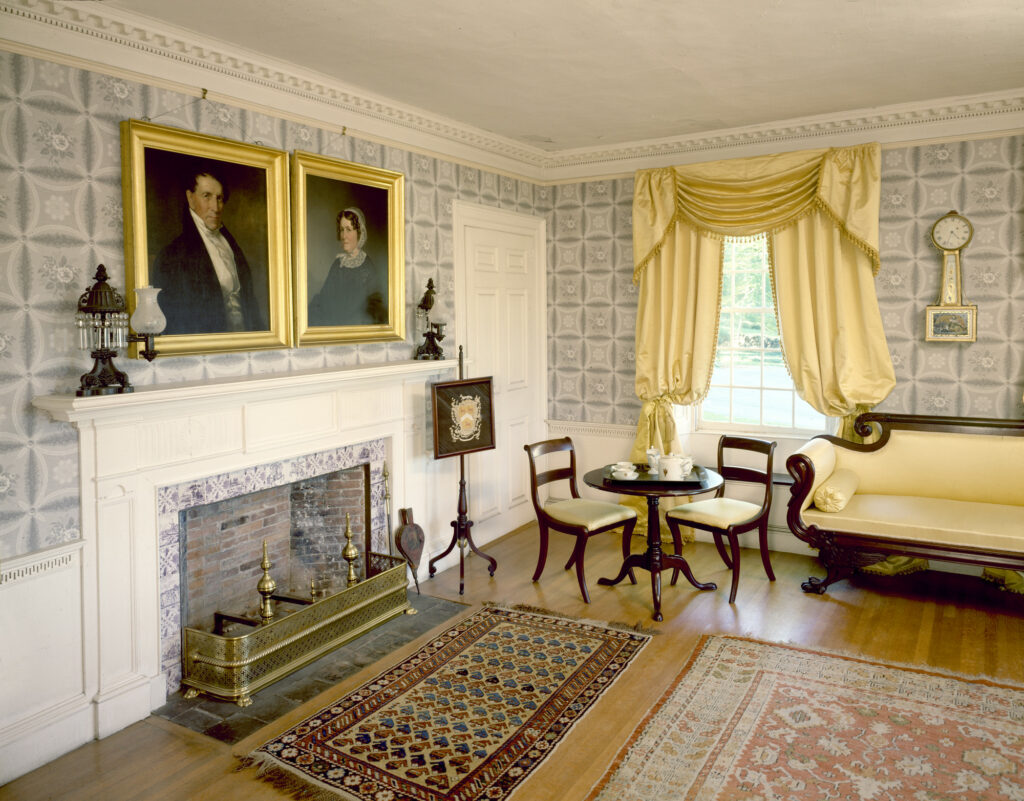
When Charles and Martha Barrett were raising their five children, New Ipswich was a bustling mill village, and the regional economy was booming with a variety of locally manufactured products. Though removed from an urban center, Charles and Martha maintained a sumptuous lifestyle with fashionable entertainment. They used the parlor, with its ornate carving and handsome furniture, for intimate gatherings such as teas, card games, and hosting friends. The dining room, with an adjacent kitchen, undoubtedly saw many formal dinner parties as well as family meals, social gatherings, and business meetings.
For many generations of the Barrett family, the third-floor ballroom served as the stunning centerpiece of elegant gatherings. Spanning the length of the building, the ballroom overlooked the Barrett’s expansive property, from bucolic meadows and productive farmland to village churches and textile mills along the Souhegan River. This grand hall was the setting for musical recitals, dances, salons, and countless entertainments provided by traveling acting troupes, musicians, and lecturers.
Country dances were a favorite diversion during the nineteenth century. In the first half of the century, women’s dresses were light and unrestrictive, making it easy to enjoy lively dances with quick footwork that included skipping, hopping, and jumping. Popular dances included formal group dancing such as contredanse française, Polonaise, quadrille, and energetic informal Scottish reels. By the mid-1840s a new dance craze swept Europe and North America and may have made its way among the fashionable families of New Ipswich. Polka, originating as a folk dance in what is now the Czech Republic, was a bouncy quick half-step dance that led the way from group dancing to partner dances. It was enormously catchy and helped usher in an era of partner dances such as the two-step and waltz. We don’t know if the polka was part of the Barrett family dances, but it’s charming to imagine women’s hoop skirts bouncing and swirling around the ballroom as Charles and Martha’s eldest son George Barrett and his wife Frances Ames Barrett took to the floor.
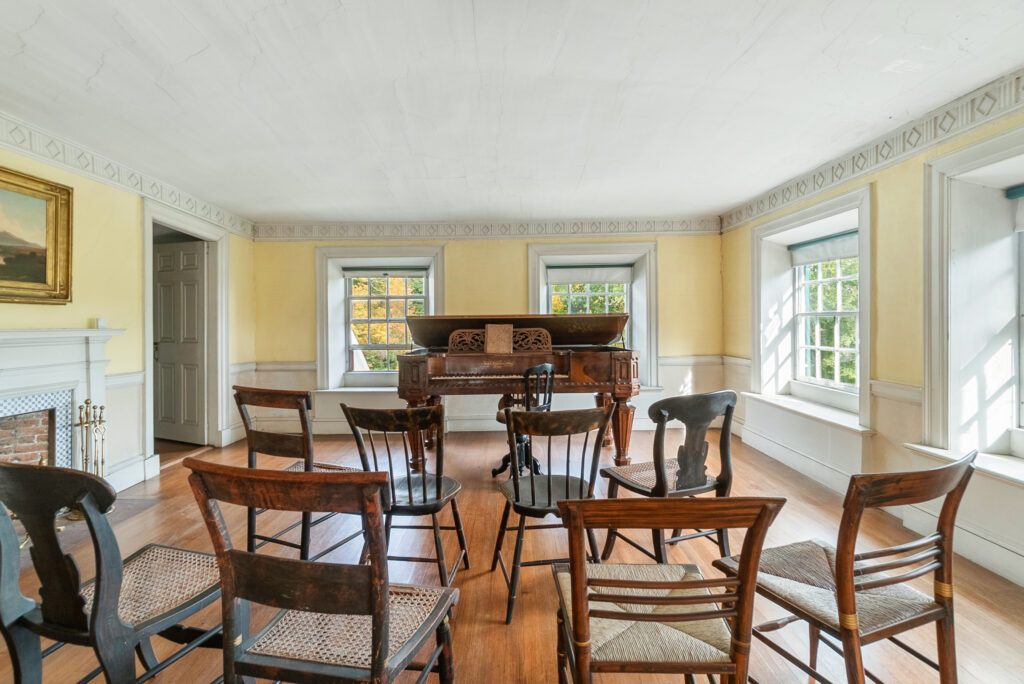
Charles and Martha lived in Forest Hall until their deaths in 1836 and 1842. Beginning in 1842, their second eldest son, Charles III occupied the house with his family before moving to Cambridge, Massachusetts, where he pursued a career as a book dealer. In 1848, George and Frances took up residence with their family. After George died in 1862, Frances built an ell connecting the house with the adjacent barn to provide accommodations for her son Edward and his family. Frances remained in the main house, sharing it with her youngest son, George Robert. She also added a partition wall to the third-floor ballroom, creating two bedrooms that could better accommodate family members who boarded with her in the house.
Though the grandeur of an elegant ballroom was gone, the refined entertainments continued and music remained an important part of the Barrett household. A descendant of the family fondly recalled attending an evening entertainment Frances hosted in her advanced age, describing the matriarch having a “sweet soprano voice, which she kept as long as she lived.” Her son George Robert is recalled as having a “lovely tenor voice and was besides a natural musician. They always sang hymns Sunday evening, and anyone who could, joined with them. It was a lovely memory of the Barrett House.” In addition to being a fine singer, George Robert also played tunes on a glass harmonium, a musical instrument that uses a series of glass goblets graduated in size to produce musical tones through friction. Invented in 1761 by Benjamin Franklin, the novel instrument sounds like a Glockenspiel with high ringing tones. George Robert’s glass harmonium and the sheet music he used remain in the Barrett ballroom today.
Written by Melissa Kershaw, Regional Site Administrator, Northern New England
Sign up to our newsletter for our latest news and events