
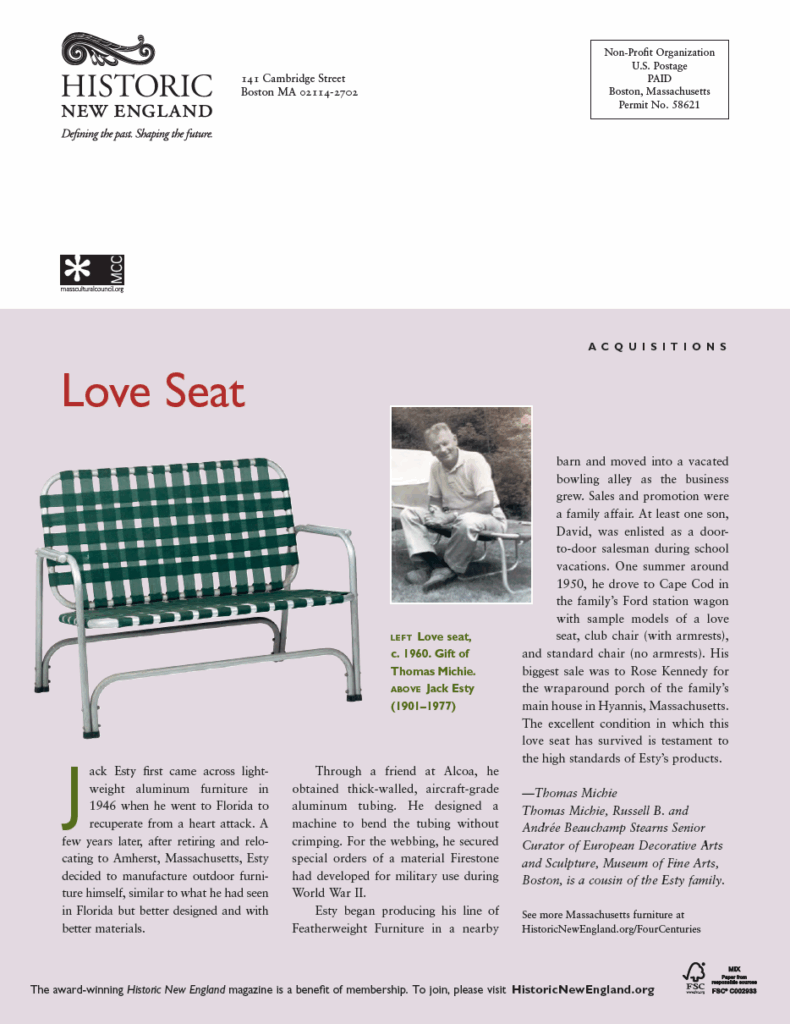
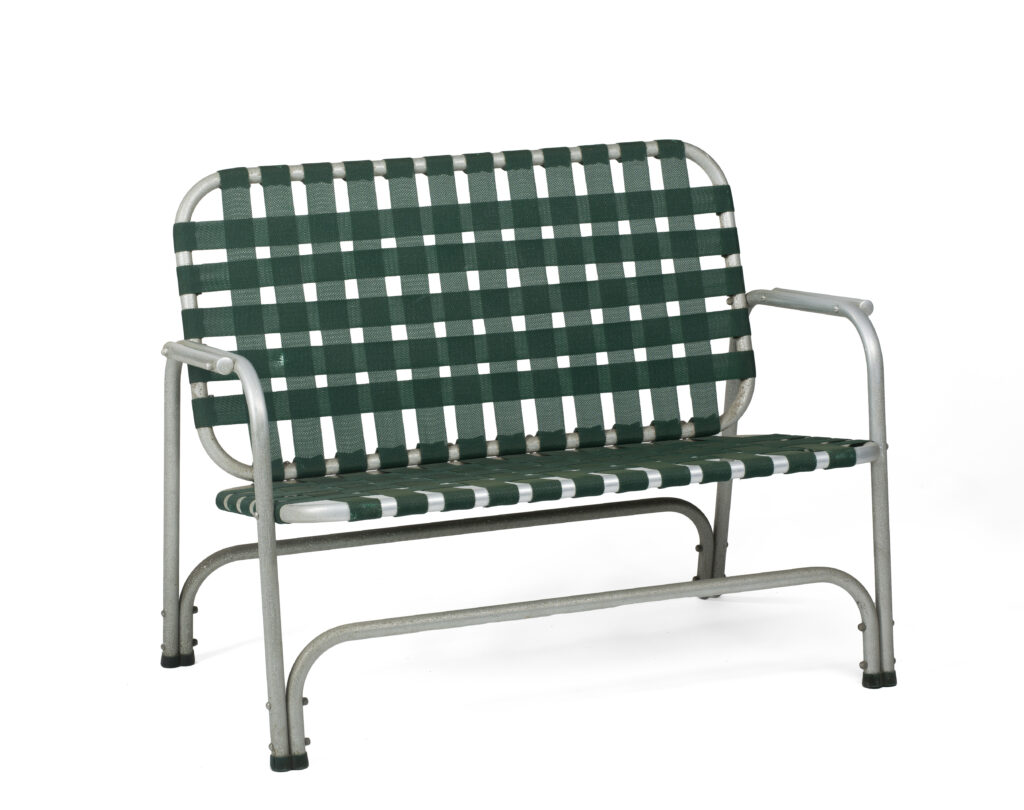
Jack Esty first came across lightweight aluminum furniture in 1946 when he went to Florida to recuperate from a heart attack. A few years later, after retiring and relocating to Amherst, Massachusetts, Esty decided to manufacture outdoor furniture himself, similar to what he had seen in Florida but better designed and with better materials.
Through a friend at Alcoa, he obtained thick-walled, aircraft-grade aluminum tubing. He designed a machine to bend the tubing without crimping. For the webbing, he secured special orders of a material Firestone had developed for military use during World War II.
Esty began producing his line of Featherweight Furniture in a nearby barn and moved into a vacated bowling alley as the business grew. Sales and promotion were a family affair. At least one son, David, was enlisted as a door-to-door salesman during school vacations. One summer around 1950, he drove to Cape Cod in the family’s Ford station wagon with sample models of a love seat, club chair (with armrests), and standard chair (no armrests). His biggest sale was to Rose Kennedy for the wraparound porch of the family’s main house in Hyannis, Massachusetts. The excellent condition in which this love seat has survived is testament to the high standards of Esty’s products.
Written by Thomas Michie. Michie, Russell B. and Andrée Beauchamp Stearns Senior Curator of European Decorative Arts and Sculpture, Museum of Fine Arts, Boston, is a cousin of the Esty family.
This article originally appeared in the Spring 2014 issue of Historic New England magazine. Check the blog monthly for new posts in our Collection Stories series.
Sign up to our newsletter for our latest news and events