
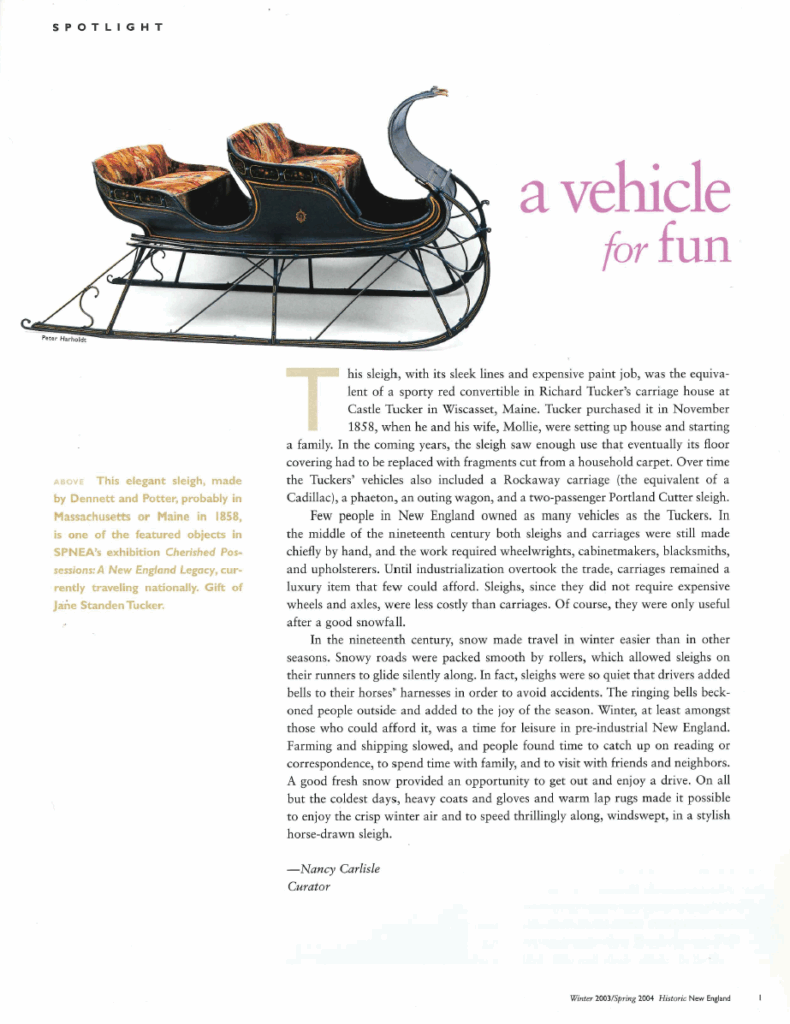
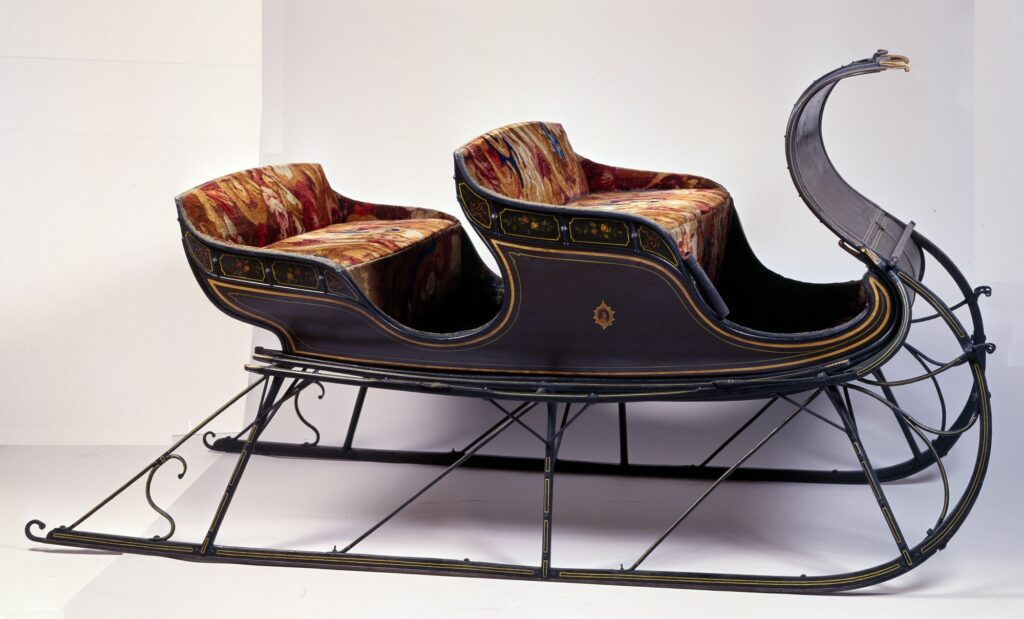
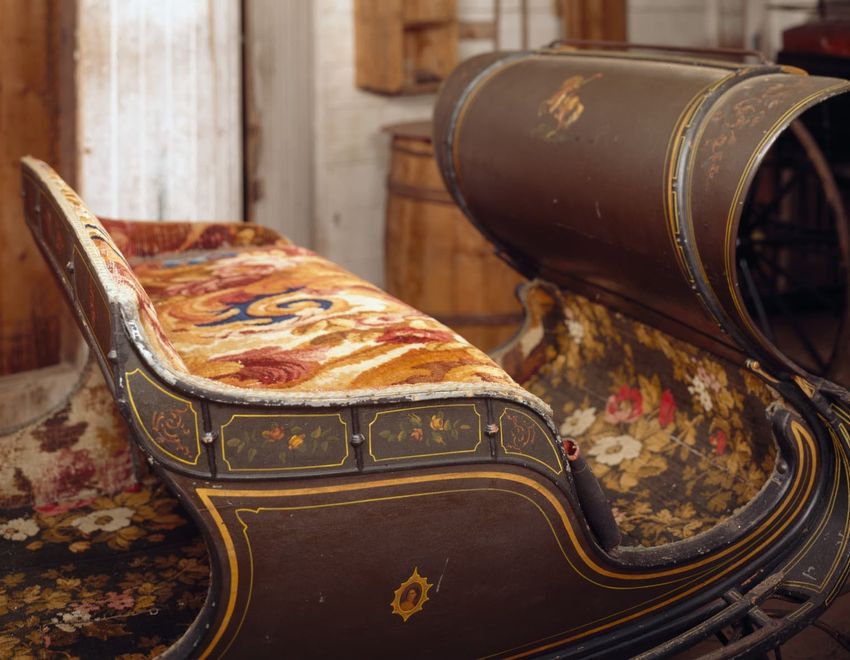
This sleigh, with its sleek lines and expensive paint job, was the equivalent of a sporty red convertible in Richard Tucker’s carriage house at Castle Tucker in Wiscasset, Maine. Tucker purchased it in November 1858, when he and his wife, Mollie, were setting up house and starting a family. In the coming years, the sleigh saw enough use that eventually its floor covering had to be replaced with fragments cut from a household carpet. Over time the Tuckers’ vehicles also included a Rockaway carriage (the equivalent of a Cadillac), a phaeton, an outing wagon, and a two-passenger Portland Cutter sleigh.
Few people in New England owned as many vehicles as the Tuckers. In the middle of the nineteenth century both sleighs and carriages were still made chiefly by hand, and the work required wheelwrights, cabinetmakers, blacksmiths, and upholsterers. Until industrialization overtook the trade, carriages remained a luxury item that few could afford. Sleighs, since they did not require expensive wheels and axles, were less costly than carriages. Of course, they were only useful after a good snowfall.
In the nineteenth century, snow made travel in winter easier than in other seasons. Snowy roads were packed smooth by rollers, which allowed sleighs on their runners to glide silently along. In fact, sleighs were so quiet that drivers added bells to their horses’ harnesses in order to avoid accidents. The ringing bells beckoned people outside and added to the joy of the season. Winter, at least amongst those who could afford it, was a time for leisure in pre-industrial New England. Farming and shipping slowed, and people found time to catch up on reading or correspondence, to spend time with family, and to visit with friends and neighbors. A good fresh snow provided an opportunity to get out and enjoy a drive. On all but the coldest days, heavy coats and gloves and warm lap rugs made it possible to enjoy the crisp winter air and to speed thrillingly along, windswept, in a stylish horse-drawn sleigh.
Written by Nancy Carlisle, Curator Emeritus
This article originally appeared in the Winter 2003/Spring 2004 issue of Historic New England magazine.
Sign up to our newsletter for our latest news and events