
Young people are often overlooked in histories of the American Revolution. This is largely because very few children or adolescents left behind written records of their experiences of war or the impact of independence. That’s not to say they weren’t involved: Children took part in boycotts and spinning bees, enlisted in the militia, and helped their families during wartime.
Compelling questions remain: Did colonial youth conceive of themselves as “rebels” or “Loyalists”? How did they express their political beliefs or partisan identities? Where the documentary record falls short, we often look to objects as evidence of the way colonial New Englanders navigated a changing political landscape. In Myth and Memory, we compare two very similar objects—with one striking difference—to help answer these questions.
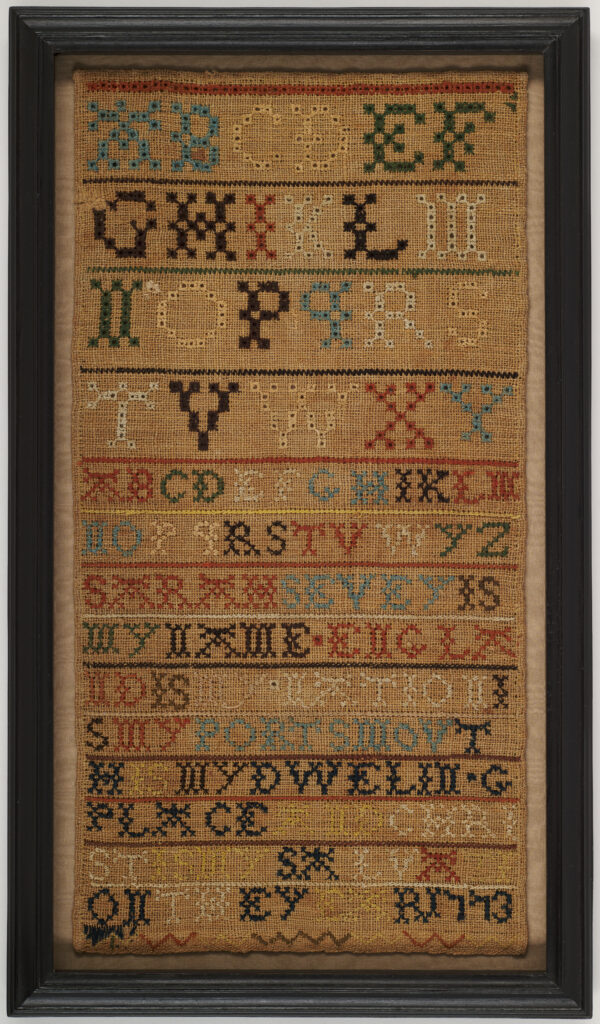
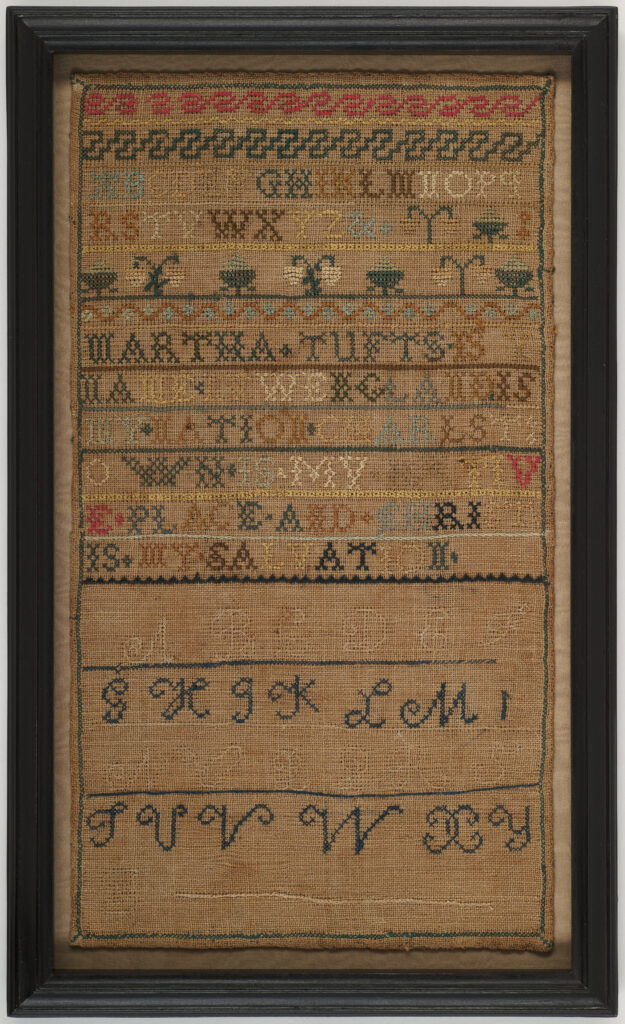
Growing up in eighteenth-century New England, Sarah Sevey and Martha Tufts each created marking samplers, which were among the most common types of needlework sampler produced during childhood. Making these samplers served to teach girls fundamental needlework skills, such as cross stitch and buttonhole stitch, which they used to practice stitching letters and numbers. Considered as examples of “plain” needlework, these lessons were intended for practical application in their future household to mark linens and other personal items to maintain an inventory. Decorative marking samplers also emerged in the early eighteenth century featuring floral or geometric bands or borders, designs from pattern books, and lines of biblical verse.
In my recent article on the topic of schoolgirl needlework, I used eighteenth-century embroidered coats of arms as historical evidence that colonial girls actively participated in and shaped the world around them. This perspective aligns with Andrea Pappas’s recent study, Embroidering the Landscape: Women, Art, and the Environment in British North America, 1740–1770, which argues that schoolgirl embroideries demonstrate their makers’ knowledge of history, religion, geography, and nature, among other subjects. As she writes, these objects “communicate views of women’s worlds, interests, work and priorities that contradict the all-too-familiar image of women passively copying patterns in their dainty needlework.”
The same interpretation extends to these marking samplers, which were quite standard in format: Sarah Sevey and Martha Tufts each included the alphabet twice, using different techniques, and they each adapted a well-known template: “[Name] is my name / [location] is my nation / [location] is my dwelling place / And Christ is my salvation.”
In 1773, Sarah Sevey marked her sampler: “Sarah Sevey is my name / England is my nation / Is my Portsmouth is my dwelling place / And Christ is my salvation.” Here, Sarah identifies herself as a British subject who lives in Portsmouth, New Hampshire. She accidentally included “is my” twice before and after Portsmouth, a mistake that could not be undone, so she continued. Historic New England has other needlework samplers in the collection dated to the 1760s that follow the same convention, referring to “England” as the maker’s nation.
This sampler came to us from a collector, not a descendant. The biographical clues on the needlework, including Sarah’s name and the date of its completion, helped me tentatively attribute this object to Sarah Sevey (or Seavey), the daughter of Portsmouth innkeeper Thomas Seavey and Sarah Cotton. While I cannot find her definitive date of birth, these kinds of marking samplers were made by girls as young as five or six years old. I suspect she was probably a little older than that, given the sophistication of some of these stitches. At the time of this sampler’s making, Sarah likely registered the rumblings of revolution in her hometown, particularly given her father’s occupation as a tavern owner and innkeeper. In 1773, the ongoing British occupation of Boston was exacerbated by Parliament’s passing of the Tea Act, which gave British merchants an unfair advantage in the trade, leading to the Boston Tea Party in December. Though many New England colonists called for an end to British Parliament’s unconstitutional oppression of its American colonies, they continued to identify Britain as their sovereign nation.
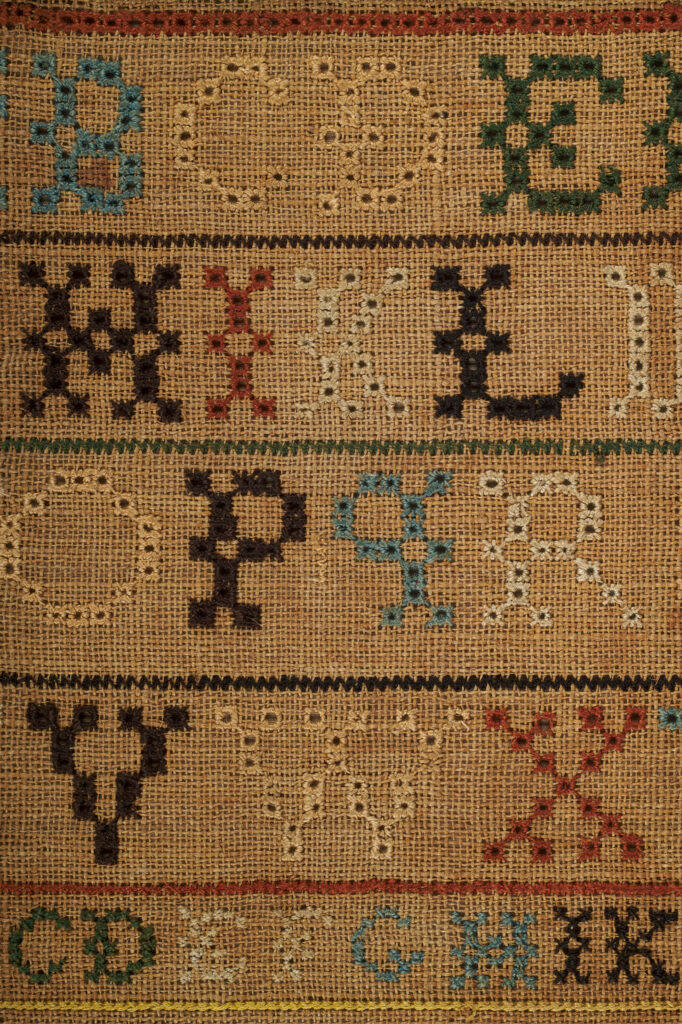
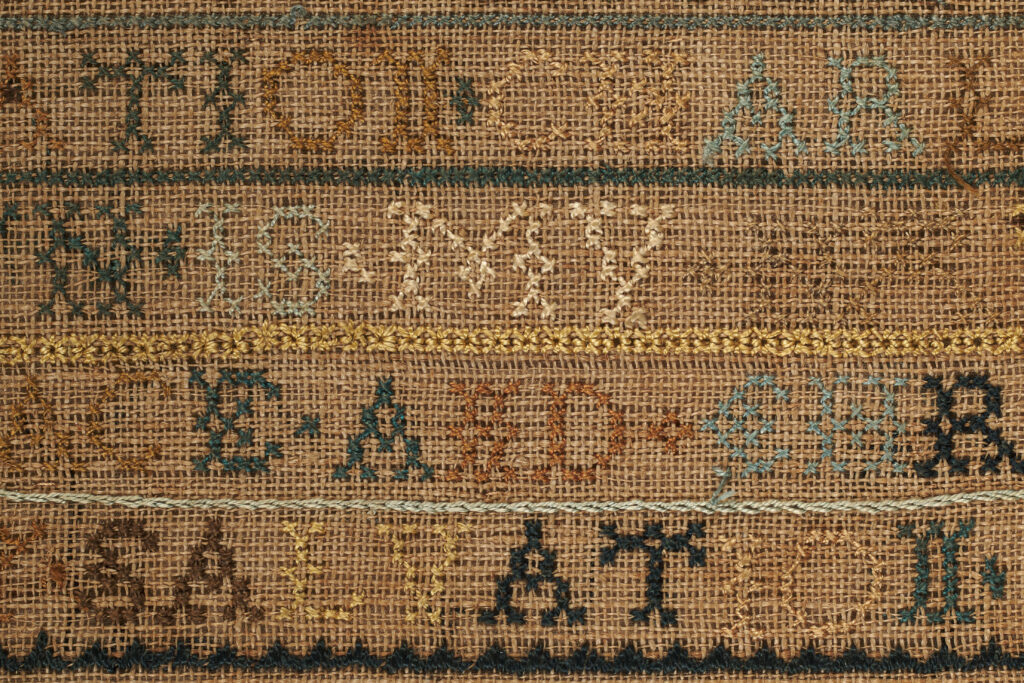
Fast forward several years to the early 1780s, when Martha Tufts worked her sampler:
“Martha Tufts is my name / New England is my nation / Charlestown is my dwelling place / and Christ is my salvation.” Here, Martha identifies New England as her nation, rather than England. Based on biographical details associated with this sampler, I’m attributing it to Martha Tufts (1773-1805) of Charlestown, born to Samuel F. Tufts and Martha Adams. Martha may have witnessed from her home the movement of British troops on the night of April 18, 1775, as they crossed the Charles River on their march to Concord. She certainly could have been present during the Siege of Boston, as her father was a captain in the local militia. Even if Martha, who would have been around two at the time, retained no direct memory of these events, their significance would almost certainly have been reinforced through family lore, particularly given her father’s military service.
Martha may have created this sampler in the early 1780s, perhaps after the Treaty of Paris in 1783 formally recognized the United States as an independent nation. She herself recognized “New England” as her nation, marking a shift in identity in the post-colonial era.
Martha was not the only girl to make this change, as several surviving needlework samplers use similar language. Others refer to their state as their “nation” or “station” and their town as their dwelling place. Of course, this was not a hard and fast rule applied to all samplers with this convention, but by showing these two pieces side by side, we might better glimpse the small but significant ways New England children made their mark in the material record of the American Revolution.
Written by Erica Lome, Curator of Collections
Exhibitions like this are made possible by the generous support of Historic New England’s members and friends. Support Myth and Memory and help preserve our shared stories.
Sign up to our newsletter for our latest news and events