
Tell us a bit about yourself and how you came to the idea of an oral history project focused on Walter Gropius.
I have a lifelong fascination with the arts and history and a particular interest in German culture. I graduated with a BA in film from Emerson College in 2003 and obtained my MA in history from UMass Boston many years later, in 2022. Though I maintained artistic pursuits during the interim period, particularly photography and music, I had largely lost touch with filmmaking and felt it would never resurface. However, while contemplating my capstone project in graduate school, my advisor suggested that I revisit my film background and make a documentary—something I had never done but was eager to try. The topic I chose (the demolition of Boston’s West End during urban renewal of the 1950s) tapped into my fascination with urban planning and passion for historic preservation. The project succeeded in reigniting my interest in filmmaking. The film found an audience outside of school—it was screened several times in Boston and won some awards, which bolstered my drive towards additional projects. Shortly after graduation, one of the interviewees from my West End film invited me to collaborate on an oral history project about Boston’s Fort Point Arts Community, a project which offered additional experience in filming interviews.
In the meantime, I was seeking ways to delve into architectural preservation. As a long-time member of Historic New England, this organization seemed like a perfect place to start. Perusing the job listings, I was excited to see an opening at Gropius House—my favorite of the thirty-eight properties and one that ties into my interest in Germany and love for Modern design and avant-garde art. I’ve been a guide there since 2024 and absolutely love it. At some point, it occurred to me that an oral history project, similar to the Fort Point series, about Walter Gropius, the Bauhaus, and The Architect’s Collaborative would be an important contribution to the subject—something not only close to my heart and current work, but also of tremendous historical value.
You’ve interviewed an unusually diverse group—architects, scientists, curators, diplomats, and family members. How did you decide whom to include?
Collaborating with Historic New England in this process was invaluable in numerous respects, one of which was the connection to interview subjects. Gropius House site manager, Wendy Hubbard, has an extensive network of connections related to the topic. She provided a list of potential interviewees, which we narrowed down based on time constraints, their connection to the subject, and willingness to participate. The final list covered a diverse range of perspectives, areas of expertise, and connections to the Gropius legacy, and each brought something unique to the project.
Oral history often captures nuance that traditional scholarship can miss. Were there moments in your conversations that challenged or complicated the established narrative around Walter Gropius or the Bauhaus?
There are many fascinating nuances explored throughout the interviews and each participant brought unique insights, memories, and observations to the discussion. Generally, the interviews affirmed many established narratives around Gropius and the Bauhaus, such as its origins and importance, while deepening, humanizing, and complicating them in important ways.
For example, the concept of Gropius as a star architect was challenged by numerous participants who highlighted his emphasis on collaboration, along with his humanity, modesty, and focus on teaching and encouraging others. Also, the often-overlooked contributions of his wife, Ise, were repeatedly highlighted, demonstrating her crucial role in his success and in the preservation of his legacy.
I was left with a greater understanding of the complexities within the Bauhaus, which is often seen as an ideologically unified environment. In many ways, it was exactly that. But it was also fraught with disagreement, competing egos, and creative friction. The Bauhaus was not a single, coherent movement, but a complex coalition of ideas, styles, and personalities.
Finally, a complication I raised myself in several interviews is the contrast between the human centered and socially conscious ideals of the Bauhaus and other modernists of the period, and mid-century urban planning and its Modern roots which were incredibly destructive to communities (tying back to my film on the West End). Not to say that Gropius was responsible for such actions, but the legacy of Modern design and its impact on built environments throughout the world is complicated and the interviewees offered interesting perspectives on this point.
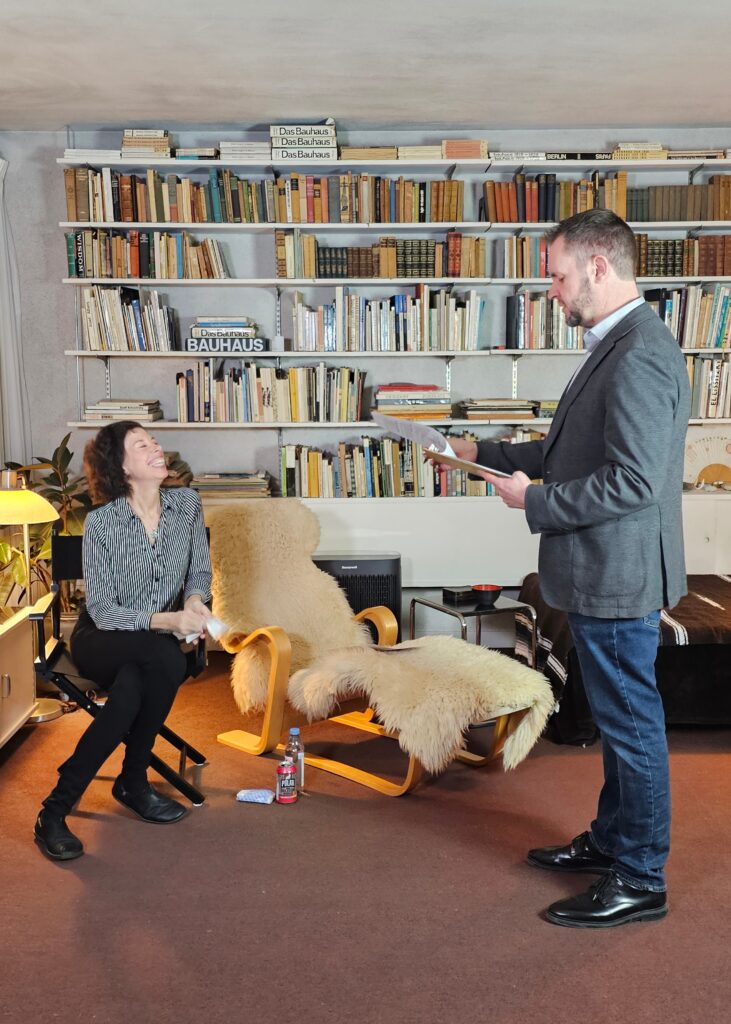
Many of the people you spoke with knew the Gropiuses personally—Nevin Summers, Douglas Adams, and of course their granddaughter, Erika Pfammatter. What new stories did their interviews reveal, things you wouldn’t have known from the archives or published histories?
I will refrain from specifics and instead encourage readers to watch the interviews themselves to hear the wonderful stories shared by these participants. But in general, what was consistently highlighted was Gropius as a person, not as a “starchitect”—his warmth, modesty, and humanity. Despite his legendary stature in architectural circles, the interviews repeatedly portray him as quiet and humble person, more interested in listening to others than in promoting himself. He had a keen interest in children, which was emphasized, in particular, by his granddaughter Erika Pfammatter, who was nine when he passed away but remembered him well. She recalled that her grandfather was genuinely fascinated by what children thought and felt.
Also, I was curious about the family’s day-to-day life and several interviewees had fascinating information to share about this topic—what they liked to eat, what music they listened to, their spiritual and religious beliefs, family traditions, and much more.
Architects like Ed Nilsson and Peter Chermayeff bring a practitioner’s perspective. What insights did they offer about Gropius’s design philosophy or the legacy of The Architects Collaborative?
Peter and Ed, as well as Doug Adams and Nevin Summers, offered fascinating insights from a practitioner’s point of view. We had wonderful talks about Modern architecture, preservation, the design of Gropius House, and each participant’s own work.
Something that stood out was the repeated emphasis on Gropius’s WAY of working, as opposed to simply discussing the work itself. His role as a teacher, as a conduit for bringing talented people together across various disciplines, and for resolving tension and disagreement, was highlighted and I came away with the notion of Gropius as a grounding figure, holding space while chaos and creativity surged around him, helping to bring wonderful things into fruition.
The interviews further reinforced how deeply collaboration was embedded in Gropius’s practice. Much of his work during his US period was done through The Architect’s Collaborative, where credit was typically shared rather than attributed to an individual architect. As Nevin Summers pointed out, he could have founded a firm like ‘Walter Gropius Associates’ but notably did not.
I was also struck by the focus on human-centered design at the Bauhaus and in Modernism more broadly, a style which is often seen as cold and sterile. Gropius House itself is a great example of this concept – it’s a warm, comfortable, and inviting place. Architecture is discussed as part of the larger human environment and its effects on human experience keenly considered, including the use of art in building designs. It is clear that social questions and concerns were at the forefront of Bauhaus philosophy.
What did you learn from Dr. Sonja Kreibich about the Bauhaus as part of Germany’s cultural identity and its international resonance today?
Dr. Kreibich offered a unique perspective as a German diplomat and cultural representative. The Bauhaus clearly remains one of Germany’s most important and lasting cultural exports, particularly during the one-hundredth anniversary in 2019 when the topic was practically inescapable throughout Germany. She noted that the German president, Frank-Walter Steinmeier, even paid a visit to Gropius House to commemorate the event. On the other hand, it seems that with the passing of time, the topic may not be as familiar as it once was, especially with younger generations. Dr. Kreibich noted that “Bauhaus” is also the name of a German equivalent of Home Depot which has muddled the term’s meaning.
What did speaking with two curators—one working with the largest Bauhaus collection in the United States, and one bringing both a curator’s eye and a family connection—reveal about the different ways Gropius’s legacy is understood and interpreted today?
In contrast to many of the interviewees, both curators brought an understandable focus on the art of the Bauhaus, as opposed to architecture, and the interdisciplinary nature of the movement. The concept of collaboration again surfaced, not only about the Bauhaus, but also in how the Busch-Reisinger’s collection came together through various donors, including Gropius himself, and Wolf’s description of the dense network of family relationships, collaborators, and friends in Gropius’s story. In fact, Wolf’s continued connection to family members who knew Walter personally provided a wonderful opportunity to pose questions to them through Wolf, who himself was born after Gropius died.
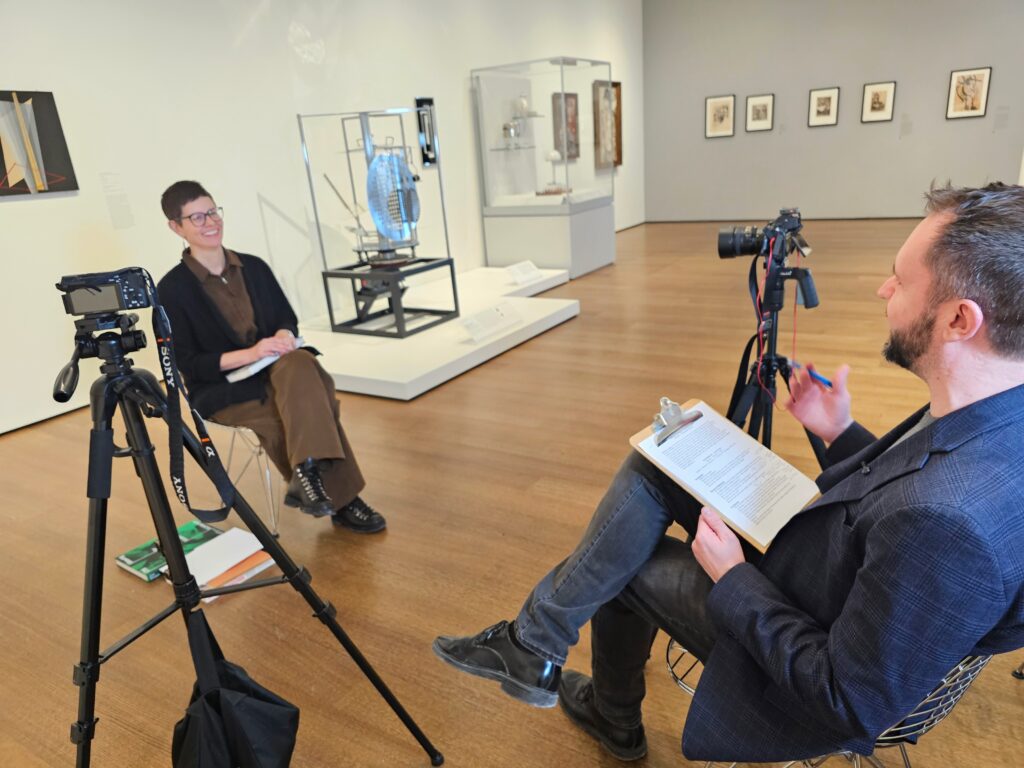
When viewers watch the interviews, what do you hope they learn—about Gropius, about the Bauhaus—that they might not have realized before?
There are many diverse and fascinating topics explored across these eight interviews. I think different viewers will gravitate towards different things, depending on their interest. There is plenty of material here for anyone interested in architecture, Modern design, German culture, urban planning, and art, but there are topics unique to each participant which expand our knowledge of familiar themes. For example, as a scientist, Nevin Summers describes doing “architecture” and design at the molecular level and outlines his climatic study of Gropius House. Erika Pfammatter and Peter Chermayeff allow us to see the Gropius family through a child’s eyes. Sonja Kreibich provides the wise perspective of a career diplomat. There are the expert insights of seasoned architects, Ed Nilsson and Doug Adams. We have the privilege of seeing a Bauhaus collection through the eyes of its curator, Lynette Roth and we get to dive deep into Gropius family lineage with Wolf Burchard. I think the variety of perspectives and areas of expertise on display allow an extraordinarily comprehensive and thorough examination of the subject.
I hope that viewers come away with an expanded knowledge of Gropius and the Bauhaus’s impact and legacy, along with a deeper appreciation for Gropius and his family as human beings. And I hope it sparks interest in these topics, prompting viewers to continue learning on their own. I think that Modern architecture is often dismissed as not attractive enough or not historic enough to warrant preservation (think Boston’s City Hall, for example) and I hope this series provides a greater understanding of the Modern Movement: where it came from, what it aimed to do, and why it matters.
Gropius House is open year-round for tours. Christopher Brown also offers guided tours of Cambridge’s Modern architecture for Historic New England.
Sign up to our newsletter for our latest news and events