
Welcome to Watson Farm, a 265-acre working farm managed using innovative, sustainable practices that continue the farm’s long tradition of pastoral husbandry. Since 1979, the farm has been managed for historical and ecological conservation by Historic New England. It was saved as a working farm because of its long continuity of cultivation by several groups of people, and it is one of the few intact farms remaining on Conanicut Island that is open to the public.
Here the farmers raise heritage Red Devon cattle and multi-colored sheep. Wool from the sheep is sent to local mills to be made into products like blankets, mittens, and hats. Lambs, sheep, calves, and cattle are sold to other farmers for meat, grazing, and breeding stock. Farmers grow hay for winter fodder, a drought-resistant crop for late summer feed, and a vegetable garden. The herd and flock are fed using rotational grazing, and when onsite a guide will tell you in which pasture to find them.

The 1796 farmhouse is the residence of the farm manager and may be viewed from the exterior. Barns and outbuildings dating from circa 1796 to modern day support the agricultural and educational uses of the property. We offer self-guided walking tours from the barnyard to the shore during open hours between June and mid-October, along with special programs like Sheep Shearing Day in the spring and a Fall Farm Festival.
We offer self-guided walking tours from the barnyard to the shore during open hours. Onsite, a tour guide on duty is available to add to your tour experience. The tour can be followed for more than two miles of hiking across fields, pastures, and coastline.
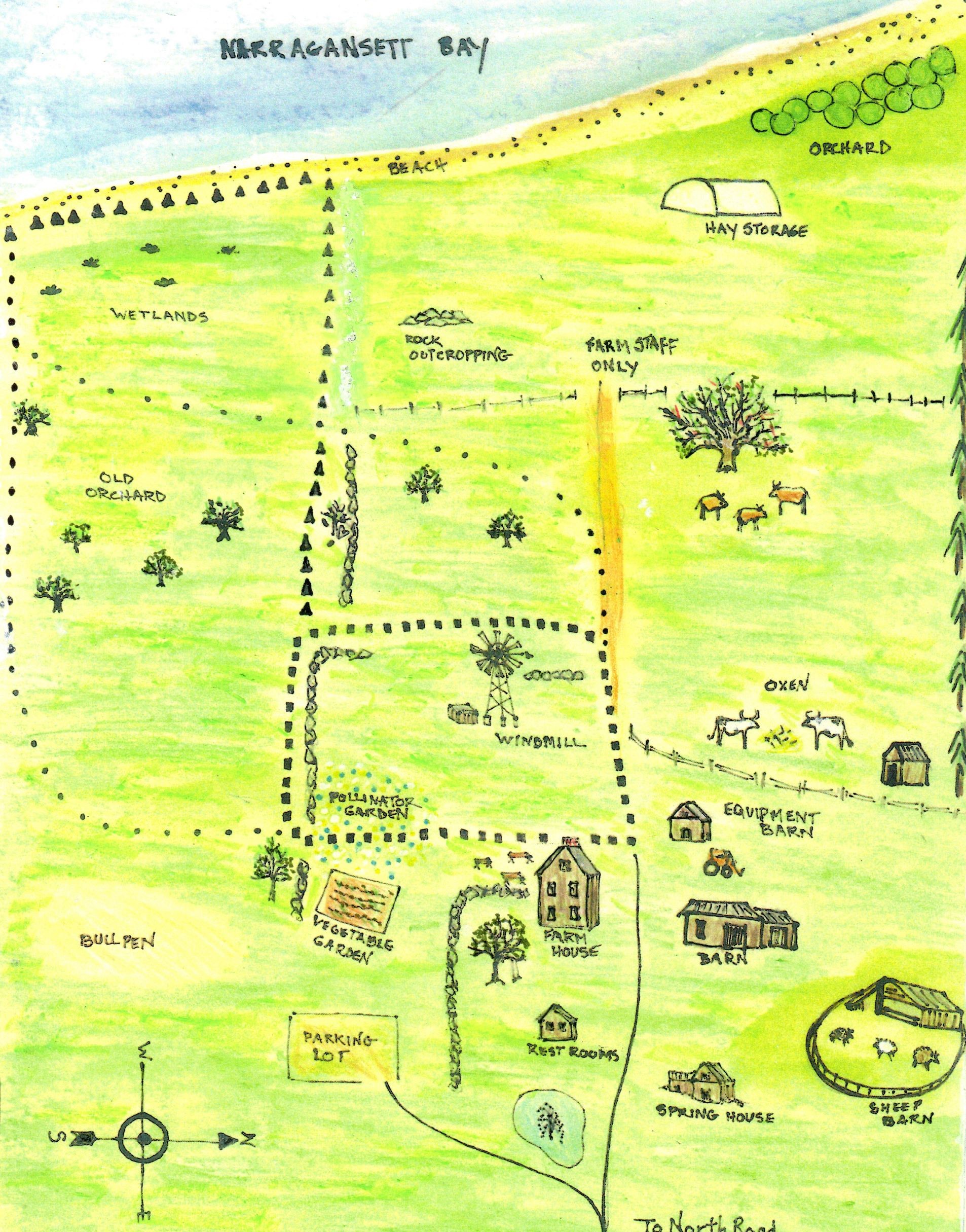
Watson Farm is open during special events and for tours from the first Saturday in June through October 15. At other times please contact us for group tours or other questions at 401-423-0005 or WatsonFarm@HistoricNewEngland.org. Onsite, a Watson Farm guide will sign you in and provide an orientation.
As you explore the farm, please:
Short Loop ( – square) – about a mile long and takes most people 45 minutes
Long Loop ( – circle) – up to an additional two miles long and takes most people 2 hours or more
Path to the Bay ( – triangle) – adds about a mile round trip and takes most people 90 minutes from barnyard to shore and back
Map artwork by Charley Wullschleger
 It is easy to view Watson Farm as unchanged, pristine, and beautiful. A deeper and even more meaningful layer is added when we consider decisions made by people over millennia created the farm landscape we steward today.
This farm is located on the ancestral homeland of the Narragansett People. For millennia, Indigenous people lived well on Conanicut Island, using controlled burning to clear the land for hunting and cultivation. European colonizers arrived in the area in the early seventeenth century and sought the grasslands resulting from Indigenous land management for their domesticated animals. Accompanied by years of war, oppression, and enslavement inflicted on Indigenous people and unfair land acquisition, colonizers from Newport acquired in 1654 “The Grasses of Conanicut.” Sheep and cattle have been raised on this island since that time. Raising livestock and growing crops meant that farmers planted non-native grasses, stacked stone fences, made more formal roads, and built permanent structures for people and livestock.
For the next century after 1657 the land was owned by three successive governors who were wealthy land investors, but worked mainly by tenant farmers and enslaved people. Seven enslaved people of color are documented as living on this land, but there were likely many more. In the 1750s, Jamestown had the highest proportion of enslaved people, about one in five, of any other New England town. Proximity to the major slave importation center of the North, Newport, is one reason, and so is the economic reliance on the plantation system in Southern Rhode Island to send wool, mutton, and cheese to clothe and feed enslaved people on sugar plantations in the West Indies.
Life on Jamestown changed dramatically because of the American Revolution. Newport was occupied by the British from 1776 through 1779 and British troops were stationed at fortifications on Jamestown and frequently raided farms for provisions. In return, some Jamestowners harassed the British. The British retaliated, burning many homes in the central part of the island, including we believe the first farmhouse here. The farm probably remained derelict until new owners took control, the only time it was not actively cultivated in its history.
After achieving independence, the new State of Rhode Island seized the Loyalist property and gave it to three Continental Army soldiers in lieu of back pay. In 1796, Job Watson purchased the farm that would be passed down through five generations of his family. His son, Robert Hazard Watson, farmed this land and lived in the farmhouse with the date “1796” carved on the staircase.
Census records indicate the Watsons lived on the farm in Jamestown and farmed the land themselves and employed live-in farm laborers and domestic servants; in 1850, Patrick Kelly born in Ireland and James Card born in RI, and Mary Stephens, recorded as a 56-year old Black person. Robert Hazard Watson, Jr. gave the farm to his son Thomas Carr Watson, a veteran of the Civil War, in 1875. By then the resort culture of Newport lifted the area’s economy and this Watson benefited from the tourist trade by buying an interest in the Newport ferry. Thomas married school teacher Laura Virginia Lutz and built a new house for them elsewhere on the island. Tenant farmers continued raising cattle and lived on the farm on and off into the twentieth century. The last Watson owner, Thomas Carr Watson, was a stockbroker in New York and donated the 265 acres to Historic New England to be maintained as a working farm in 1979.
We can enjoy the beauty of Watson Farm while still appreciating the history even if it may be difficult to contemplate, because we know that all the people—Indigenous people, enslaved people, tenant farmers, farm managers, and owners—made that experience possible for us today. As you walk in the their footsteps, we hope your appreciation only grows for this place.
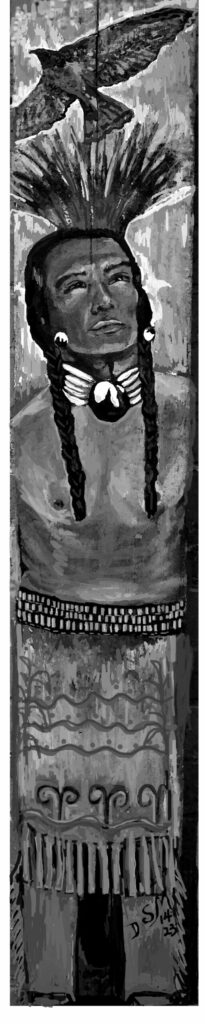
“Red Hawk Looking Up” by Deborah Spears Moorehead
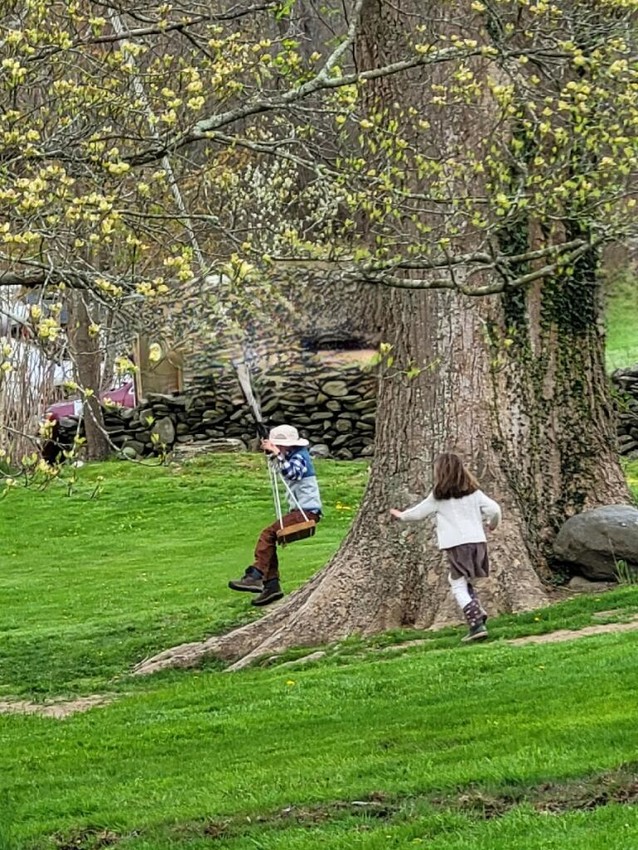
The large lawn is planted with a border garden and trees sloping down to a pond. Here you will find the restroom building. The large rock is fun to climb (but please do not climb fences and walls) and the tree swing is a favorite. The swing hangs on one of the oldest and largest trees on the property, a tulip poplar. In springtime, beautiful yellow and orange flowers bloom on the branches and it provides cool shade in the summertime. Arborists say it could be older than America itself, and it could have been planted for Governor Thomas Hutchinson who owned this land from 1734 until his property was seized by the State after the American Revolution. The pond helps to control drainage and provides habitat for wildlife like ducks and frogs. The fountain helps to keep it aerated, but also makes a pretty view with the large overhanging willow tree.
The 1796 farmhouse is late Georgian in style with its central chimney, balanced facade, and strong moldings. Still serving as the farmer’s residence, the interior is not open to the public. The house is sited on the sheltered side of the hill. It faces south like most houses of its age to take advantage of the southern light in the best front rooms and keep the kitchen and working rooms to the north cooler. It has thirteen rooms, six fireplaces, a smokehouse, an enclosed well, and large root cellars. Over the years, both Thomas Carr Watson and Historic New England have made extensive repairs to this large wooden building which was always used as the farm family’s residence whether they were Watsons, tenant farmers, or today’s farm managers. Modern utilities were not added until Historic New England’s farm managers, the Minto family, moved in during the 1980s. Farm manager Max Sherman has lived here since 2020.
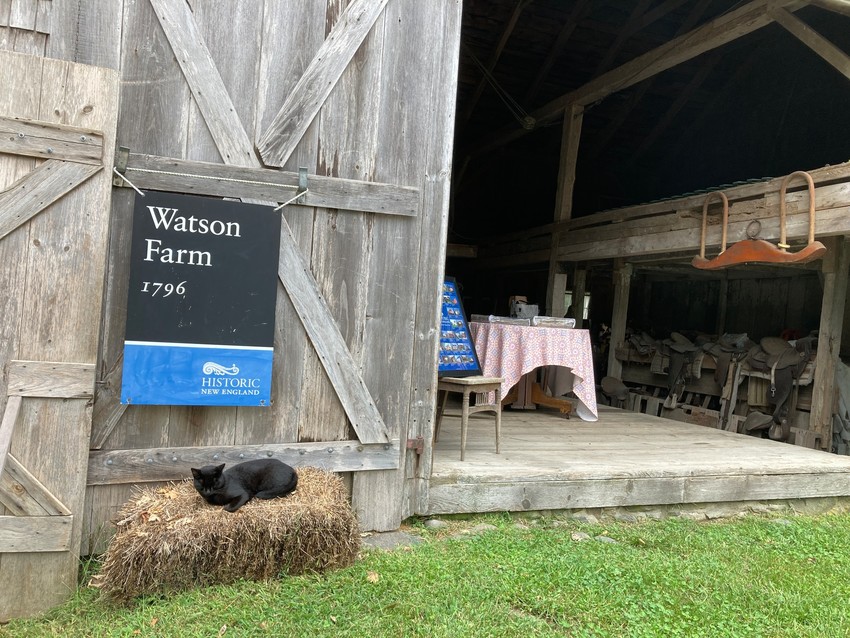
The barnyard is a center for agricultural activities. Like the farmhouse, the main barn is believed to date to the Watson family’s ownership in 1796, a rare surviving agricultural building of this age. It sheltered livestock, feed, and equipment. It was designed as an English-style hay barn so that a wagon could be driven inside the central bay via the large swinging doors and then the workers pitched the hay up into the lofts for storage. On the right-hand side there was room for cow stalls where they were milked and sometimes fed turnips and radishes to make their cheese taste more complex. Today, the right and left wings of the barn are equipment storage and repair shop areas which are for farm staff only. The back of this barn has a small added shelter for an animal or two leading to its own paddock. The vintage farm items on the barn floor and in the hay loft were collected by the Minto family as gifts and while on their travels to agricultural shows and to bring in new animals to diversify the genetics in the herd of Red Devon cows.
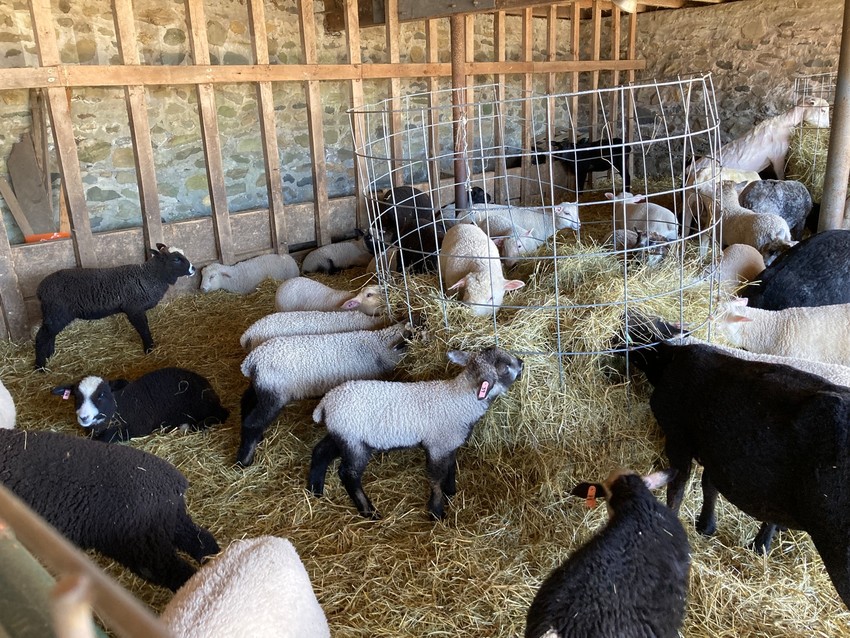
Behind the main barn is a 1950s shed built for the Black Angus cattle raised here then. These days, farmers bring the flock of sheep to this shelter for the winter to feed them hay. Lambing season happens in March and early April here, and the farmers can provide veterinary care for the new lambs and the ewes in this sheltered spot. The flock stays here through shearing time in late April or early May. Once the lambs are strong enough and the ewes have their warm weather haircuts, they go out on to the pastures to graze one large fenced section after another until the next winter.
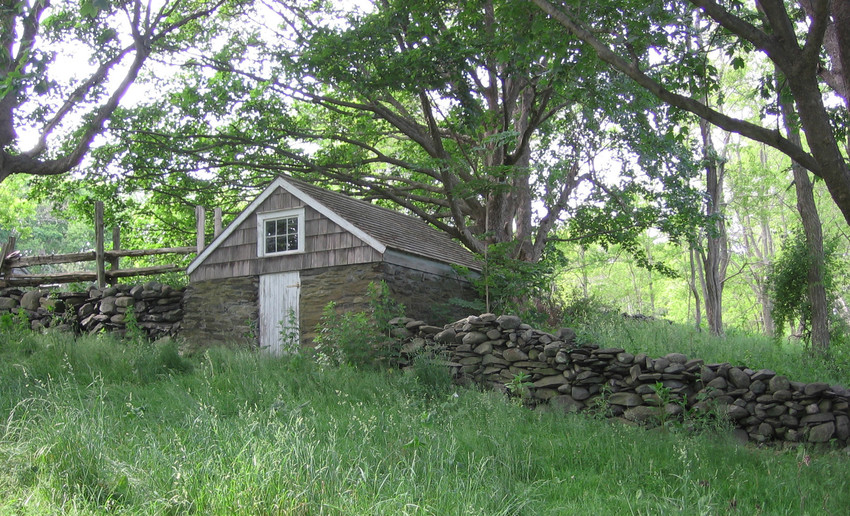
Down the driveway toward the pond you can see two small outbuildings. The one on the front lawn is the circa 1985 restroom building and storage shed for agricultural products like those made from Watson Farm wool. The other, built into the hill for natural insulation, is an early building whose exact date is not known. The shelter also keeps the natural spring clean and makes a cool place to store food and keep ice. Cow’s milk was one of those products in the past, and farmers from around the area brought theirs to this Spring House for storage before making cheese.
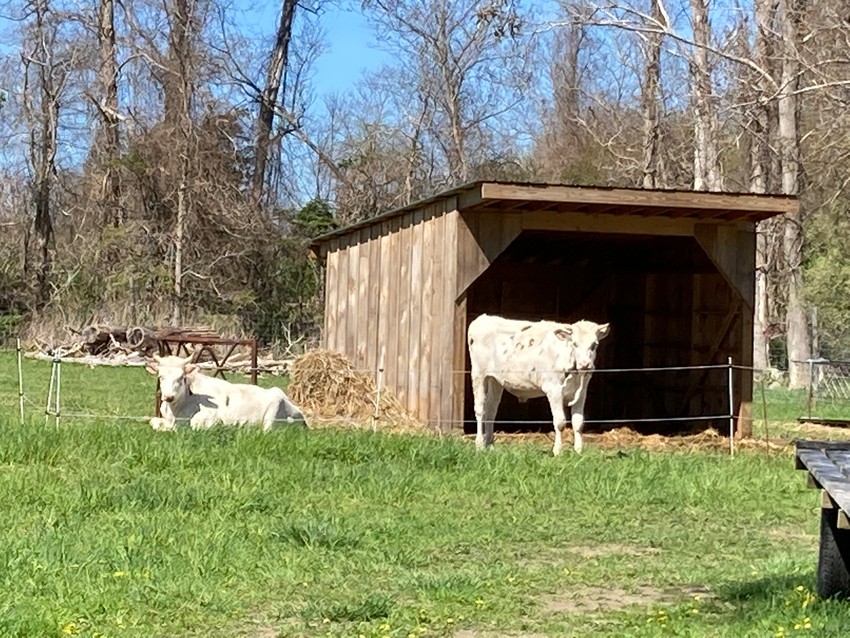
Just up the hill from the barnyard on the Short Loop is the enclosure for two oxen, Ollie and Otis, a pair of Holsteins that farm manager Max Sherman is training to be a matched pair of working animals. A skilled driver with oxen in a yoke could pull a huge amount of weight in a wagon, plow a field, or drag stones on a sledge to the edges of a field. Historically, oxen were often the animals of choice for farm work because they are hardier than horses. Notice the raw tree trunks that make up the fence around this enclosure. The oxen are protected by a modern, solar-powered electric fence as well, so please be careful not to touch it. The trail you are now following is the Short Loop which either leads west for less than a mile back to the barnyard or connects to the Long Loop and Path to the Bay for more than two miles of hiking.
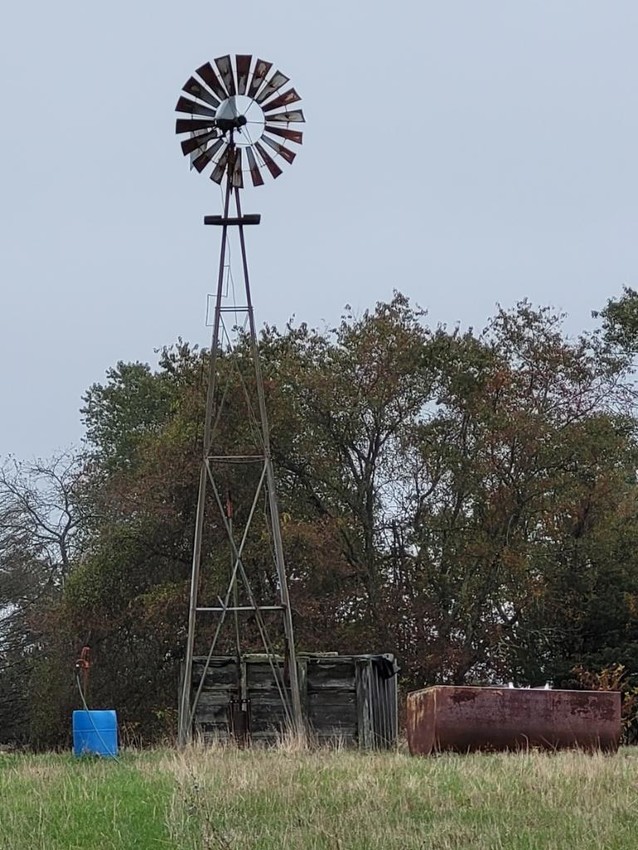
Windmills have been an important feature of the landscape for centuries here in Jamestown’s Windmill Hill Historic District. The large windmill on North Road owned and operated by Jamestown Historical Society dates to 1787. A tenant farmer here, Gershom Remington, was hired to repair this mill that was used to grind corn. Our windmill pumps water from an eighty-foot-deep well which fills the 2,000-gallon tank at its base. Each cow drinks an average of ten gallons during a summer day. With a good wind, it takes six hours to fill the tank. The strong winds that blow across the island make windmills a sustainable method of pumping water and providing electricity. The picturesque windmill was the inspiration for some scenes of the 2012 Wes Anderson movie Moonlight Kingdom which was filmed in Jamestown including Watson Farm. The field nearby is where Kite Flying Day is held each June, where hay is cut, and where sheep are grazed.
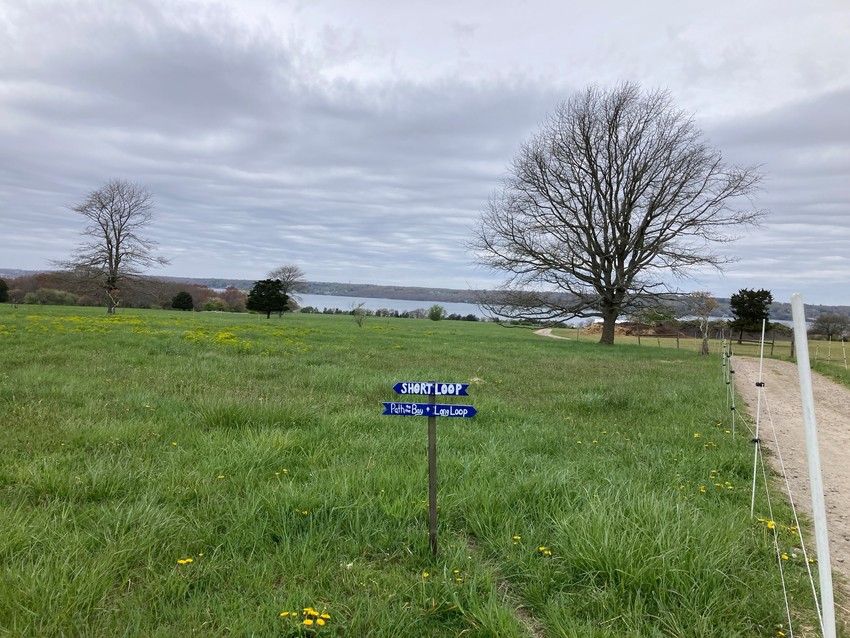
The Short Loop will take you back to the barnyard in less than a mile, or you can continue toward the water to take the Long Loop and Path to the Bay in under two miles. You have reached the highest point on the farm and the highest elevation on Conanicut Island, 135 feet above sea level. The water is the West Passage of Narragansett Bay with the village of Saunderstown in North Kingstown visible on the mainland. Most of the land near here is pasture for grazing animals. It looks less uniform than the hayfields and is scattered with trees to provide shade and scratching posts for the animals, giving the trees a flat-bottomed silhouette. Many of these trees are tupelos which sport a red leaf here and there among the green. The hayfields, beyond the stone wall and hedgerow to the south, are planted and harvested to provide winter food for livestock.
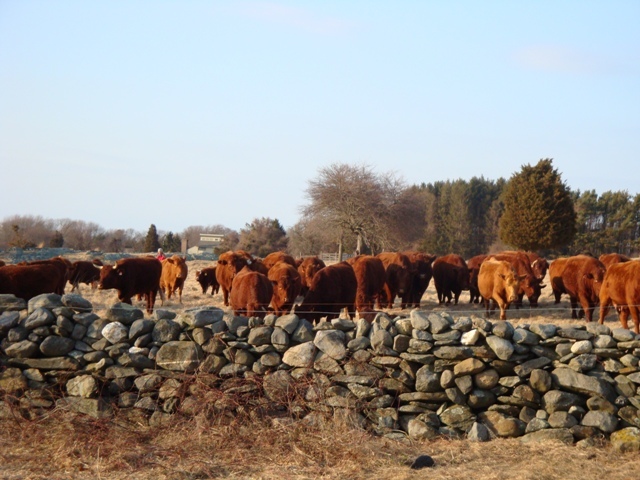
Most of the land on either side of the stone fence (or wall) leading toward the bay is set aside as pasture land for the herd of cattle and you may be able to see them along this way depending on where they are in the grazing rotation. Red Devon are the English breed first brought to America by the Pilgrims in 1623. They are a triple-use breed, providing muscle to pull wagons or plow, milk to drink or make into cheese, and veal or beef to eat. Don and Heather Minto were the first to bring Red Devons back to this part of New England in the 1980s, proving that cattle can be raised here on grass alone. Typically, most farms feed corn in a lot which is resource intensive and hard on the environment. In this rotational grazing model, cows get their nourishment on the farm through grass on the pastures and hay cut and stored for the winter. Their manure then fertilizes the pasture. The farmers move them to the next section to eat grasses they find delicious, to keep the land clear of many invasive plants, and to fertilize it in a continuous cycle. You may see solar-powered electric fences in use to encourage the cows to stay in and to discourage predators.
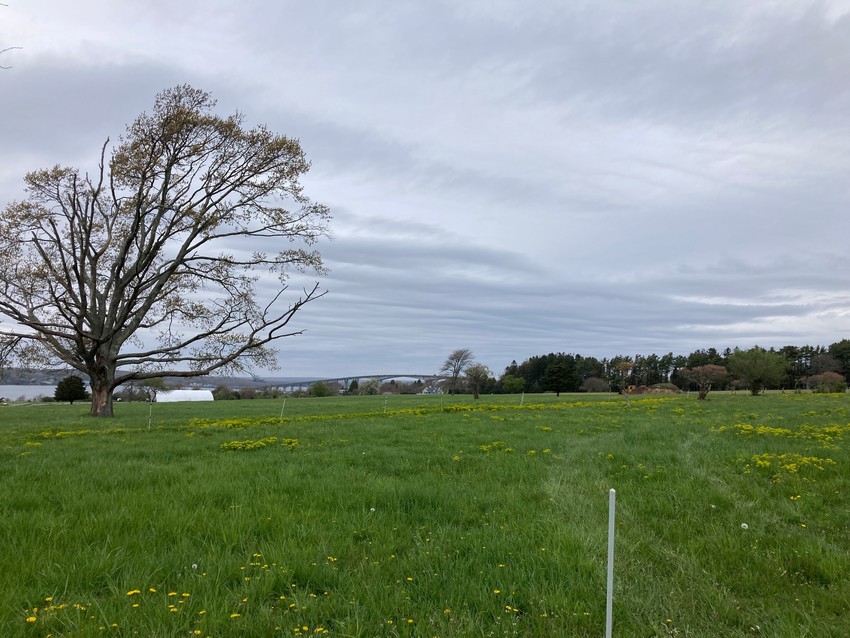
You can follow the Long Loop across the whole farm for more than two miles. If you have chosen this path, you will see to the West large pastures that are the winter home of the Red Devon cattle herd. They are a hardy breed but they benefit from the natural shelter formed by one of the old orchards in a swale near the water at our northwest border. Winter feed for the cows and sheep, up to 300 tons of hay harvested from the farm, is stored in the white Quonset hut shaped structure installed in 2021. This pasture with the hay storage structure is accessible by farm staff only. A large compost pile of cow dung and straw often accumulates here, later to be spread for fertilizer. In late February and March the cows give birth to their calves in the pasture. Some cows are simultaneously pregnant and nursing last winter’s calf, meaning they need lots of food. You may see a bright green crop of the drought-hardy cross between Sorghum and Sudan grass which is a climate-resilient feed for the cattle.
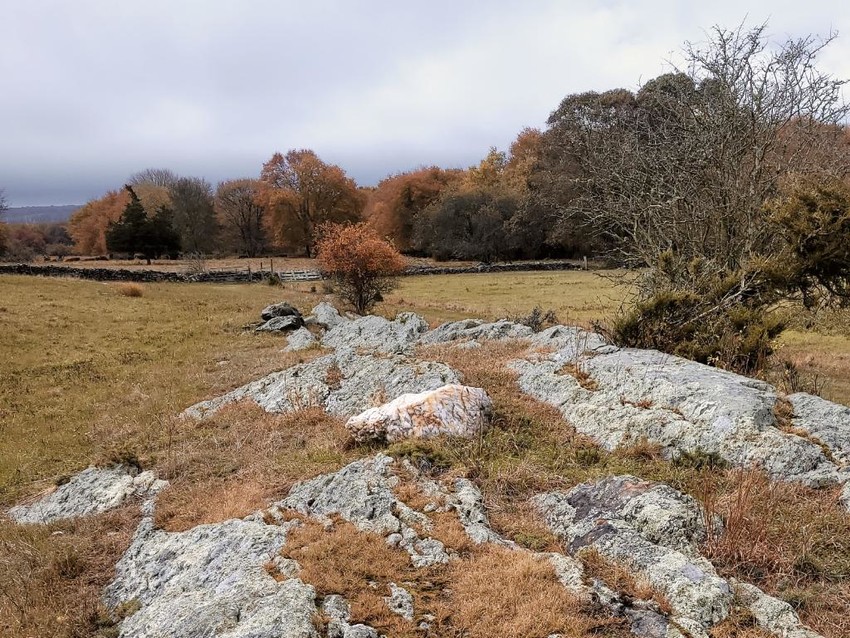 Continuing on the Long Loop, a large outcropping of stone may rise above the grasses as you look toward the bay shore. This is puddingstone, one of the oldest geological formations on Conanicut Island. This conglomerate rock is roughly 620 million years old and was once part of a great mountain range that gradually eroded and became the bedrock underlying the land. About 12,000 years ago, the glaciers carved out the bay and landscape we see today and left plenty of rocks for farmers to pick out of the fields as they plowed in the beginning of the agricultural season and built into stone fences at the end of it.
The earliest record of stone fences on this land was in 1681 when Governor Peleg Sanford notified the town he intended to have them built. The wall pattern we have today could very well reflect those 1681 pastures. Peleg Sanford led the Rhode Island Militia and served in King Phillip’s War. This conflict had terrible implications for Indigenous people across New England, and many of them were enslaved as a result, including on Jamestown. The Sanford family were all directly involved with plantations in the West Indies, and Peleg spent some time living in Barbados. Though the historical record is vague about who was working the land in this time period, tenant farmer Michael Kaly may have still been active, and there may have been enslaved people of color employed, including Pequot and Narragansett people. Many Indigenous people were skilled in stonework and could have had a hand in building walls here.
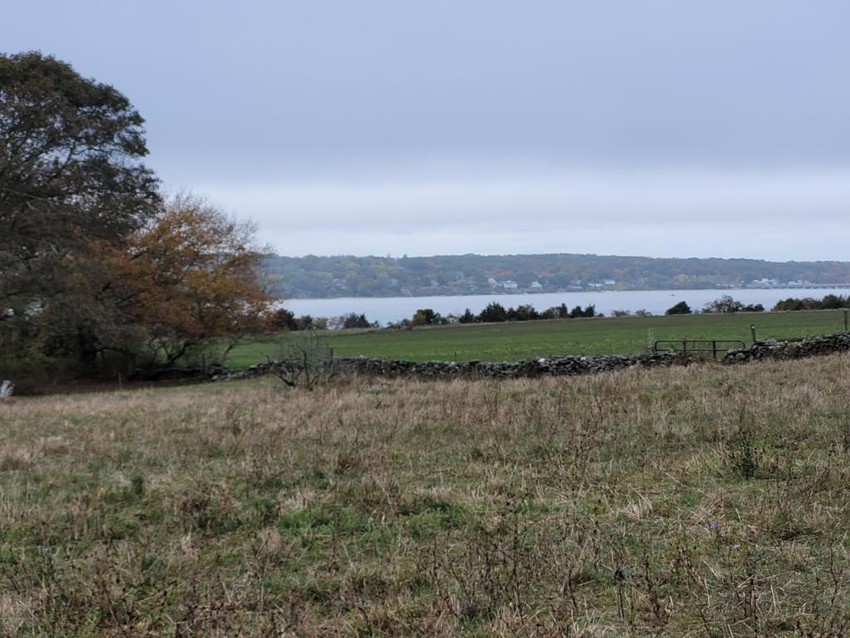
Head west toward the water and you will have the old orchard and then the wetlands to the south of the path, and pastures to the north. Especially during the hottest summer months, the shade and water sources here are important to support the herd of cattle. Across the West Passage of Narragansett Bay is the mainland with the village of Saunderstown where our sister property, Casey Farm, is located. You may be able to spot its white farmhouse and shingled barns. If you find any gates that lead to the shore closed, please close them securely after you. The path leads briefly south once you near the beach, and a steep gully brings you down to the shore of Narragansett Bay. If it is high tide, you may not be able to cross the whole beach to continue for more than a mile and a half on the Long Loop. Some people like to head back up the same way and then take another branch of the Short Loop which is just about a mile back to the barnyard.
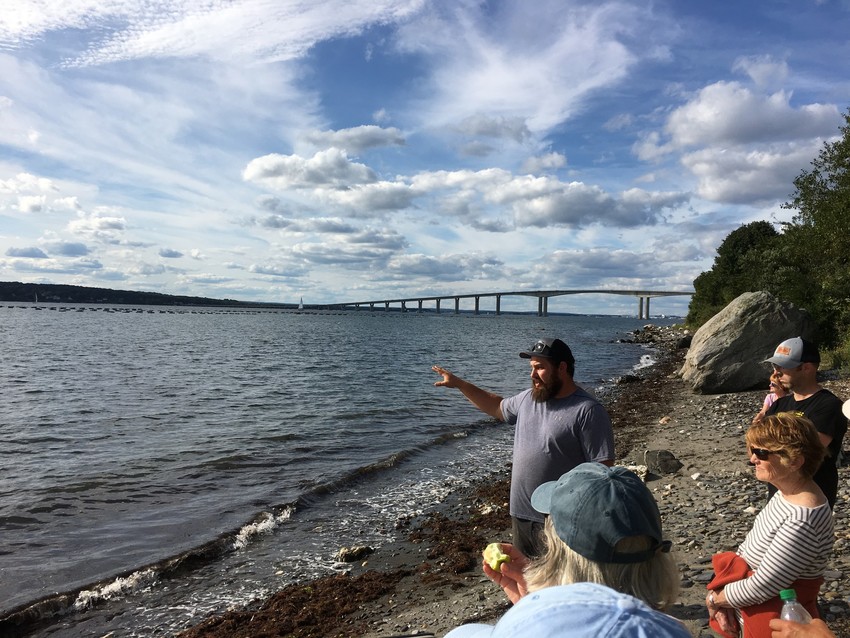
The rocky beach has rounded pieces of dark and shiny shale and a big boulder of white quartz, time-worn sea glass and brick, and shells of sea creatures like slipper shell snails and the large quahog clamshells prized for making purple and white wampum. Indigenous people made wampum beads by hand, a time-consuming process that required great skill, to give as gifts of respect. Offshore, you may see the floating oyster farm that takes advantage of the current that provides the growing shellfish with nutrients. Just to the south is Dutch Island, part of the Town of Jamestown, so named because the Dutch West India Company established a trading post with the local Native people around 1636. You might be able to spot the ruins of Fort Greble, a Civil War fort and training site for the 14th Rhode Island Heavy Artillery made up of soldiers of color. The fort was decommissioned after World War II and the island is now a wildlife management area owned by the State of Rhode Island.
Farther south leading out to the Atlantic Ocean is the rest of Conanicut Island called Beavertail, while west across the bay are the towns of North Kingstown and Narragansett. Looking north you have the neighborhood of Jamestown Shores and a great view of the Jamestown Verrazzano Bridge. For most of the farm’s existence, the best means of transportation was by boat or ferry. Many fishing and pleasure boats still travel the bay. A bridge was not built until 1940, and this is the second one which was completed in 1992.
If the tide is low enough, you can continue south down the beach until the Long Loop picks up again where the wetlands end, or go back the way you came and perhaps take a different path back to the barnyard which is just under a mile.
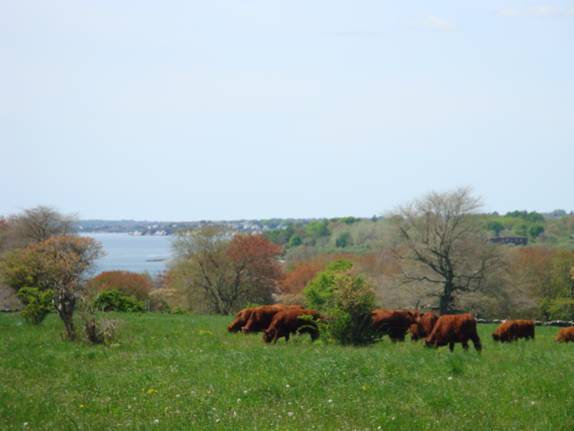
The farm’s varied landscape of fields, woods, wetlands, and hedgerow offers home for wildlife. This abandoned apple orchard attracts butterflies and other insects, small mammals, harmless reptiles, and some deer. Birds flourish on many parts of the farm. Depending on the time of the year, you may see redwing blackbirds, killdeer, woodpeckers, bobolinks, swallows, sparrows, brown-headed cowbirds, goldfinches, orioles, robins, hawks, turkey vultures, osprey, and glossy ibis, as well as migratory songbirds in spring and fall.
For Indigenous people, the island was rich with resources for food, shelter, and medicine. Archaeology tells us that it is likely Indigenous people about 4,500 years ago returned seasonally over many years to the land now called Watson Farm to harvest tree nuts like walnuts and beechnuts and to make tools from stone such as white quartz.
That this open landscape has survived is notable. Orchards covering more than an acre are listed in land records from the mid-eighteenth century and were an important source for apples and cider. Later in the eighteenth century, when Job Watson applied for settlement in Jamestown he was nearly denied for fear he would become a burden on the town. Within two decades he was the largest landowner on the island. He and his son Robert worked hard to remove invasive briers and bushes, just as our farmers continue to do today. The last family owner, Thomas Carr Watson, Jr., nearly sold the land in the 1950s to be subdivided, but changed his mind in favor of preservation and donated it to Historic New England in 1979.
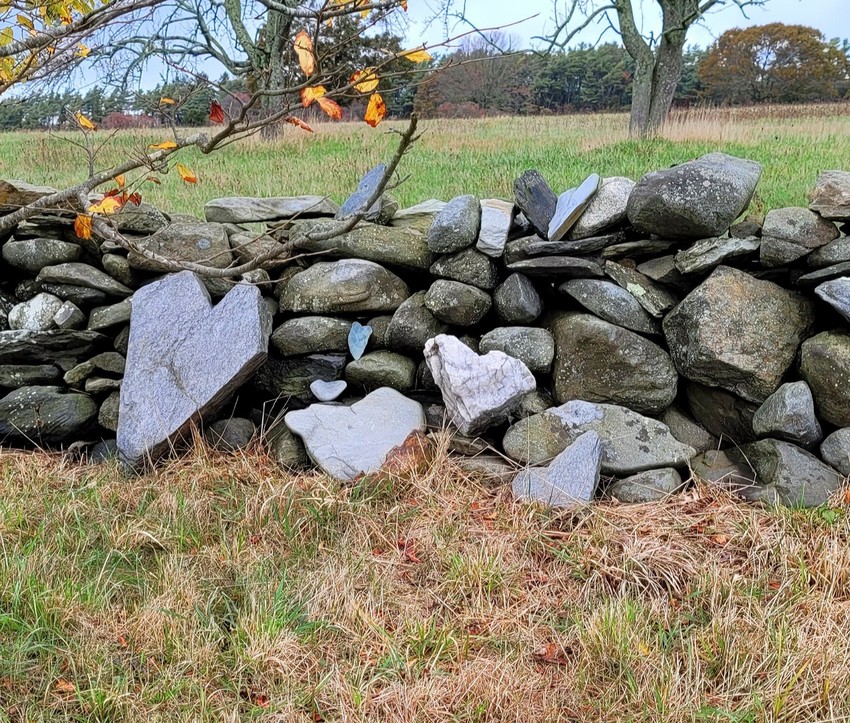
If you are taking the Short Loop you are close to the central east-west stone fence. Near the wall you will see a granite bench and ornamental trees which were planted to honor the memory of a farmhand who once worked here, Ian Krebs. If you are taking the Long Loop you are closer to the farm’s southern border with Hodgkiss Farm. The two farms were joined in ownership twice in their history but have been separate since the late eighteenth century. Inspired by Watson Farm, the families that own the surrounding farms have also protected themselves from development through the Conanicut Island Land Trust keeping more than 1200 acres of working farmland in Jamestown.
The extensive hayfields on this part of the farm are planted with a mix of grasses (timothy, fescue, June grass) and legumes (clover, alfalfa, vetch, and trefoil) which make up the wintertime diet of the herd and flock. The hay harvest is an important agricultural activity that can take place up to three times in the growing season from June through October. Farmers look for five days of clear weather before mowing, drying in the sun and tedding (spreading out and turning over), raking into rows, and then rolling into 800-pound bales. A sudden storm can ruin the hay if the wet product is allowed to rot in the field, or it might even cause spontaneous combustion if bales are rolled wet.
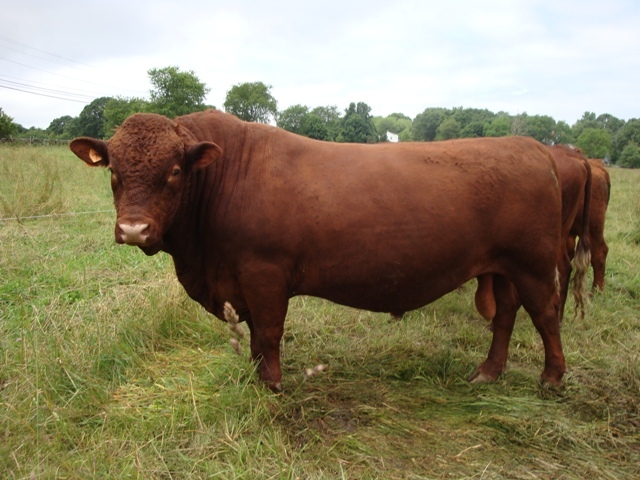
Two bulls are often kept in this corner of the farm where the Short Loop and Long Loop meet and lead back toward the barnyard to the north. The bulls are let into the same field as the cows in the autumn. The farm managers are cooperating in an international project to revive the heritage breed Red Devon cattle.
Starting in 1687 and for the next fifty years, Stephen and then son Gershom Remington leased the land from the wealthy landowners to raise livestock and probably built the first farmhouse which records suggest may have been near the south border. Stephen served in many official capacities and hosted the town’s quarterly meetings in the farmhouse. In 1708, he was granted an innkeeper’s license for this central location on the island. Gershom continued to serve the town and managed the farm for pasture, crops, hay, and an orchard. His prosperity was due to at least seven enslaved people listed in town records.
One of these enslaved people was a Black man named Orman Remington. Orman, perhaps by working outside of his farmhand duties to Gershom, was able to pay “100 Spanish silver milled dollars” for his freedom in 1781. Two years later, he purchased the freedom of his wife Cate and children Jenny (8), Acuba (3), and Sue (9 months) from a nearby farm. He bought a home for them, becoming the first Black man to own land in Jamestown. We know his story today because his grandson, Henry O. Remington, documented it as part of his work as an abolitionist in New Bedford.
Don and Heather Minto planted a pollinator meadow to support beneficial insects like bees that are crucial to agriculture. They help the nearby vegetable plot to flourish. Farm staff and volunteers cultivate this plot as a demonstration garden and for their own enjoyment. The Short Loop leads to the barnyard to the north, or continues for less than a mile starting south from here.
This part of the farm is where you often see the flock of sheep. With no natural predators and little way for the animals to escape, islands were ideal for grazing animals in the eighteenth century. Wool and mutton would become staples of the economy for the next 250 years. The sheep is still on Jamestown’s flag and seal today. The tradition continues at Watson Farm, with a mix of heritage breeds: Romney (with brown wool) crossed with Texel (with white wool) and other British breeds for black wool, strong bodies, and good maternal instincts. Heather Minto, a fiber artist and one of the resident farmers from 1980-2020 who re-introduced sheep at Watson Farm, called them “South County Specials.” Their wool is prized by spinners and weavers because it does not need to be dyed. We bring our wool to New England mills to be made into accessories and blankets.
Your journey around Watson Farm has either ended or just begun, and we hope that you will visit again to witness the seasonal cycles of the farm. We thank you for supporting the farm through your visit. Visit again for free if you increase your support by becoming a member of Historic New England, and if you are already a member, we are grateful.
Sign up to our newsletter for our latest news and events