
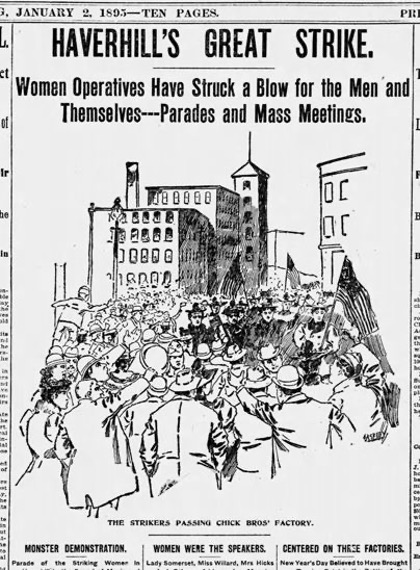
The 1890s were turbulent years in New England—and Haverhill, Massachusetts, was no exception. Following the financial panic of 1893, the “Queen Slipper City” quickly felt the effects of the national economic decline. At that time, Haverhill’s booming factories produced ten percent of the country’s shoes, employing a workforce of over 11,000 men and women engaged in cutting, stitching, lasting, trimming, and packing at over 230 factories. When the economy struggled, however, consumer demand for shoes decreased. An unexpected increase in the cost of leather cut further into profit margins, and employers quickly turned to several austerity measures to recoup their losses. They initiated a wave of lockouts, firings, and unfair “ironclad” contracts while allowing working conditions to decline, leading to a massive general strike in 1895 in which over 3,000 shoe workers left the factories in protest.
The strike was a warning for the local government. Haverhill’s workers wanted more for themselves and their families. They wanted better alignment with national unions, and they wanted the local government to recognize their needs more responsively. It was an ideal moment for advocates of municipal socialism to find a voice, and one of the first to make themselves heard was James P. Carey.
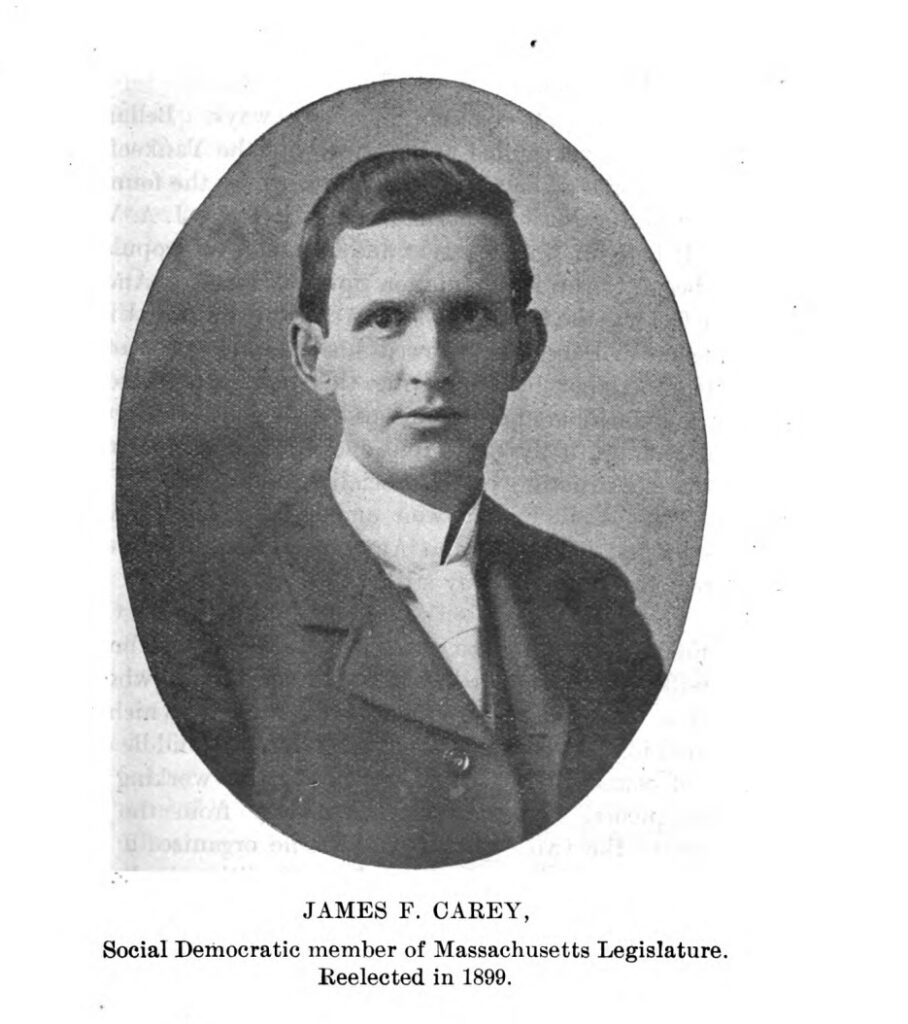
Carey, born in Haverhill to Irish parents, helped lead the Great Shoe Strike, organizing what The Boston Globe called a “Monster Demonstration” of over 1,500 workers who marched past the factories on River Street on New Year’s Day in 1895. A lifelong shoe worker himself and a charismatic speaker, Carey was the first to address the crowd of strikers that afternoon. He spoke pointedly to women’s equal participation, declaring, “Wax dolls are good and they do not strike, but it is better that women be good for something and that they do not stand idly by and see their brothers beaten down by themselves by a club in the hands of the capitalists.” The crowd cheered wildly when he asserted that the ironclad contract system directly opposed the Declaration of Independence and by the time he left the stage, all of Haverhill’s striking workers knew Carey’s name.
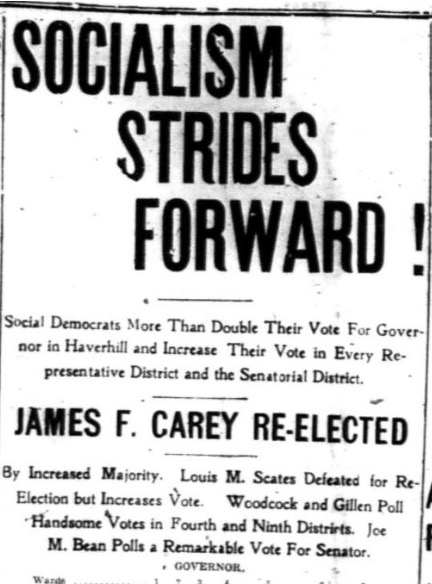
First a populist and then a nationalist, Carey’s time working in Haverhill’s shoe factories eventually exposed him to a wide range of socialist thought. The revolutionary doctrines that swept across Europe during the nineteenth century found their way to factory floors in New England, where workers were influenced by the writings of Karl Marx and Friederich Engels. Driven by a strong belief that workers should have some ownership of production systems, Carey had previously helped to organize the Haverhill chapter of the Socialist Labor Party (SLP) and had been elected to the Haverhill City Council on their ticket in 1894. After the strike in 1895, he ran for mayor as an SLP candidate and although he did not win, he took a six percent of the vote, which was a significant advance for the socialists.
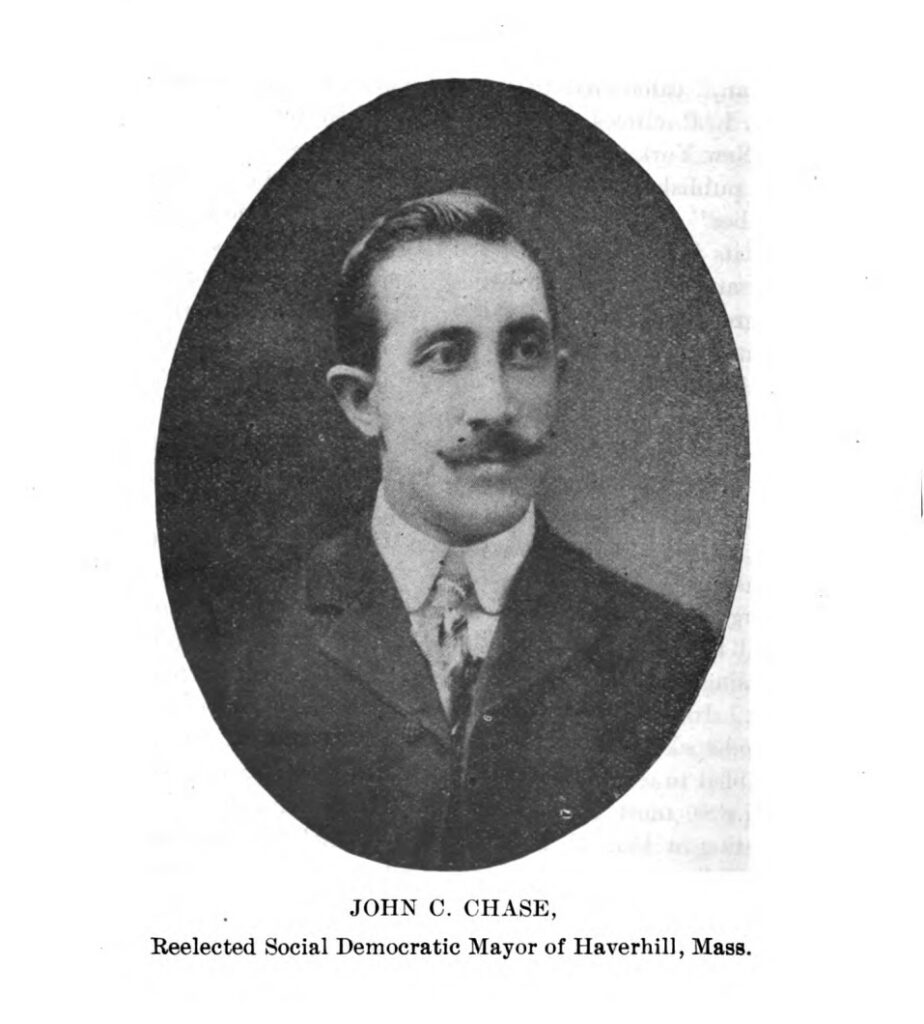
A public scandal occurred soon after the strike concluded, when several local aldermen were convicted of “boodling,” or selling illegal liquor licenses for personal gain. The trial provoked widespread disgust at establishment politics in Haverhill. Capitalizing on the moment, the SLP advanced another prominent local socialist, John C. Chase, to pair with Carey and work together on a strategy to bring Haverhill city government under socialist control. Chase was a New Hampshire native who had worked in factories since childhood. He already had a good deal of labor organizing experience, having joined the Boot and Shoe Workers Union several years earlier and served as a delegate at their annual convention. As a result, he was blacklisted when he arrived in Haverhill in 1890 and was unable to find work in the shoe industry. He instead worked at a cooperative grocery store and started the Haverhill Social Democrat, a newspaper which soon became a voice for the working class in the city.
Together, Carey and Chase strategized and ran a strong campaign for election to the Common Council in 1897. While Carey won a seat and Chase did not, they pressed forward for the SLP. The next year, Chase successfully ran for mayor of Haverhill. At the same time, Carey won a seat on the State Legislature, bringing with him a progressive agenda that reached even further towards socialist governance and nationalized public utilities. Although James Carey’s appointment gave him a broad platform for advocacy, John C. Chase’s victory brought Haverhill the national distinction of having the first socialist mayor ever elected to office.
The early twentieth century was central to Haverhill’s story of intertwined labor and socialism. Eugene Deb’s Socialist Party of America emerged, advocating radical inclusivity as a path to success and bringing in previously overlooked factions. Socialist candidates soon won seats on the city council and the school committee, and although the national labor campaigns of the early twentieth century brought strikes to Haverhill through the mid-1930s, the city flourished as it increasingly adopted socialist principles. Bolstered by a strong working-class population and a hard-won but steady rise in job satisfaction, Haverhill’s population and property valuation increased through World War I. Clubs and reading groups, as well as benefit and educational societies continually sprang up throughout the city, further empowering workers and their families.
Newly-arrived immigrant groups settled into cohesive neighborhoods and formed cultural bonds while also finding acceptance in the broad embrace of socialist-led labor unions. The socialist city government of Haverhill successfully pushed through policy initiatives around healthcare, education, utility services, municipal projects and child labor. Haverhill’s “old” political corruption was largely eradicated. After his term as mayor, Chase turned his eye to the national scene; he made gubernatorial bids in Massachusetts and New York and ran for congressional seats in West Virginia and Ohio, all without success. Carey remained in Massachusetts, an active, devoted, and sometimes outspoken socialist who served in many capacities, including as the party’s state secretary.
Despite its successes, the course Haverhill charted through socialism at the turn of the century faced challenges and opposition. The general fear and hostility directed at socialists as “wild radicals” persisted even as socialist organizations worked to improve the lives of workers across the country. Practical and theoretical divisions within the larger socialist movement sometimes threatened the unity that was so essential. The labor wars of the early twentieth century were often violent, with tragic human costs preceding worker’s rights as we know them today—but nowhere in America was the idea of a socialist utopia closer than in the streets and factories of Haverhill, led by stubborn visionaries like James Carey and John C. Chase.
Written by Eleanor Martinez-Proctor, Study Center Research Fellow
Photos of Carey and Chase are from Frederic Heath, Social Democracy Red Book: A Brief History of Socialism in America. Terre Haute: Debs Publishing Co., 1900. Courtesy of HathiTrust.
Sign up to our newsletter for our latest news and events