
At the height of the industrial era, Massachusetts’s booming shoe factories were simultaneously engines of progress and sites of deep inequality. Amid the noise of machinery, women workers began to organize and demand change. In the winter of 1913, Haverhill was in the thick of decades of labor struggles. Although the city’s shoe industry was booming, it had already experienced seven major strikes, and there was no end in sight as tensions mounted between factory owners and unions. That January, the Witherell & Dobbins shoe factory on Essex Street became the site of the city’s next labor dispute. The company was accused of a variety of misdeeds toward its employees, including blacklisting, poor working conditions, and low wages. Women, who made up much of the shoe-stitching workforce, figured prominently in the strike and in the accompanying lawsuit. When negotiations faltered, they received crucial support from another woman: a union agent named Julia Lyons, whose steady leadership soon earned her a place among the top ranks of New England’s labor organizers.
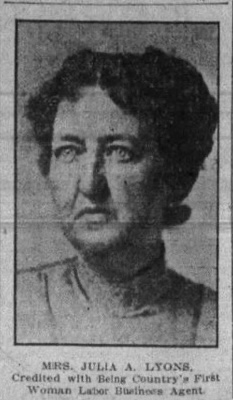
Julia’s life began in modest circumstances. She was born Julia Ann Drynan on January 1, 1859, to Morris and Catherine Drynan in Salem, Massachusetts. The Drynans soon moved to Lynn, where Julia and her two siblings were raised. Morris was a laborer who died by the time Julia reached her early twenties, after which the family worked in the shoe industry to support themselves. In 1887, Julia married a fellow shoe worker named Martin Lyons. Martin was also a well-known local athlete—an oarsman who rowed for the Father Mathew Society and a member of the Farragut Boat Club’s much-lauded champion crew, which competed on the Merrimack River. The couple lived in Lynn’s crowded Third Ward, a neighborhood of factory workers like themselves whose struggles mirrored those of the workers in Haverhill. Martin worked as a stock fitter, cutting and preparing raw leather for shoemaking. Julia, like many women, worked at the other end of the process, operating small finishing machinery for heels and buttonholes.
As a part of the industrial workforce, Martin and Julia would have witnessed the growing influence of labor unions and the power of collective action in the first decade of the twentieth century. In 1908, Julia extended her interests beyond the factory floor by helping to organize the local Buttonhole Operators, Finishers, Buttoners, and Eyeletters Independent Union, a local affiliate of the Amalgamated Clothing Workers of America and composed primarily of women. Led by Mrs. Carrie B. Horne, with Julia as secretary, the union became a strong force in Lynn’s labor movement. Together, they negotiated contracts and hosted community events to unify and empower local workers, quickly improving shop conditions and doubling their salaries.
In 1911, Julia’s life took a sudden and tragic turn when her husband died by suicide. The couple had no children, and Julia never remarried, but whether by wish or necessity, her pace did not falter and in the following years, she dedicated herself even more fully to labor organizing.
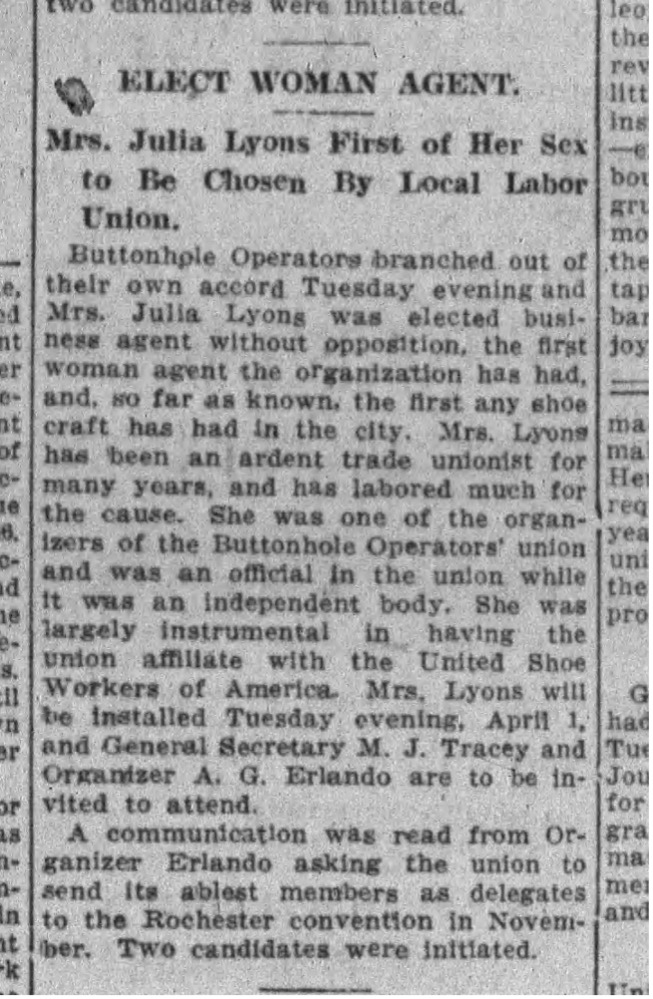
In 1913, she heard about the stitchers, cutters, and lasters from the United Shoe Workers of America union striking the Witherell & Dobbins factory in nearby Haverhill. More than forty workers, many of them women, eventually testified in court about unfair and abusive treatment by the company. Julia soon became involved in organizing and educating the strikers, as well as making appeals to other unions for support. She was chosen as a member of her union, along with two men from other local unions, to form an advocacy committee to canvass local workers and talk with them about successful strike strategies. By the time the strike concluded, Julia had been elected the business agent of the Buttonhole Operators Union, representing members’ interests on the ground, enforcing contracts, assisting with grievances, and helping with negotiations. She was reportedly the first woman in the country to have earned such a position: a local newspaper reported, “Mrs. Lyons enjoys a unique and distinct honor in being the pioneer among the women labor agents.”
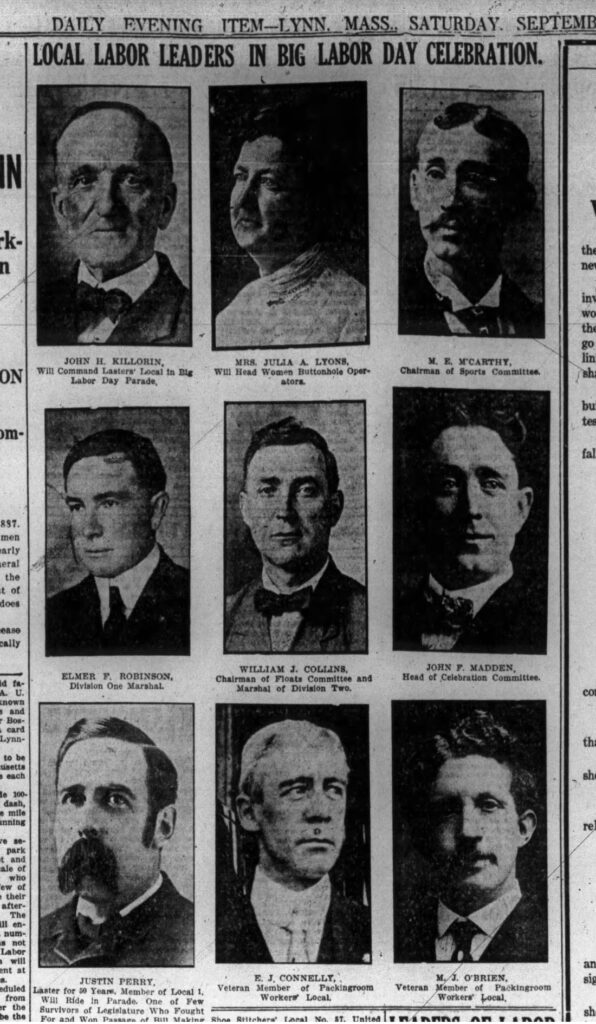
After her first term, Julia was reelected unanimously. She stayed on the board of the Buttonhole Operators Union and later served on the executive board of the Women’s Stitchers Local 57. Known as a powerful labor leader, she organized workers’ efforts and supported local political campaigns. During labor unrest after World War I, she helped hold unions together, filing legal actions in 1919 and 1921 against factory owners who hired non-union workers. She fought to enforce agreements, win better pay, and secure union control over hiring. Julia earned widespread respect in a turbulent time and in a field still dominated by men.
Julia Lyons died in 1922, and her life was defined by her activism. Her legacy continued on in the thousands of workers whose lives were improved by her vision, dedication, and tenacity. As one of the first women to hold a major union office in New England, she helped pave the way for generations of women labor organizers who followed.
Written by Eleanor Martinez-Proctor, Study Center Fellow
Sign up to our newsletter for our latest news and events