
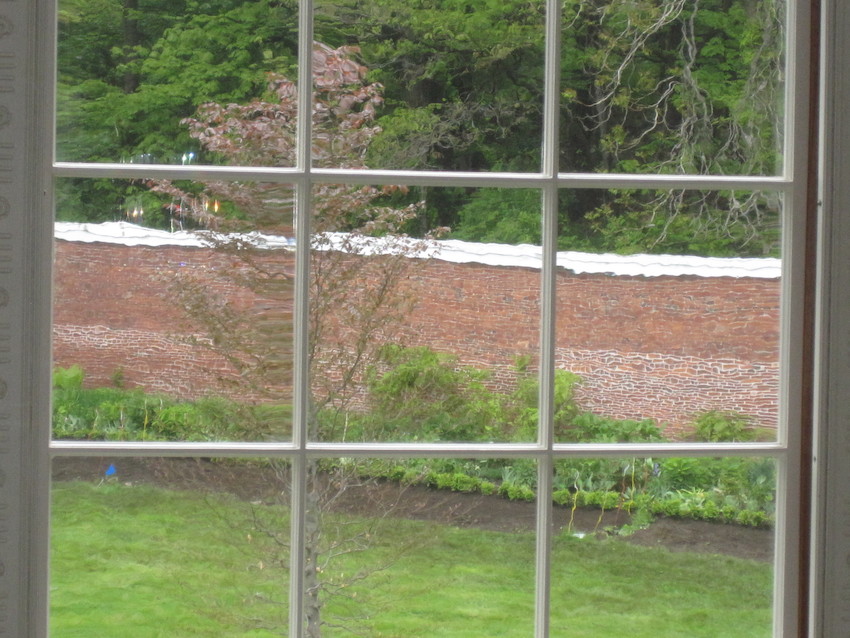
“Old glass, so easily overlooked and so easily broken, is the most fragile architectural legacy we have from the 18th and 19th centuries.” – James L. Garvin, A Building History of Northern New England
In the eighteenth and nineteenth centuries, window glass was not a flat sheet but a “gather” of molten glass on the end of a glassblower’s pipe, later shaped by one of two handmade methods. The first step of the first method, crown glass, was to blow the gather into a hallow globe. A glassblower would then attach the globe to a punty (an iron rod) and remove it from the blowpipe. Where the glassblower would remove the blowpipe, a hole would form a bowl-like shape. The glassblower would repeatedly heat and spin the bowl until it formed a disk between four and six feet in diameter.
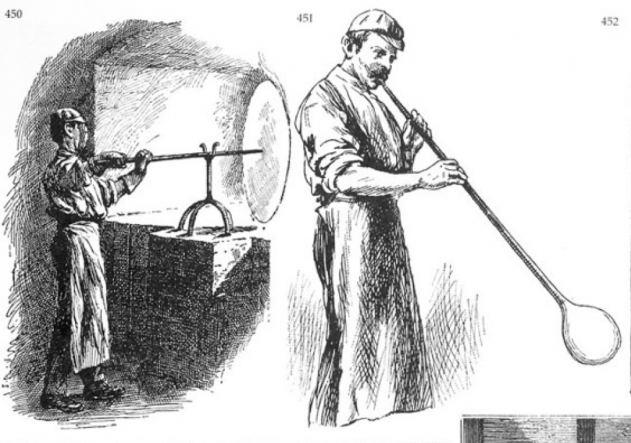
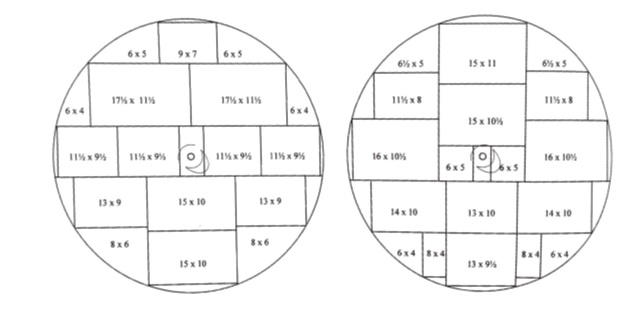
One of the drawbacks of crown glass was the limited number and size of rectangular panes that could be cut from the disk shape as shown below. It is common to see diamond-shaped panes in early casement windows because more diamonds could be cut from the circular shape than the rectangles in the diagram below. The removal of the glassblower’s punty resulted in a distinctive bullseye mark at the center of the disk. This blemish was sometimes used as a decorative feature in windows or door transoms.
The second method, cylinder glass, began in the same way as crown glass, except the hollow globe was elongated into a cylinder shape by heating, blowing, and swinging in a deep trench. This process repeated until the cylinder measured approximately ten inches in diameter and four to five feet in length. After removing the blowpipe, the glassblower would split the cylinder along its length and flatten it on a table top.
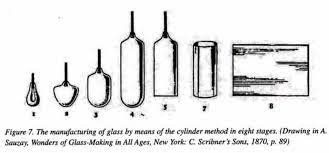
Cylinder glass was a more efficient method that resulted in less waste when cut and allowed for larger sheets of glass. However, it lacked the clarity of crown glass due to the flattening process on a table top. Because crown glass did not require any surface contact, the resulting panes were noted for their clarity, brilliance, and reflective quality at the time. Craftsmen produced crown and cylinder glass simultaneously through the nineteenth century until rendered obsolete by mechanization in the early twentieth century.
The distinctive patina of crown and cylinder glass is not the result of time but the handmade methods used to create it. Both of these methods resulted in an uneven, wavy surface that varied in thickness and could include inclusions and tool marks. Be sure to look out for the distinctive appearance of handmade glass at your own home or the next time you visit a Historic New England site.
Written by Leigh Schoberth, Senior Preservation Services Manager
Sign up to our newsletter for our latest news and events