undated
HAV-01-403-Z-G-211
GUSN-361676
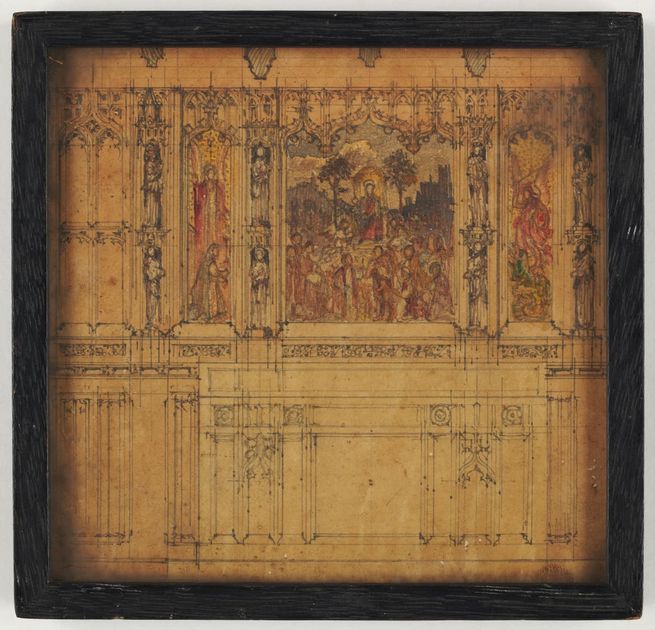
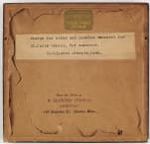
Framed design drawing for alter and reredos memorial for St. Pauls School by architect Richard Clipston Sturgis. The design was not executed, and the location of the church is unknown. The design drawing is undated. A gold sticker attached to the top of the frame's verso reads: "FOSTER BROS. / 4 PARK SQUARE / BOSTON." On the verso of the frame, the following is typed in the center: "Design for altar and reredos memorial for / St. Pauls School, Not executed. / R. Clipston Sturgis, Arch." The following is stamped on the bottom of the frame's verso: "From the Office of / R. CLIPSTON STURGIS / ARCHITECT / 120 Boylston St., Boston, Mass."
design drawings
altars (religious building fixtures)
reredoses (screens)
churches (buildings)
religious art
religious buildings
Christianity
iconography
architectural elements
design drawings
frames (furnishings)
pencils (drawing and writing equipment)
watercolor (paint)
FOSTER BROS. / 4 PARK SQUARE / BOSTON. (Applied)
Design for altar and reredos memorial for / St. Pauls School, Not executed. / R. Clipston Sturgis, Arch. (printed)
From the Office of / R. CLIPSTON STURGIS / ARCHITECT / 120 Boylston St., Boston, Mass. (stamped)
1 framed design sketch : color illustrations ; 6 x 6 1/4 inches
AR001
General architectural and cartographic collection
2023
AR001.UNK.036
Library & Archives Purchase
Library & Archives purchase, 2023
Boston (Suffolk county, Massachusetts)
Sturgis, R. Clipston, 1860-1951 (Architect)
design drawings
frames (furnishings)
pencils (drawing and writing equipment)
watercolor (paint)
Foster Brothers
Art
Architecture
Item
HAV-01-403-Z-G-211
Richard Clipston Sturgis was born December 24, 1860 in Boston Massachusetts to Russell and Susan Codman (Welles) Sturgis. He studied at George Washington Copp Noble's boys' day school known as Noble's Classical School, now known as the Noble and Greenough School. In 1877, he entered Harvard college and graduated in 1881. He studied architecture from 1881-1883 in Sturgis & Brigham, the office of his uncle John Hubbard Sturgis, at 19 Exchange Place. During this time, he married Esther Mary Ogden (1861-1935) of Troy, New York. The couple one surviving son, Richard Clipston Sturgis Jr. (1884-1913), and one daughter, Dorothy Margaret Sturgis (1891-).
In 1884, he had the opportunity to travel to London and work for architect Robert William Edis. He spent a period traveling before returning to Boston after his uncle dissolved his partnership in 1886 to assist in running the office. Sturgis was left in charge in 1887 when his uncle returned to England. In February 1888, he succeeded to the practices following his uncle's death. In May of 1888, he formed a partnership with William Robinson Cabot known as Sturgis & Cabot. This partnership dissolved in May 1895. Sturgis worked alone until 1902 when he formed a partnership with George Edward Barton known as Sturgis & Barton. It was at this time the offices were moved from Exchange Place to 120 Boylston Street. In 1908, this partnership dissolved, leaving Sturgis as the sole proprietor until 1922, when he reorganized the firm as The Office of R. Clipston Sturgis, with William Stanley Hall, William Adams, William B. Coffin, S. Winthrop St. Clair, and his nephew, Alanson Hall Sturgis, as associates. He retired in 1932, and the firm was reorganized as Sturgis Associates Inc. with Parker as the head of the firm. He died May 8, 1951 in Portsmouth, New Hampshire.
Some of the architectural and other works Sturgis designed over the course of his career were the Lewis Cabot Estate in 1894, the Windsor School from 1909-1910, the Perkins School for the Blind campus from 1910-1911, the Boston Common Tablet in 1913, the former Federal Research Bank of Boston Building from 1920-1922, and the original Charles station from 1931-1932. The vast majority of architectural works over the course of his career reside in New England.
Historic New England is committed to implementing reparative language description for existing collections and creating respectful and inclusive language description for new collections. If you encounter language in Historic England's Collections Access Portal that is harmful or offensive, or you find materials that would benefit from a content warning, please contact info@historicnewengland.org.
Sign up to our newsletter for our latest news and events

 Loading...