1827-1890
HAV-01-403-Z-K-203
GUSN-358375
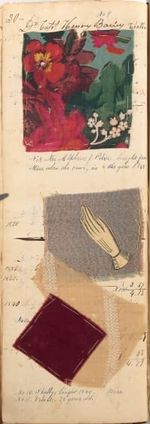
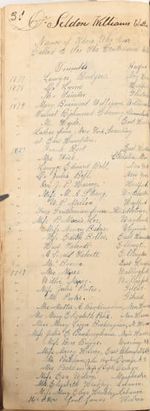
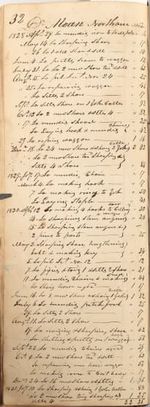
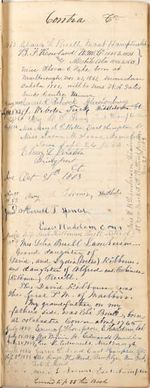
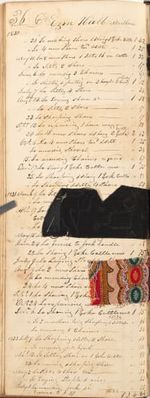
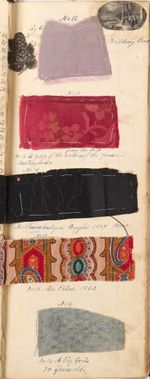
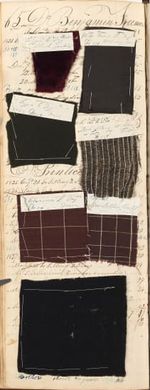
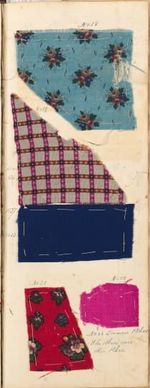
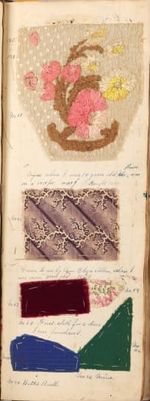
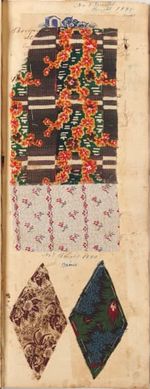
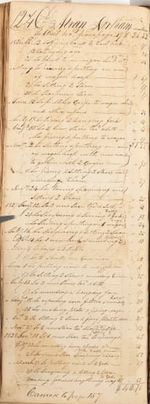
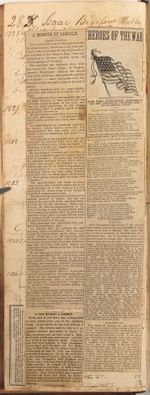
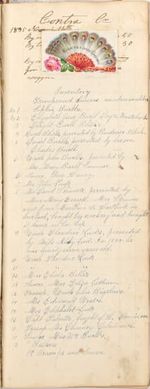
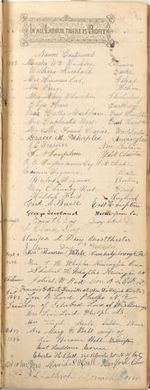
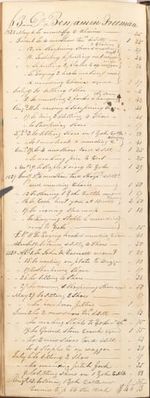
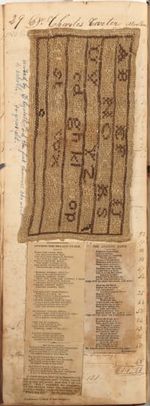
This book is a hybrid document, with entries made between 1827 and 1890 in the town of Marlboro (now Marlborough), Connecticut. Initially, this was account book for blacksmith and foundry owner William Wadsworth Richmond (1797-1843). His account book spans the 1820s through 1840s. His portion of the account book is almost entirely within the dates of 1827 to 1843, but a couple accounts are settled (perhaps by another hand) in 1844. In 1877, Sophia Buell (1816-1900) started using the book as the base material for a scrapbook, writing in free spaces and attaching clippings from periodicals and swatches of fabric on top of existing account information. This item is an iteration of a sewing diary, although it is unique in its focus on the broader local and national news and history rather than Buell's individual sewing projects. Materials found within the item are ink, paper, cotton, linen, silk, feather, grass, unidentified hair or animal fiber. Bookmarks are not period, but added in 21st or late 20th century.
Locations mentioned include: Marlborough, Connecticut; Chatham, Connecticut; Colchester, Connecticut; Glastonbury, Connecticut; East Wadham, Connecticut; Norwich, Connecticut; South Hampton, Connecticut; and New York, New York. Individuals mentioned in the book include: Elijah Foote; George Foote; Hiram Foote; William L. Foote; Mrs. Eunice Foote; Huldah Foote Brainard; Deacon David Skinner; Prentice B. Skinner; John Tubbs; Captain Augustus Blish; Delight Buell Blish; Roger Blish; Daniel Buell; Enos Buell; Elisha Buell; Effie Buell; Isaac B. Buell; William Buell Jr.; Esther Buell; David Buell; Harriet Buell; Abigail Buell; Mary Buell Sumner; Mrs. Margaret Bigelow; Seth G. Bigelow; John Bigelow; Ira Bigelow; Anne Bigelow; Roswell Bolles; Horatio Bolles; Flora Sumner Bolles; Lizzie Sumner Allen; Jane E. Day; Susan Day; Lizzie G. Day; Mrs. Daniel B. Day; Clarissa L. Day; Lazerous Waitrous; Jeremiah H. Taylor; Richard Coleman; David Phelps; Sarah Ann Phelps Holmes; Rev. Chauncey Lee; Captain Jonah Root; Ozen Carrier; Henry Jones; Augustus Floyd; Epaphras Lord; Ogden Lord; David Lord; Almira Lord; Mrs. David M. Lord; George Lord; Charles Lord; Captain Moseley Tallcott; John C. Snow; Ogden Wilson; George R. Beach; Ralph B. Clark; Joel Archer; Dr. George Hunt; Sylvester C. Dunham; Emma C. Whittemore; Dr. Jessey Kellog; Newbury Darling; Benjamin Freeman; Bordil Nealson; Mary Veazey; Mrs. Warren Veazey; Isaac Hayling; Mrs. Amos Latham; Eliza Latham; Benjamin Root; James Goodwin; James C. Floyd; Eliza Carter Warner; Charles Carter; Mrs. Charles Carter; Laura A. Carter; Francis Carter; Henry Dickinson; Alfred Kellogg; Gilbert Saunders; Ann Eliza Allen; Lydia Owens; Pomeroy Hall; Lucretia Munson; M. Elizabeth Peck; Martha A. Buckinham; Allan Northam; Mrs. Ira Hays; Warren Warner; Lucy Kilbourn; Mary Wilson; Kate Curtis; Mary Ann Strong; Lizzie Hosford; Mrs. Lyman Brown; Honorable B. Bondman; Miss Louisa Huntington; Rev. David Huntington; George Washington; Abraham Lincoln; John Quincy Adams; Chester A. Arthur; James A. Garfield; and Rutherford B. Ha yes and his wife Lucy Webb Hayes.
scrapbooks
account books
sewing (visual works)
histories
towns
clippings (information artifacts)
textiles
diaries
historians
scrapbooks
account books
ink
paper (fiber product)
cotton (textile)
linen (material)
silk (textile)
feather (material)
grass (plant material)
hair
bookmarks
clippings (information artifacts)
1 combined account book and scrapbook
MS004
Scrapbooks collection
MS004.059
Marlborough (Hartford county, Connecticut)
East Hampton (Middlesex county, Connecticut)
Glastonbury (Hartford county, Connecticut)
Colchester (New London county, Connecticut)
Norwich (New London county, Connecticut)
Hampton (Windham county, Connecticut)
New York City (New York state)
Richmond, Williams Wadsworth, 1797-1843 (Blacksmith)
Buell, Sophia, 1816-1900 (Compiler)
scrapbooks
account books
ink
paper (fiber product)
cotton (textile)
linen (material)
silk (textile)
feather (material)
grass (plant material)
hair
bookmarks
clippings (information artifacts)
Foote, Eunice, 1819-1888
Buell, Elisha Lewis, 1792-
Buell, Abigail, 1779?-
Chauncey, Lee, 1763-1842
Huntington, David, 1745-1812
Huntington, Louisa, 1790-1881
Washington, George, 1732-1799
Lincoln, Abraham, 1809-1865
Adams, John Quincy, 1767-1848
Arthur, Chester Alan, 1829-1886
Garfield, James A. (James Abram), 1831-1881
Hayes, Rutherford B., 1822-1893
Hayes, Lucy Webb, 1831-1889
Sewing
Book
Very fragile. Front and back cover are close to separating from book. Handle with care.
Item
HAV-01-403-Z-K-203
Materials are entirely in English.
This item was initially an account book for William Wadsworth Richmond (1797-1843). Richmond was a blacksmith and shop and (eventually) foundry owner in Marlboro, Connecticut. His account book spans the 1820s through 1840s (covering the Panic of 1837, which would bring his son, later coal magnate William H. Richmond, home and prompt him to join the family business). William W. Richmond died May 31, 1843. His portion of the account book is almost entirely within the dates of 1827 to 1843, but a couple accounts are settled (perhaps by another hand) in 1844.
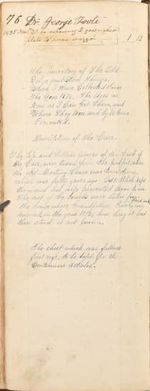
Sophia Buell's (1816-1900) interventions begin in 1877 and continue until her death, in 1890. Richmond's account book is rather straightforward, showing the interconnectedness of the town and documenting this industry in Connecticut. Sophia Buell's work is less straightforward. Beginning in 1877, she started using the book as the base material for a scrapbook, writing in free spaces and attaching clippings from periodicals and swatches of fabric on top of existing account information. She calls the book a record of "The Oldest Articles She Could Collect, for A Memento of Persons, Which Is to Be Kept for Ages to Come, to See The Changes from Generation to Generation." Her scrapbook is a complex accounting of the history of her family and her town. She has a list of objects that she has solicited from town members in a section entitled: "The Inventory of the Old Relics and Other Things, Which I have Collected Since the Year 1876, The Ages as Near as I can Get Them, and Whose They Were and by Whom Presented." Much of the book has been repurposed into a guestbook, recording the names of people who have come to see Sophia's collection. Objects collected include sugar bowls, teacups and saucers, teapots, plates and platters, other fine ceramics and items associated with food production and serving, candlesticks, looking glasses, arrows, and more.
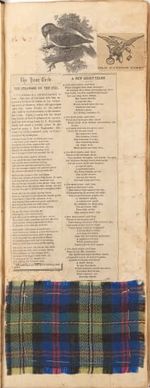
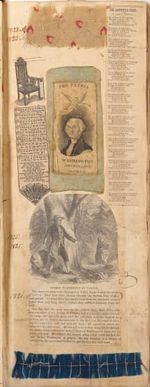
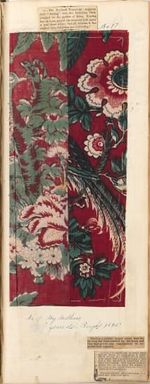
These efforts seem to be inspired by the Centennial in 1876, as Sophia consistently notes when she is able to find things that are "100 years old." She has not just solicited whole objects, however. The scrapbook also contains swatches of fabric both from her own wardrobe collection and from a wider array of women in the town. She has tacked fabric swatches from dead and living town members, recording materials worn by her mother, Esther, and two of her sisters, Abigail and Harriet, all of whom died of dysentery (along with her father) in 1849. While most of the fabrics tacked into the scrapbook document garments, there is also a sampler sewn to the paper (worked by Elizabeth Lord and made, according to Sophia, "92 years ago.") and a few examples of other textiles. Women donated swatches from their wedding dresses, church jackets, garments made from local silk farming, etc.
This is an interesting iteration on the "sewing diary." There are many examples from the nineteenth century, and a few extant from the eighteenth century, including Barbara Johnson's sewing diary. This example is particularly relevant because Barbara has also used the form of an account book as her base material and overlaid her fabric scraps and decades of notes about her garments. This book is in the Victoria and Albert Museum; she started it at 8 years old in 1746 and kept using into the 1810s). Scholars have discussed this text as a form of material account book a record of consumption (see Serena Dyer's Material Lives). Other scrapbooks also use the account book as a base material. There is another book somewhat like this in the collection of the Cornwall Historical Society in Connecticut, in which an unknown person pasted clippings (somewhat similar to those chosen by Sophia Buell) inside an existing account book in the 1880s. Other fabric journals, sewing diaries, and textile scrapbooks, like those held in the collections of Historic Deerfield (Alice Abercrombie Merriam), Winterthur (Kate S. Harris), the former American Textile History Museum (Ann Eliza Cunningham), Naperville Heritage Society (Hannah Ditzler Alspaugh), follow a relatively clear format: they include fabric swatches and notes about the fabric's origins, the method of garment construction, memories about wearing or making the garment, or other notes associated with the fabric's provenance and material life.
Interestingly, Sophia is not necessarily documenting her own sewing projects or logging her own fashion history, but is simply including swatches of fabric from clothes that she wore or were worn by townsfolk (and their ancestors). A few are explicitly discussed as being woven by the woman who donated the fabric, but, on the whole, Sophia is not discussing the manufacture of pieces of clothing. Many of the notes are quite sparse, but a few times Sophia notes a story about the provenance of the garment or under what circumstances it was won. Linkages to earlier history seem to be given preference.
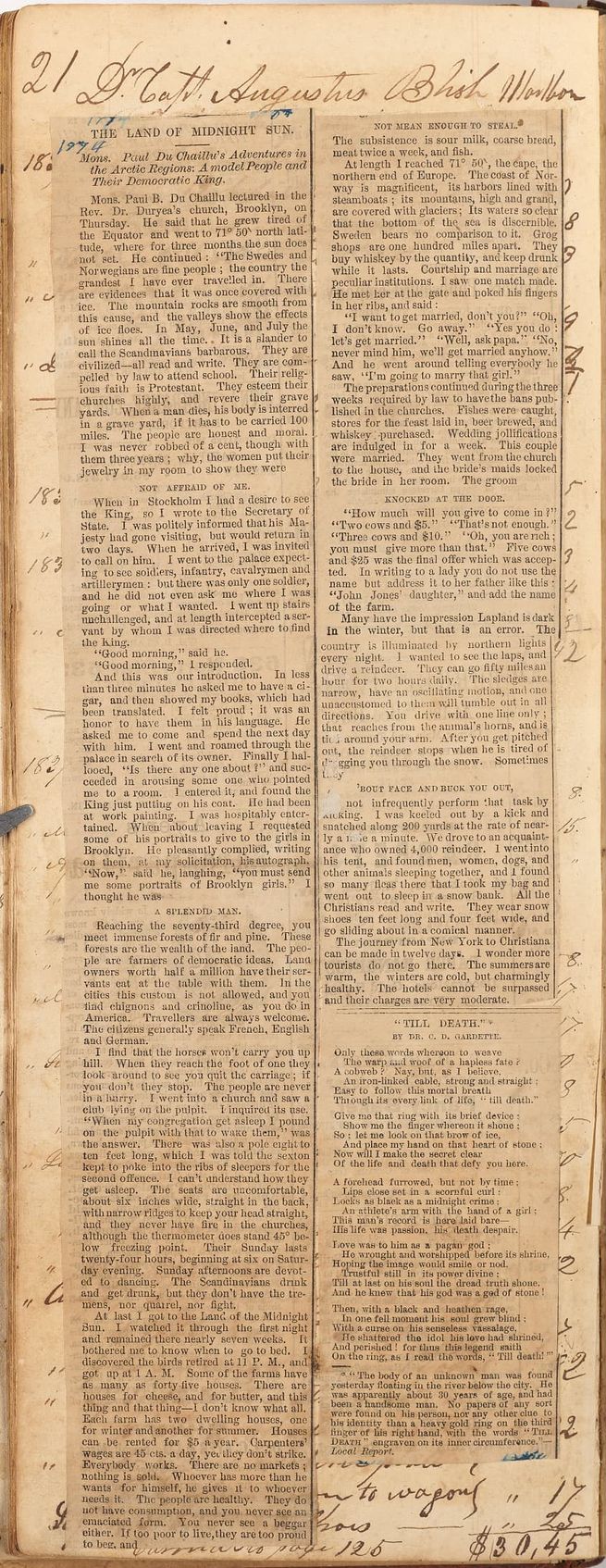
With this textile and textual record of local history, Sophia has pasted clippings from periodicals. Clippings include religious poetry, aphorisms, comical sketches, timelines of inventions, folk remedies for diphtheria and other diseases, news accounts of medical emergencies, local fires, birthdays of elderly residents, and the risks of using damp fuel, recipes for whitewash, treatments for glass, etc. She has included many poems about loneliness and duty alongside patriotic clippings related to presidential history (including Chester Arthur's visage, a facsimile of Garfield's letter denouncing the Morrey letter as a forgery, and accounts of Rutherford B. Hayes' wife riding in a sleigh). She has also included news items about her family members' deaths, along with a poem written by her sister, Harriet, who died in 1849.
Although Sophia does not seem to be engaging directly with the content of the account book (she does not, for example, seem to place information about a town resident on a page marked with his father's name), connections do emerge. William W. Richmond's son, William H. Richmond, recounted working for Sophia's father, also named William, during the haying season in the early 1840s. Several of the families whose names repeat in Richmond's account book are also included in Sophia's list of "relics" and in her collection of fabric swatches. For example, Jeremiah H. Taylor both has an account listed in Richmond's book and also emerges in Sophia's guest book. It is a palimpsestic town history.
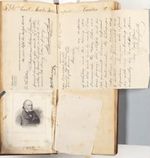
A few other voices emerge in the scrapbook, including that of Mrs. Huldah Foote Brainard, who died in 1881. A piece of fabric that she spun and wove is tacked into the book, but there is also a letter of hers tucked into the book (and also transcribed). The letter is challenging to read; the transcription helps orient the reader: she has written to Clarissa Day and notes that she's gone almost completely blind in her 86th year of life (about 1878). There's a quiet parallel with Sophia's own story; in 1882, she goes back and edits an earlier genealogical entry for herself. Next to her birth date, she writes, "In the year of 1882 I put my left Eye all most to tally blind." She died in 1900.
Sophia's work as something of a town historian is recorded in the Report of the Celebration of the Centennial of the Incorporation of the Town of Marlborough in 1903. She had died recently and some of her collection of antiquities, clearly collected for years, were displayed. However, the status of her collection is not entirely known. She left a detailed will, leaving money and objects to her brother and other relatives and setting aside money to ensure that her gravesite (and that of her parents and sisters who died of dysentery) would be attended and kept in order. However, her brother was unable to execute her wishes, as her estate was not able to pay for her debts and funerary costs. After much negotiation (during which time his own wife died), her brother sold her house and her estate to cover costs.
Although her death was recent and her insolvency advertised in the local newspaper, Sophia's death and the status of her collection are not mentioned in materials recounting the town's Centennial in 1903. The material read, "An interesting display of antiques was shown at the Sophia Buell house, next north of the church, in charge of Clayton S. Bolles and Mrs. Bolles, members of the committee on antiquities. There was the old Bible first used in the original Congregational Church, a toddy stick made by a former minister, spinning wheels, a quilt made in 1817, old powder horns and Revolutionary muskets, old clocks and documents, and a large number of articles formerly the property of Captain Moseley Talcott, the father of Hart Talcott of Hartford, shown by the latter.
"Several ladies of the town, members of the committee, dressed in the dresses worn by their grandmothers a century or so ago, arranged their hair in the style of the early part of the last century. They looked very quaint and interesting, particularly when imitating the simpering ways of the misses of the period they represented. They also imitated the graceful courtesy and manners and the courtly bow of the former generations." ("Report of the Celebration of the Centennial of the Incorporation of the Town of Marlborough," August 23rd and 25th 1903, p25)
Sophia Buell never married and was listed as living with different members of her family over years of census reports. She was reported as living with her brother, David Buell, when she died, though two houses were listed as her property (and were later sold by David).
Historic New England is committed to implementing reparative language description for existing collections and creating respectful and inclusive language description for new collections. If you encounter language in Historic England's Collections Access Portal that is harmful or offensive, or you find materials that would benefit from a content warning, please contact info@historicnewengland.org.
Sign up to our newsletter for our latest news and events

 Loading...