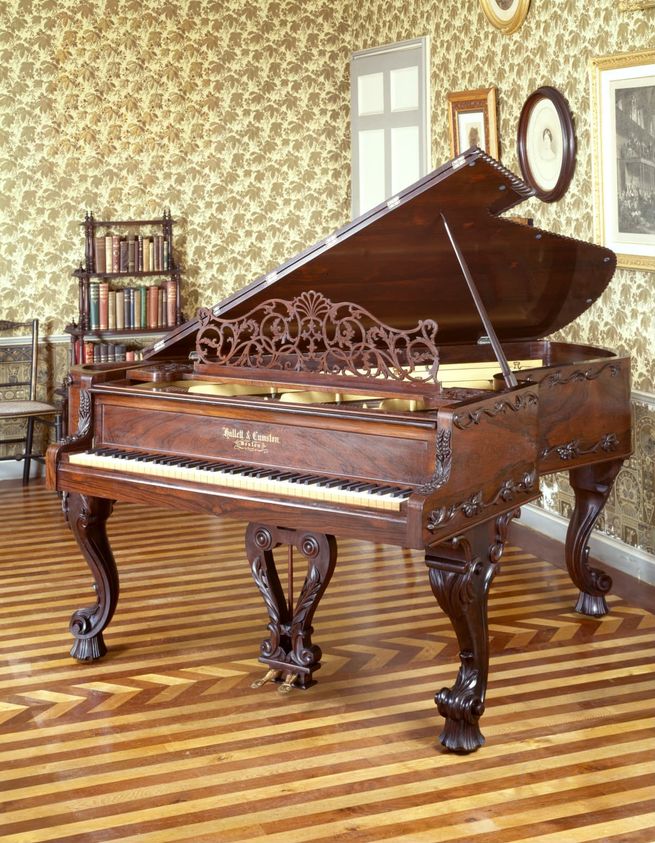
Parlor grand piano, cocked-hat form. with scallop-edged top. Rosewood. Fret-worked music stand with foliate detail. Grape leaf applique sides. Acanthus leaf cabriole legs on casters; lyre pedal support. Canvas cover fitted for top. Rests on cabriole legs with scroll feet.
grand pianos
rosewood (wood)
oak (wood)
ivory (tooth component)
Instrument, Keyboard
Piano
Piano, Grand
Piano, Grand
This grand piano in the "cocked hat" style was made by Hallett & Cumston, Boston. Part of the original house furnishings purchase by Captain Richard Tucker Jr. and installed in a prominent place in the parlor, the piano was an important part of family entertainment for themselves, friends, and visitors. Mollie had significant musical talent, playing not only the piano but also the mandolin. She wrote a song called "The Tryst."
Used in Cherished Possessions 2002-2005: This Boston-made grand piano cost Richard and Mollie Tucker $600 when they purchased it in 1858 to furnish their new home in Wiscasset, Maine. The piano was both an impressive piece of furniture and a symbolic addition. In many middle-class households in Victorian America, the piano replaced the hearth as the center of the home. The instrument came to represent achievement, refinement, and taste. It also meant something more-the piano signified the chaste and virtuous home, the symbolic opposite of the degradation and depravity of life in the teeming industrial world outside.
Painted above keyboard: ""Hallet & Cumston./ Boston""
Original to Castle Tucker (Wiscasset, Me.),
1998.299.1,2
Hallett & Cumston (Maker)
Boston, MA, USA
38 3/4 x 68 x 60 1/2 (HxWxD) (inches)
Gift of Miss Jane S. Tucker
1998.299.1-.2
Massachusetts (United States)
Historic New England is committed to implementing reparative language description for existing collections and creating respectful and inclusive language description for new collections. If you encounter language in Historic England's Collections Access Portal that is harmful or offensive, or you find materials that would benefit from a content warning, please contact info@historicnewengland.org.
Sign up to our newsletter for our latest news and events

 Loading...