
Fashion mavens of New England during the middle of the twentieth century no doubt would have rated Newbury Street in Boston as the style capital of the region, not Brattle Street in neighboring Cambridge. Many women who shopped on that very attractive street in Harvard Square were, after all, once called “bluestockings,” a moniker that reflected their interests in scholarly rather than sartorial pursuits.
All that changed in the post-World War II era, when international trade resumed in earnest. Boston and many of its suburbs fell under the spell of things Scandinavian: architecture, furniture, glassware, and pottery; movie stars and film directors; and in particular, Finnish-designed and manufactured clothes.
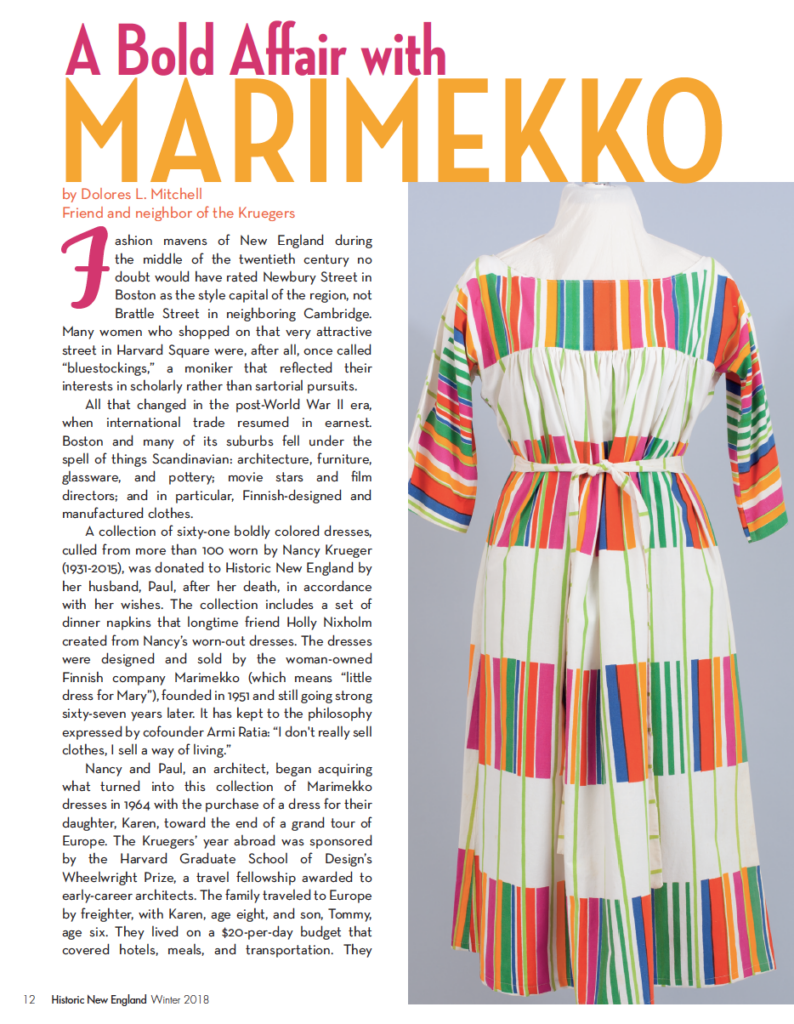
A collection of sixty-one boldly colored dresses, culled from more than 100 worn by Nancy Krueger (1931-2015), was donated to Historic New England by her husband, Paul, after her death, in accordance with her wishes. The collection includes a set of dinner napkins that longtime friend Holly Nixholm created from Nancy’s worn-out dresses. The dresses were designed and sold by the woman-owned Finnish company Marimekko (which means “little dress for Mary”), founded in 1951 and still going strong sixty-seven years later. It has kept to the philosophy expressed by cofounder Armi Ratia: “I don’t really sell clothes, I sell a way of living.”
Nancy and Paul, an architect, began acquiring what turned into this collection of Marimekko dresses in 1964 with the purchase of a dress for their daughter, Karen, toward the end of a grand tour of Europe. The Kruegers’ year abroad was sponsored by the Harvard Graduate School of Design’s Wheelwright Prize, a travel fellowship awarded to early-career architects. The family traveled to Europe by freighter, with Karen, age eight, and son, Tommy, age six. They lived on a twenty-dollar-per-day budget that covered hotels, meals, and transportation. They made their way through much of Western Europe, including a pilgrimage to the Paris studio of Le Corbusier, the Swiss French architect who is credited with being one of the pioneers of Modern architecture. Paul revered Le Corbusier; he was, at age twenty-eight in 1960, the project architect in charge of the Le Corbusier-designed Carpenter Center at Harvard University.
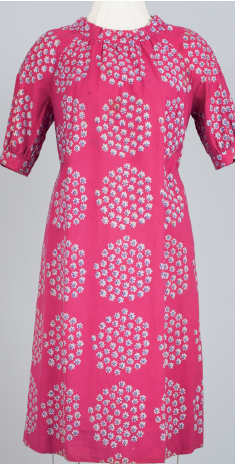
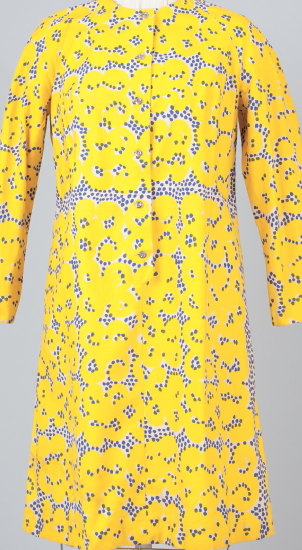
In Zurich, in a building that Le Corbusier designed, the Kruegers used the then strong US dollar to buy a Marimekko dress for Karen. Nancy and Paul knew about Marimekko dresses, which had arrived in America in 1959 and were sold exclusively at the Brattle Street store Design Research, or D/R, founded by architect Benjamin C. Thompson. Thompson was one of the eight architects, along with Walter Gropius, who in 1946 formed The Architects Collaborative, which was known for its Modern designs.
Besides clothing, D/R carried furniture and household items, most of which came from Scandinavia. The store became a mecca for the Cambridge-area academic and design community. These were the men and women who bought Scandinavian furniture, painted the walls of their houses dead white, covered their floors with Finnish woven Rya (also known as ryijy) rugs, learned to drink the spirit aquavit, bought Dansk ice buckets, wanted to look like, or at, actress Liv Ullmann and went to see her movies, which were directed by Ingmar Bergman, the Swedish film director/writer. These lifestyle choices contributed to what became known as Midcentury Modern. Commercial and academic buildings were part of the canon, but in the homes of New Englanders, Scandinavian design also flourished.
Nancy and Paul were born in Bad Axe, Michigan, a small city 108 miles from Detroit. High school sweethearts, they attended the University of Michigan, where in 1952, after their third year, they married. Nancy was a good-natured, nurturing mother and grandmother (of four), an ardent gardener (she particularly loved dahlias), and a potter. She had a great interest in art, the theater, and jazz and was an avid reader of police procedural crime dramas. For forty years, Nancy was manager/bookkeeper of her husband’s firm, Krueger Associates Architects.
The Kruegers maintained the historic character of the exterior of their 1890 Victorian house in Watertown, Massachusetts, but renovated the interior to live in an entirely Modern, minimalistic way. Every object they chose for their home reflected a unified Modern vision, including custom furniture and a profusion of artwork—lithographs by Le Corbusier, Miró, Picasso, Matisse, Giacometti, and Leger.
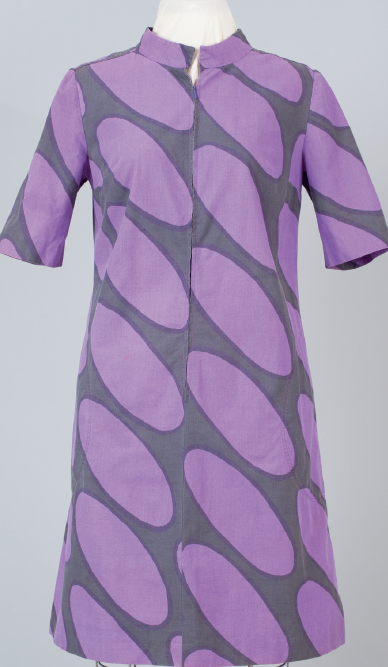
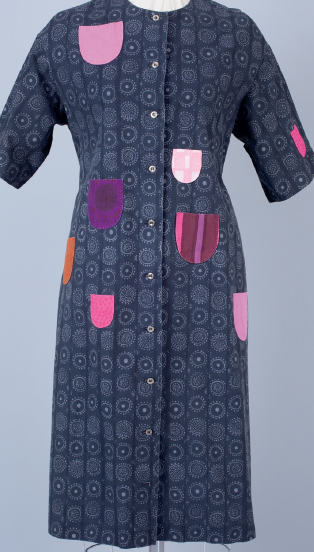
Nancy liked Marimekko’s sturdy cotton fabrics and the simple, comfortable, long loose sleeves, big pockets, triangular silhouettes, and bold colors. Increasingly able to afford the US costs of Marimekko clothing, and living in Watertown with D/R nearby in Cambridge, Nancy began buying one or two items annually. “Year by year, each year I bought not only beautiful Marimekko dresses, but beautiful Marimekko shirts, coats, socks, strips of fabric used for tablecloths, sheets, towels and ceramics,” she wrote shortly before her death. “There is a certain timelessness and courage that the talented designers at Marimekko have incorporated into the brand. I have never seen fit to throw away a single dress, and somehow the dresses stay beautiful for a very long time. I have worn them to work, to garden in, to baptisms, weddings, and all sorts of parties and occasions. In a way, the Marimekkos have become my identity. They suit my personality just fine.”
For those who knew her, Nancy was not—to use a current popular-culture term—a fashionista; she had very strong likes and dislikes and didn’t care what anyone else thought, even after one untactful neighbor said to her, “I can’t understand why you girls like Marimekko—to me they look like maternity dresses.” Nancy wasn’t fazed. Fortunately for Marimekko, Jackie Kennedy bought seven of them in the summer of 1960 and was photographed wearing one while sailing with her husband, who was campaigning for the US presidency. Her picture, wearing a pink sleeveless dress, made the December 26, 1960, cover of Sports Illustrated.
Not everyone loved Marimekko dresses. An early critic noted that the dresses were expensive and only elite customers could afford them. While the complaint about the high price was not unwarranted, the company’s commitment to combining comfort with beautiful colors and fine fabrics gained a growing audience. The June 14, 1959, edition of The Boston Sunday Globe applauded the colorful vibrancy of the clothing, remarking on the “mad, wonderful shades alone and in superb, off-beat combinations.” Negative comments about Marimekko clothing were few, and the business thrived and expanded.
In 1963, Marimekko cofounder Ratia wrote, “My approach is something like the architect’s. He makes a house for people to live in. I make a dress for women to live in. . . . For the woman who wants to forget her dress.” Six decades later, in a June 23, 2017, New Yorker article titled “Jane Jacobs, Georgia O’Keeffe, and the Power of the Marimekko Dress,” architecture and design critic Alexandra Lange pointed out that those two icons of independent-minded, forceful women bought and wore Marimekko. “Who could be more desirous of forgetting what they have on than women such as Jacobs and O’Keeffe who had so much to do?” Lange wrote.
Ratia came to dress design by way of textile design. She had turned to fabric printing as an alternative to weaving and to silkscreen printing as more flexible than engraved roller printing. She started working for Printex, a small manufacturer of oilcloth, when her husband, Viljo Ratia, purchased the company. She began designing cotton fabrics as part of a new Printex marketing strategy, hired designer Ritta Immonen to help, and in 1951, the two women decided to start a separate company with their husbands as minority partners. Their design mission to bring joy to everyday life succeeded—even as, over the years, different designers joined the company. Designers were given prominent credit for their work, with their names printed on the margins of the fabric along with the design dates. Like many corporations, Marimekko has had its ups and downs, but its vigor remains. Today, with stores in Cambridge and on Newbury Street, Marimekko products are still carried locally and around the world.
Marimekko continues to offer beautiful, comfortable, iconic dresses—the kind that Nancy Krueger loved and wore with such pleasure.
Written by Dolores L. Mitchell, friend and neighbor of the Kruegers
This article originally appeared in the Winter 2018 issue of Historic New England magazine. Check the blog monthly for new posts in our Collection Stories series.
Sign up to our newsletter for our latest news and events