
Welcome to Cogswell’s Grant, a 165-acre coastal farm overlooking the Essex River, just two miles inland from the Atlantic Ocean. The family of Bertram K. and Nina Fletcher Little made this their summer home in 1937, filling the eighteenth-century farmhouse with their significant collection of American folk art. The landscape here has supported settlements for more than 3,000 years, from the Indigenous Pawtucket people to the farming families of the sixteenth through twentieth centuries.
As one of the largest land masses remaining in the Town of Essex that originated as a seventeenth century land grant, and with extant landscape features on the property dating from each of its ownership periods, it is an extremely significant historic agricultural landscape. One of the few protected stretches of open land along the Essex River, it also provides an important and diverse habitat for local and migrating wildlife.
Today, Historic New England still operates Cogswell’s Grant as a working farm, honoring the Little family’s desire to preserve both the property’s agricultural history and its ecological importance as part of the Great Marsh.
Visitors to the landscape are invited to walk the grounds year-round, from dawn until dusk. Leashed dogs are welcome as long as owners respect wildlife and other visitors, and remove all waste. Please also be aware of farm activities while here, keeping a safe distance from tractors.
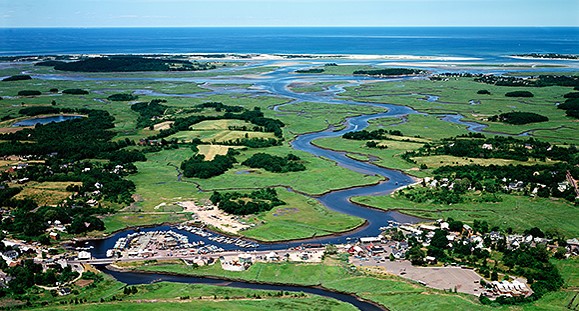
Aerial view of Essex, Massachusetts. The Cogswell’s Grant property and farmland is visible in the center of the photograph.
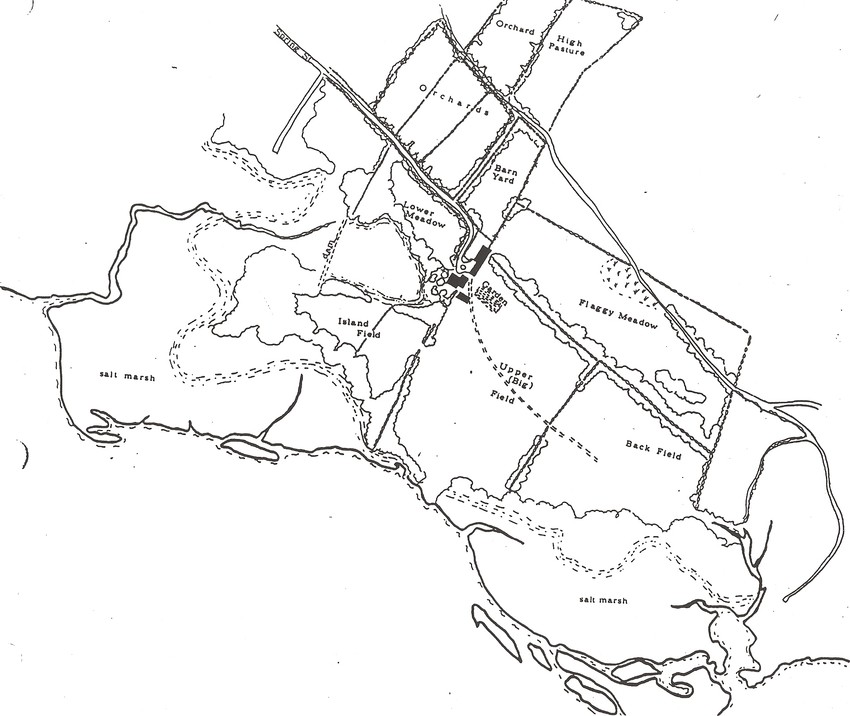
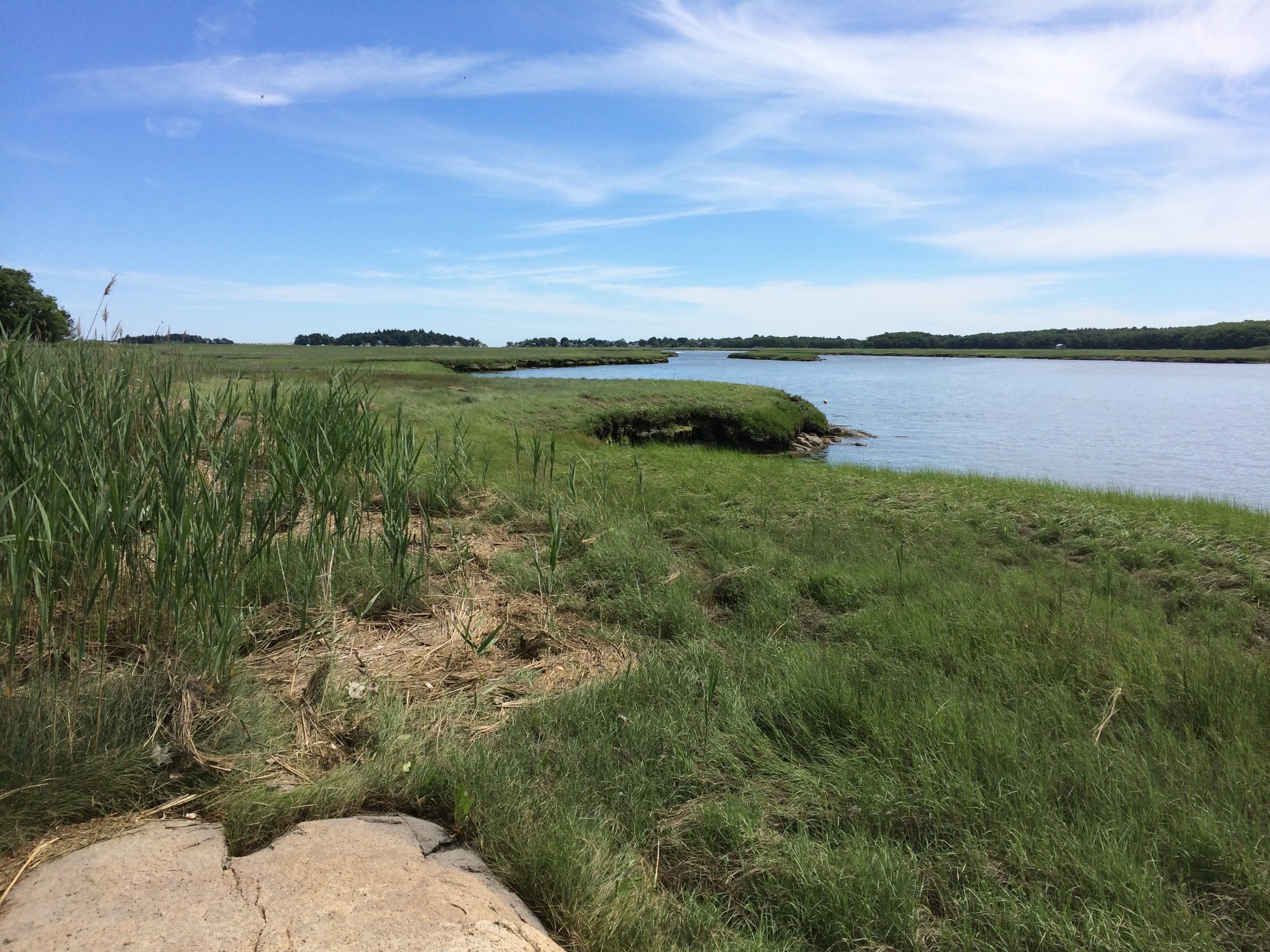
Archaeological evidence has located Indigenous materials in the Spring Street neighborhood of present-day Essex dating to more than 3,000 years ago, including at least one known Middle Woodland period site within the current boundaries of Cogswell’s Grant. More recently, at the time of contact with European colonists, the Indigenous people living on Cape Ann were the Pawtucket, an Algonquian-speaking group closely related to the Pennacook tribe from further north.
The Pawtucket had settlements or villages throughout the North Shore, migrating seasonally to the coast from a winter home further inland near present-day Lowell. Agawam was the name of the Pawtucket village which is now the town of Ipswich, and the area now known as Essex was named Chebacco, meaning “the place between,” referring to the land and the lake between the Ipswich River and the Annisquam River.
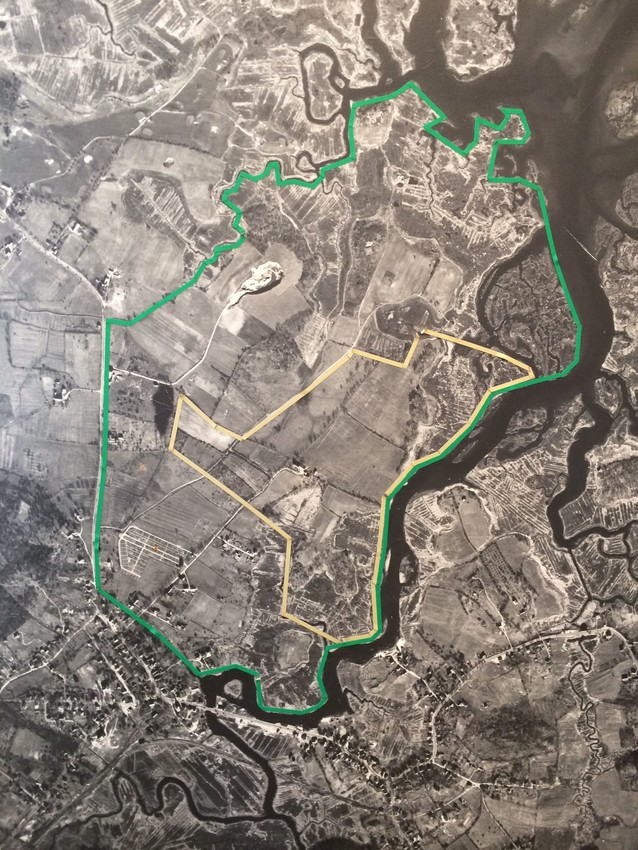
The original grant of land from to John Cogswell in 1636 was for 300 acres, and though that original property (outlined in green) was partly divided and sold or given to various Cogswell heirs, the current parcel of 165 acres (outlined in yellow) has been intact since it was passed to Jonathan Cogswell Jr. in 1717.
Seventeenth, eighteenth and nineteenth century town tax valuations show that the acreage was used consistently for pasture and hay to support livestock, with some cultivated crops of rye, barley and corn, and orchards with apples and pears.
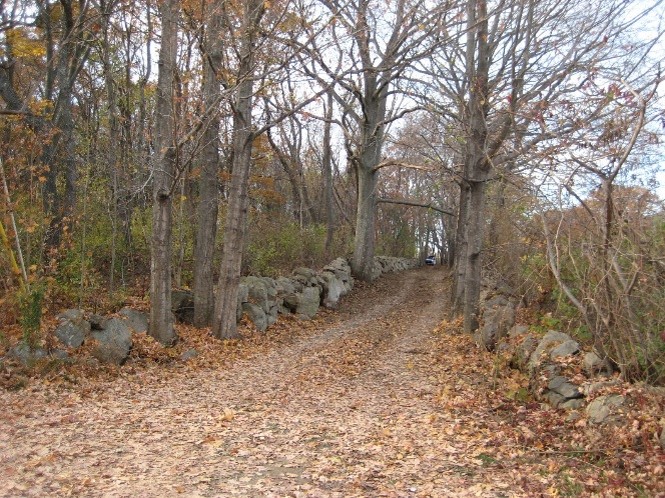
A seventeenth-century feature was the road from Ipswich to Gloucester, which passed through the property and for which William Cogswell was granted three and a half acres of land in Ipswich in 1656 as compensation.
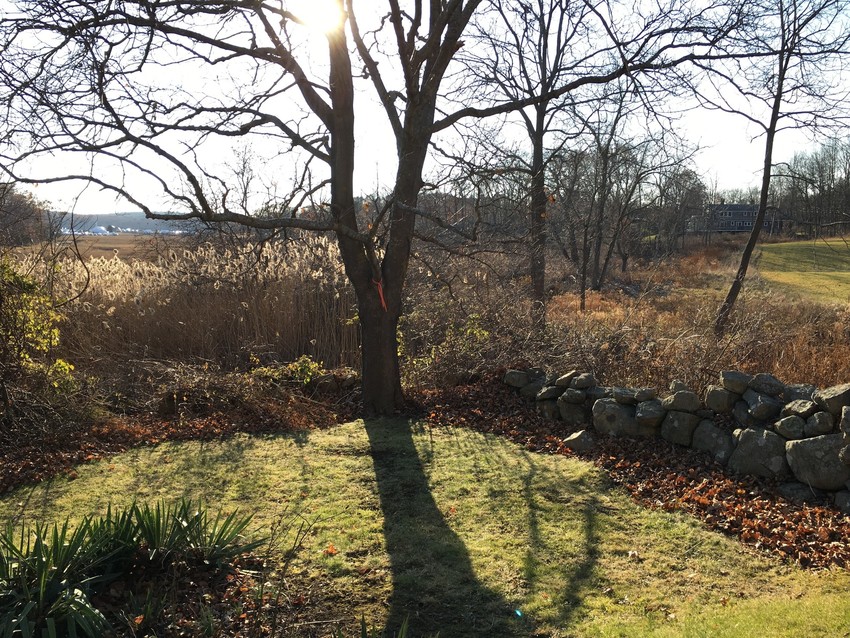
Remnants of historic man-made landscape features can still be seen on the property, including a dam and pond in front of the house which dates to the mid-seventeenth century and likely serviced a small mill. The water collects in the pond at high tide, and would have drained slowly through a mill system on the dam, providing tidal water power to either a grist mill or a saw mill, both of which are mentioned in period documents. The terracing of the lawn in front of the house probably dates to the eighteenth century, as that was characteristic of country estate landscaping at the time, and some of the flowers there and unusual species (such as the yucca plants) date to the Boyd family period during the nineteenth century.
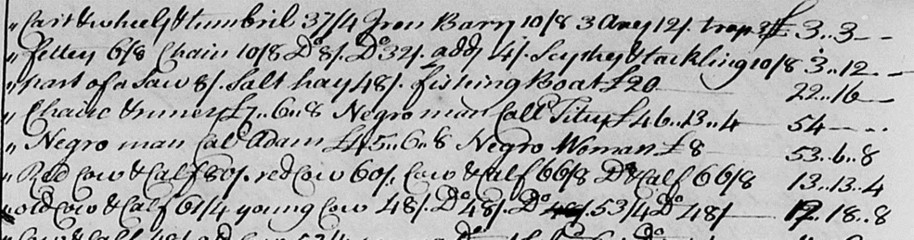
Historical documents show that at least six Black and Indigenous people were enslaved by the Cogswells on this site in the eighteenth century. When Jonathan Cogswell died in 1717, he left his wife Elizabeth an enslaved Black man called Jack and an enslaved Indigenous woman called Nell. A few years later when Elizabeth Cogswell died, she mentioned a third enslaved person as part of her property—a young Indigenous girl called Genne. Elizabeth Cogswell gave Nell and Genne to her daughters, and left Jack to work towards purchasing his own freedom if he could find someone to pay £50 to the town. A Massachusetts law passed in 1703 required enslavers to provide a £50 bond to town officials towards any future financial burden the town might face if the formerly enslaved person became ill or disabled. This law discouraged people from releasing slaves from bondage in their wills, and it worked in the case of Elizabeth Cogswell.
Elizabeth and Jonathan Cogswell’s son, Jonathan Cogswell, Jr., also enslaved people here. He is the family member who likely built the oldest part of the Cogswell’s Grant house. He died in 1752, and his estate inventory mentioned three enslaved people of African descent: Titus, Adam, and an unnamed woman. They are described as property in the Jonathan Cogswell Jr.’s inventory and listed along with a fishing boat and livestock.
Enslaved people engaged in both domestic and agricultural labor for the profit of the Cogswell family. They would have planted and harvested crops, prepared food, tended the livestock, kept the household clean and comfortable for the family, and may have constructed parts of the house and outbuildings.
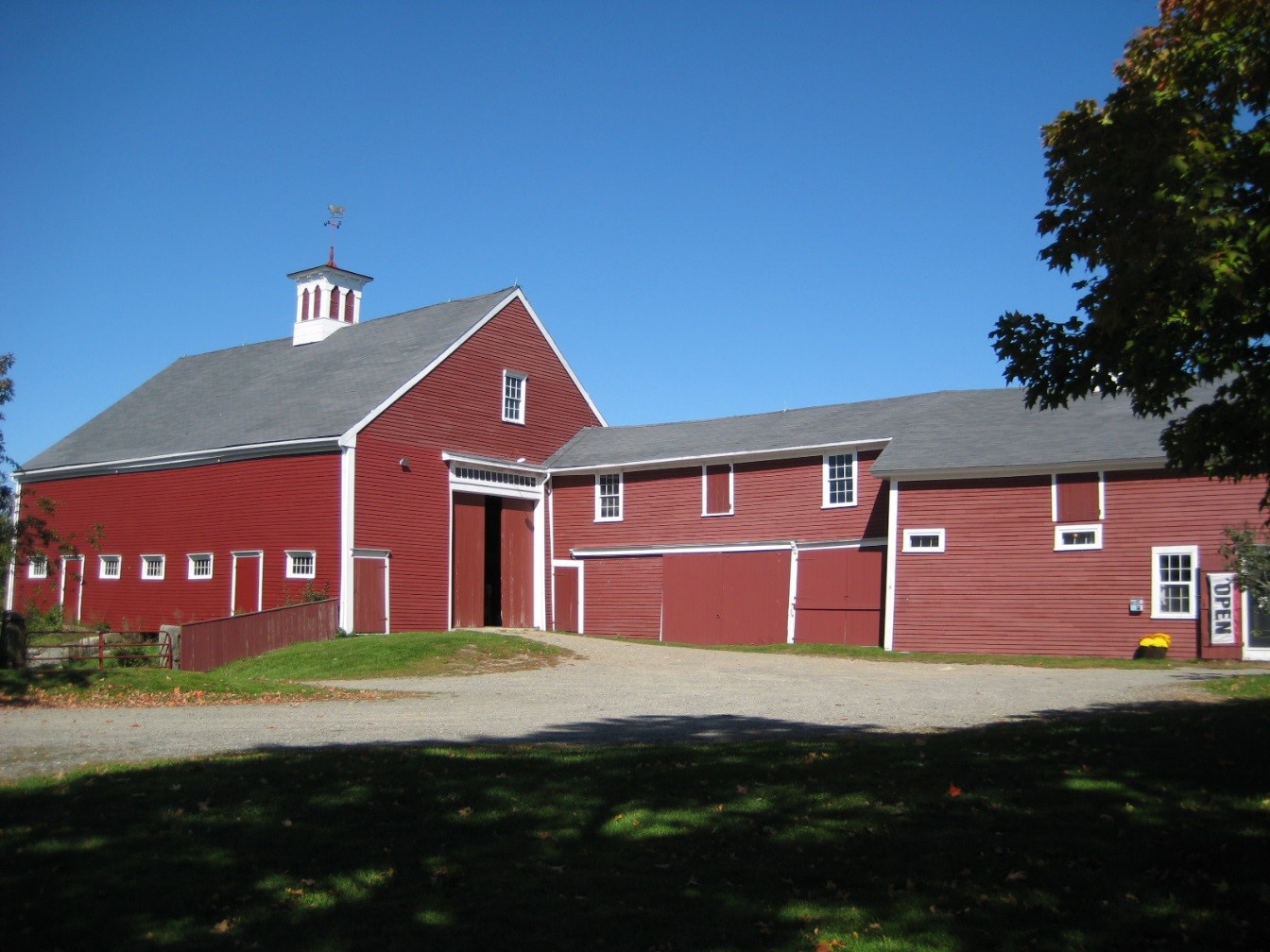
During the period of Cogswell family residence between 1636 and 1839, the rear entrance of the house from the service ell oriented the farm activity between the Cow Barn (now our visitor center) and the Salt Hay Barn (behind the house and built in 1719 – the oldest building still standing on the property). Sometime after the Boyd family took over the farm in 1839, the orientation of the barnyard shifted to the front of the house. The Main Barn appears in farm documents starting in 1863, and the connecting sheds between the Main Barn and the Cow Barn (with doors opening onto our circular driveway) were constructed in stages in the 1870s and 1890s. During the Boyd family era (1839-1925), agricultural records show that dairy, wool, and orchard products were cultivated in addition to the hay and other crops for feeding livestock.
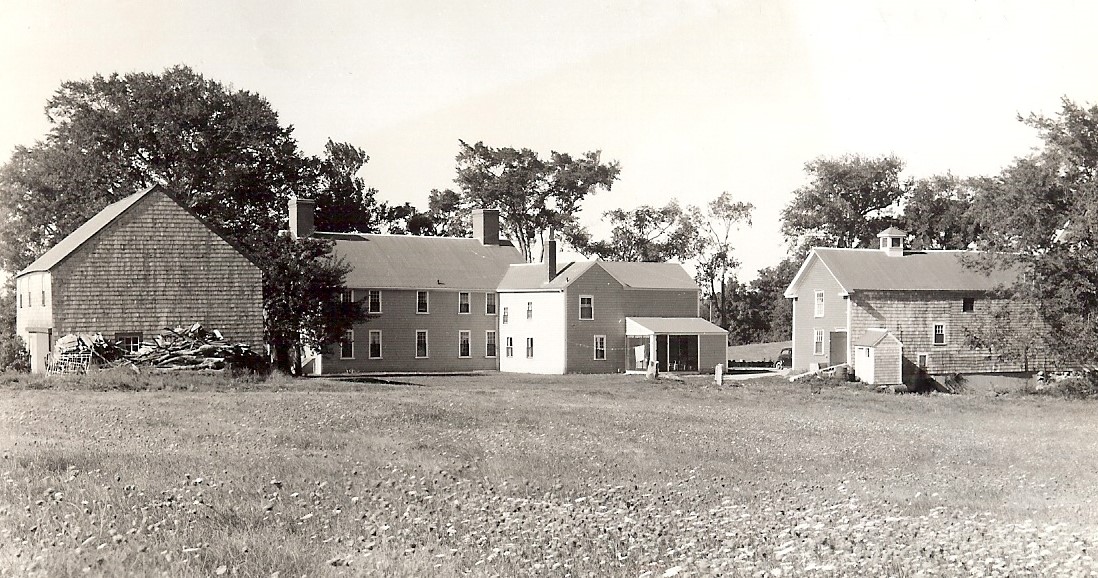
The working side of the house/barns after the Littles built the caretaker apartment extension off the back of the main house. The Salt Hay Barn is on the far left and the Cow Barn on the far right.
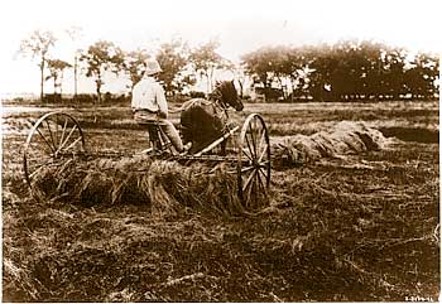
The process of turning upland grasslands into hay for consumption by farm animals and livestock has changed very little over the centuries, even accounting for the introduction of mechanized equipment. The most important thing is to “make hay while the sun shines”, as the process of putting up a dry crop of hay that can be safely stored for many months requires several days of clear weather. When the grass (on our farm a mix of timothy, clover, and orchard grass) has reached the right height and maturity, it is cut (once by hand with a scythe, now with a tractor mower). The cut grass then needs to lay out in the sun for a day or so to dry. Next, that layer of grass needs to be turned, or “tedded” so that the underside also gets turned to the sun and has another day or so to fully dry out. Grass used to be turned by hand with large forks; now a spider-like machine called a tedder is drawn over the grass to stir it up. Once the hay is dry, it is raked into “windrows” from which the hay can be tossed into a hay wagon and transferred to the barn or a haystack for storage. Traditionally this was done by hand, but these days a baling machine can be driven over the windrows; the baler scoops up the hay, packs it into a tight rectangular bale, ties it with twine, and throws the finished bale into the hay wagon, towed behind.
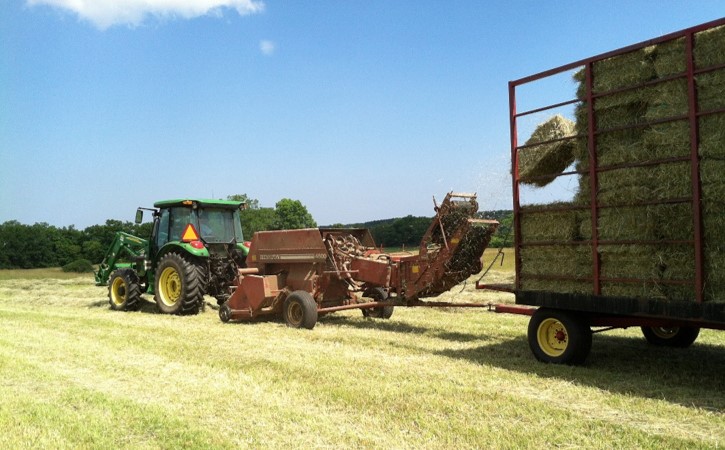
The Little family continued the haying traditions at Cogswell’s Grant, and were mindful of the important agricultural legacy here. Their deed to Historic New England states that the land is “to be held in perpetuity as an historic example of an early New England tidewater farm.” Today hay is still harvested on approximately 35 acres here at Cogswell’s Grant, and sold to local horse farms, by the grandson of Al and Caroline Craig, the Littles’ last farming/caretaker family.
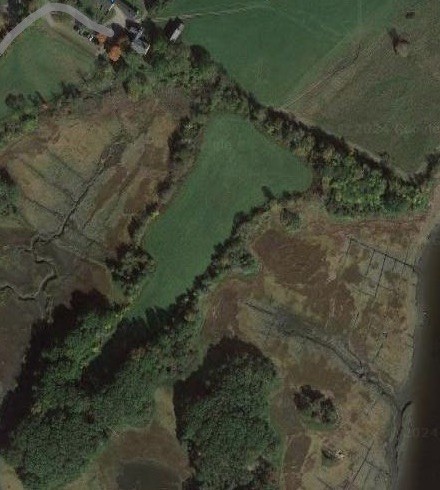
There is a long horseshoe-shaped hayfield opening off a gap in the tree line to the southwest of the Upper or Big Field; the Little Family named this the Island Field, as there is water on three sides. In geology terms, this field is believed to be an esker or a drumlin, a raised ridge of land created by sediment deposited after the movement of a glacier during an ice age.
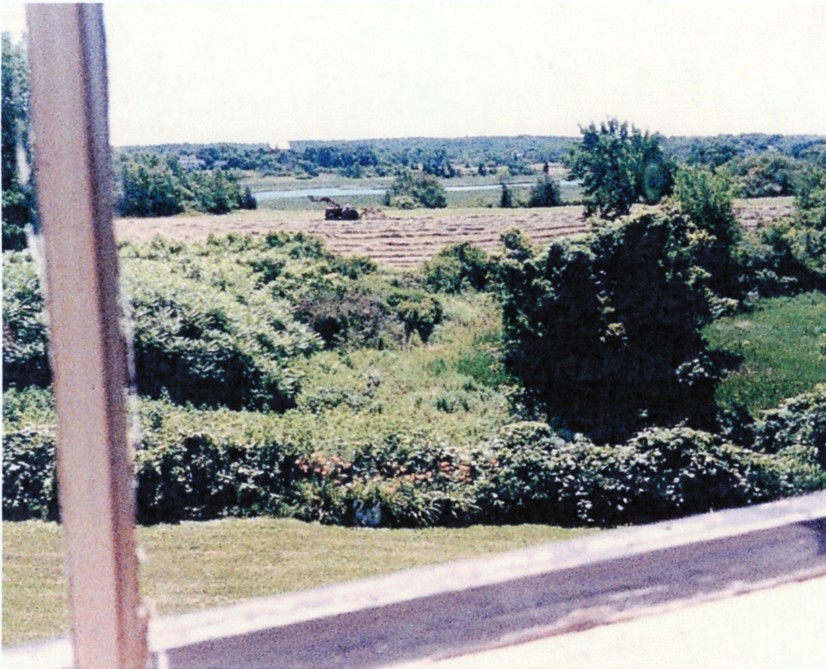
Island Field being cut for hay in 1986, as viewed from window of the house.
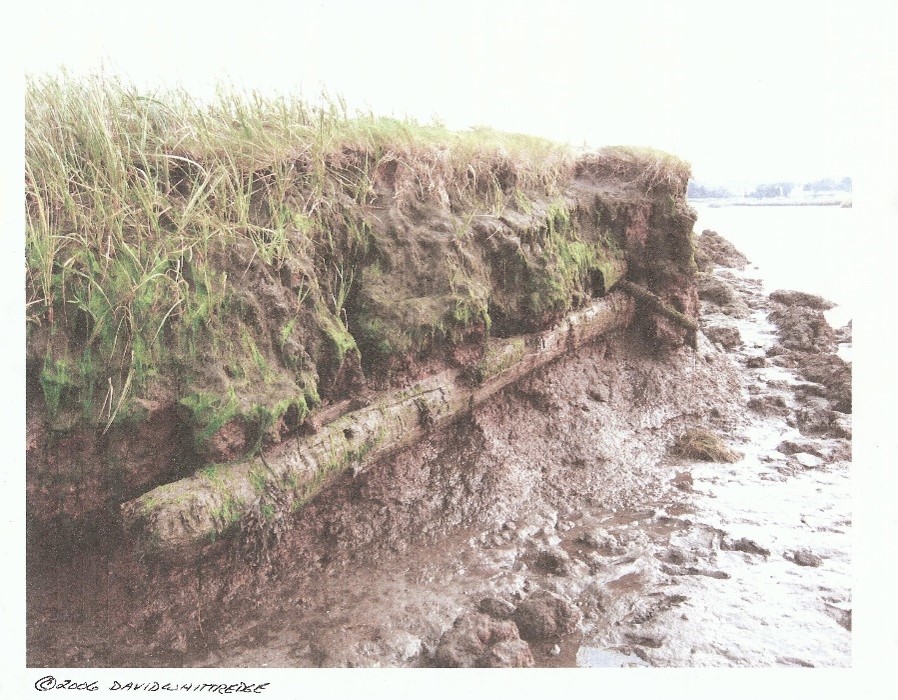
Timbers in the riverbank, still seen at very low tides, are believed to be the remains of the horse bridge built as part of that road in 1666. A shipyard is built in 1668 at the site of the Essex Shipbuilding Museum. By 1698 the bridge is gone and by 1700 the road is today’s Route 133.
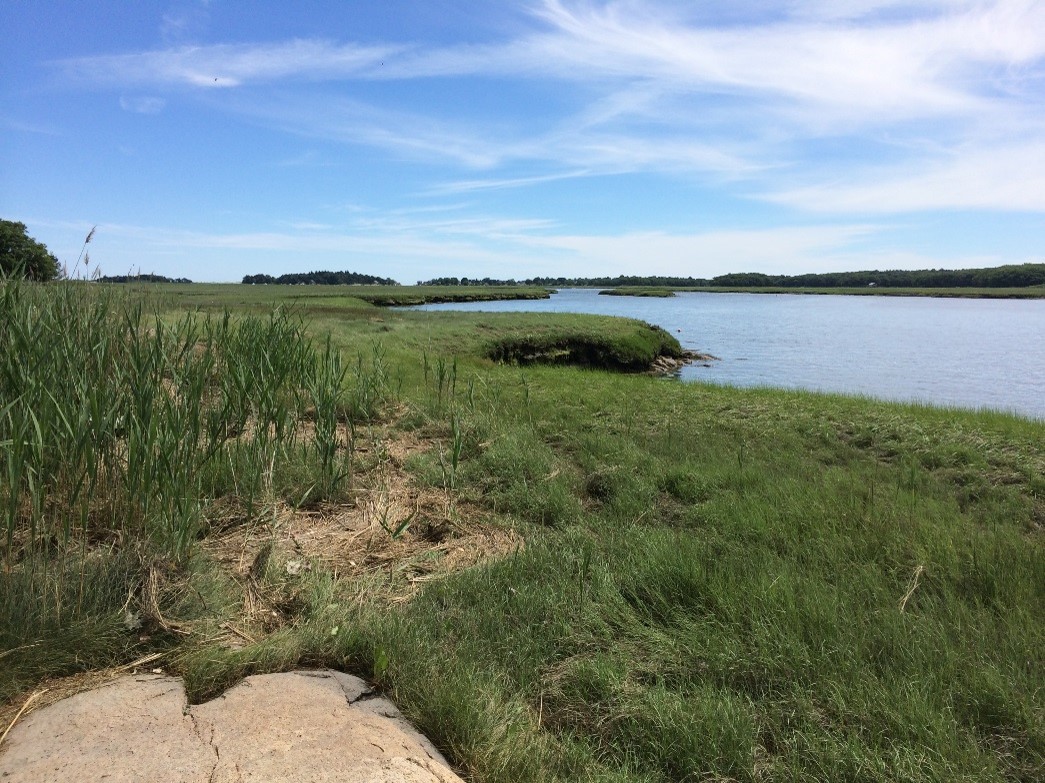
The Great Salt Marsh is the largest salt marsh in New England, comprised of 17,000 acres, and a vital natural resource that stretches from Cape Ann to New Hampshire. Its resources of grasslands, tidal creeks, and estuaries support habitats for extraordinarily diverse species of plant, animal, shellfish, insect, and bird life. These coastal wetlands also serve crucial functions in storm surge mitigation and filtration of water pollutants.
The indigenous Pawtucket people who settled on Cape Ann benefited greatly from the salt marsh: fishing, hunting, plant gathering, and especially clamming. Evidence of shell middens in Essex County coastal areas date to the Middle Woodland period (over 3,000 years ago). The colonists who farmed this part of New England in the 17th century also understood the advantages of the marsh, as they often emigrated from similar salt marsh communities, such as Ipswich and Essex in England, and were familiar with coastal farming in such a location.
In the 20th century, as Essex gradually lost open space to development, Mrs. Little wrote “As time goes on, I realize that the upland and marsh surrounding Cogswell’s Grant in Essex are becoming increasingly important as a conservation area, and that fast diminishing wetlands as a necessary protection for coastal wildlife should be firmly protected as a natural resource.”
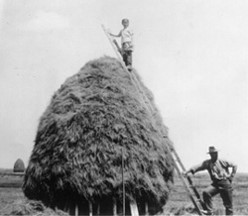
In the colonial period, salt marsh hay and the heavier marsh grass, thatch, was a valuable resource for farmers, so much so that William Cogswell took someone to court in 1673 for illegally cutting thatch on his land. Harvesting salt marsh hay required no clearing of trees or planting or other maintenance, and the salty hay made excellent, nutrient-rich fodder for cattle and horses. Marsh hay could be stored in haystacks on platforms or “staddles” right on the marsh itself, saving storage space in barns, and collected when needed by sleds over the frozen marsh in the winter, or transported by flat-bottomed “gundalow” boats.
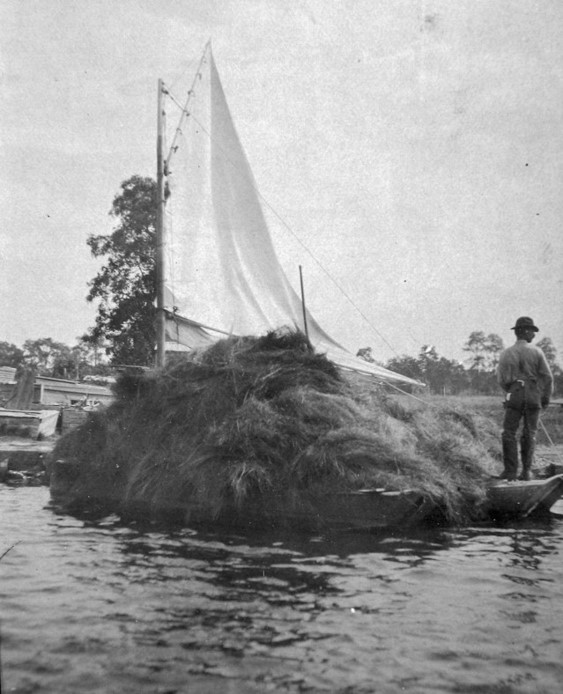
The process of cutting salt marsh hay was not much different from that for upland hay; it was cut with a scythe and left to dry, then raked and collected and formed into conical haystacks that were shaped to shed rain. The primary difference in the harvesting of marsh hay came in the timing. Hay could only be harvested during low tidal periods, about 8-12 days per month, and only one cut could be made per season. There were only three opportunities to get all the marsh hay cut, in June, July and August, as the hay became tough after the end of August. However, if the weather did not cooperate during low tide days, harvesting might need to continue into the early fall. As mechanized equipment came in to assist with upland haying, the hand-cutting of marsh hay declined by the mid-20th century; today it is highly valued by gardeners for mulch, as it is weed-free and enriching for soil.
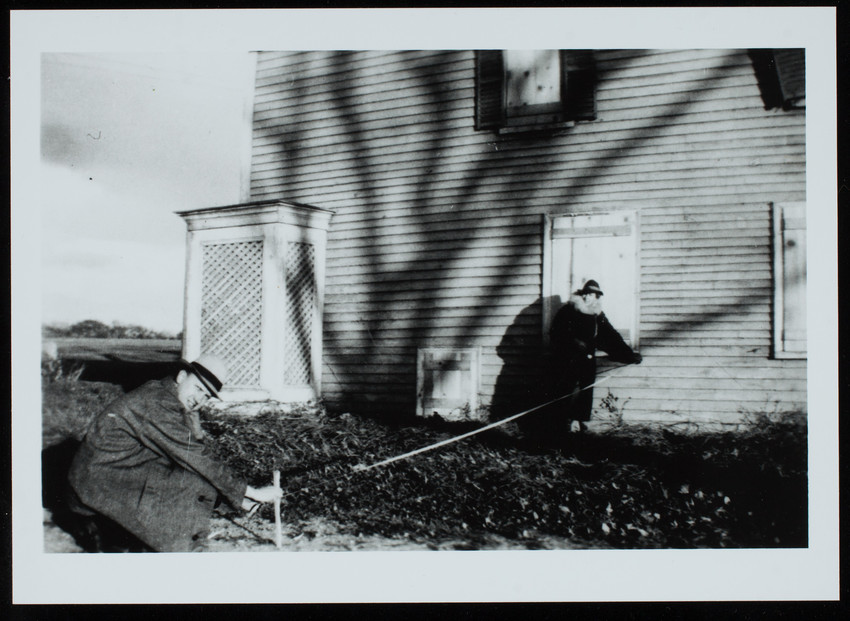
Bert and Nina Little “Measuring for New Ell” Cogswell’s Grant, November 1937
When the Little family purchased the farm in 1937, they continued to operate the farm as a breadbasket for their own family, and produce from Cogswell’s Grant supported them year-round.
The Little family continued the traditional uses of the farm at Cogswell’s Grant, raising cattle, lambs and pigs for freezer meats, cultivating a large vegetable garden based on the preferences of the family members, and keeping a flock of chickens to provide fresh eggs which were consumed by the family and also sold locally on a small scale. Fields were used much as they always had been, for pasture and for hay, both to feed the livestock and for sale. Flowers were grown in a section of the garden for cutting and decoration in the house, but there are few formal flower beds around the property, as preserving the character of Cogswell’s Grant as a typical New England tidewater farm was important to the family. When the time came to plan for the future, Mrs. Little gave very clear instructions for the preservation of the landscape and not just the buildings and collections.
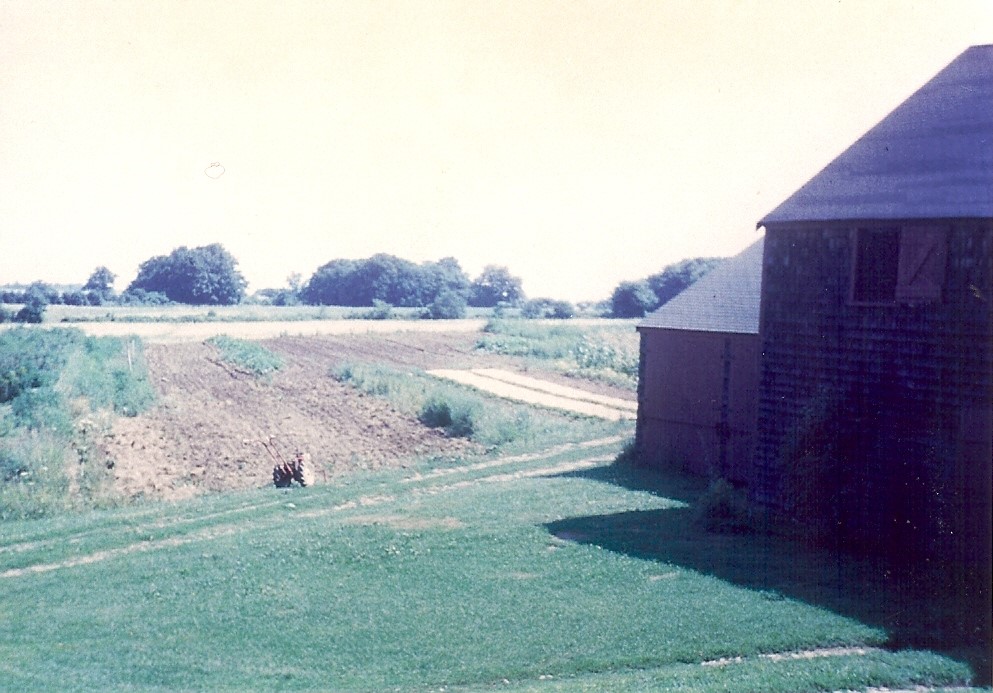
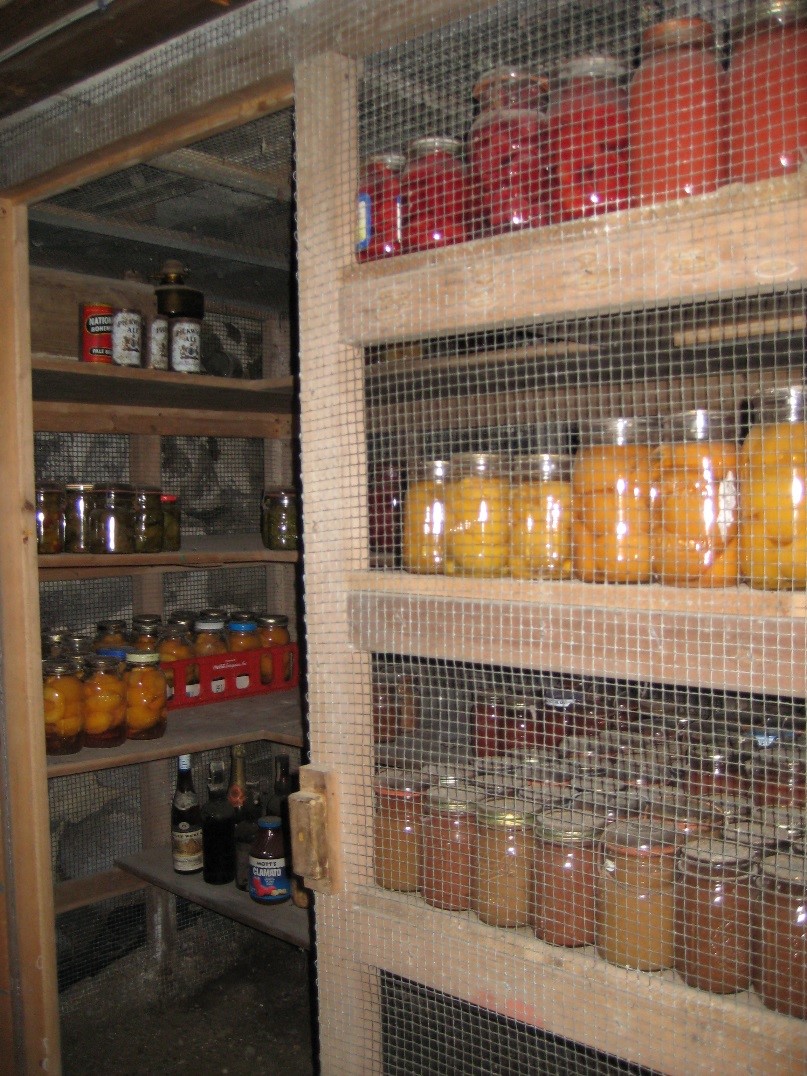
The food produced at Cogswell’s Grant supported the Little family year round. The live-in caretaker families (farmer and cook-housekeeper) would manage farm livestock and gardens all season, preserve the produce, and make regular deliveries during the winter to the Littles at their home in Brookline.
The Littles and the caretaker families originally maintained a few dairy cows, and operated a small local milk delivery service. Beef cattle, lambs, and pigs were raised for freezer meats, and chickens were kept, about 100 for meat and 100 for egg-laying. Fresh eggs were used by the family and also sold from a barn refrigerator on an honor system (take a dozen, leave a dollar in the Tupperware container). The orchard lots were mosly left untended, but the fields were used much as they always had been, for pasture and for hay, both to feed the livestock and for sale. Flowers were grown in a section of the garden for cutting and decoration in the house.
The vegetable garden was large and cultivated based on the preferences of the family members, including:
Asparagus, lettuces, radishes, carrots, beets, corn, potatoes, green beans/shell beans/lima beans, tomatoes, peas, broccoli, cauliflower, cucumbers, zucchini/summer squash/winter squash, blueberries/raspberries/strawberries/concord grapes.
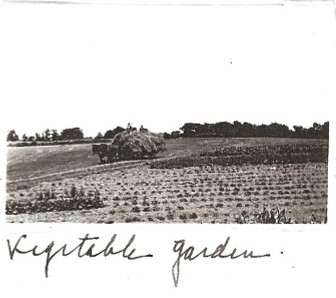
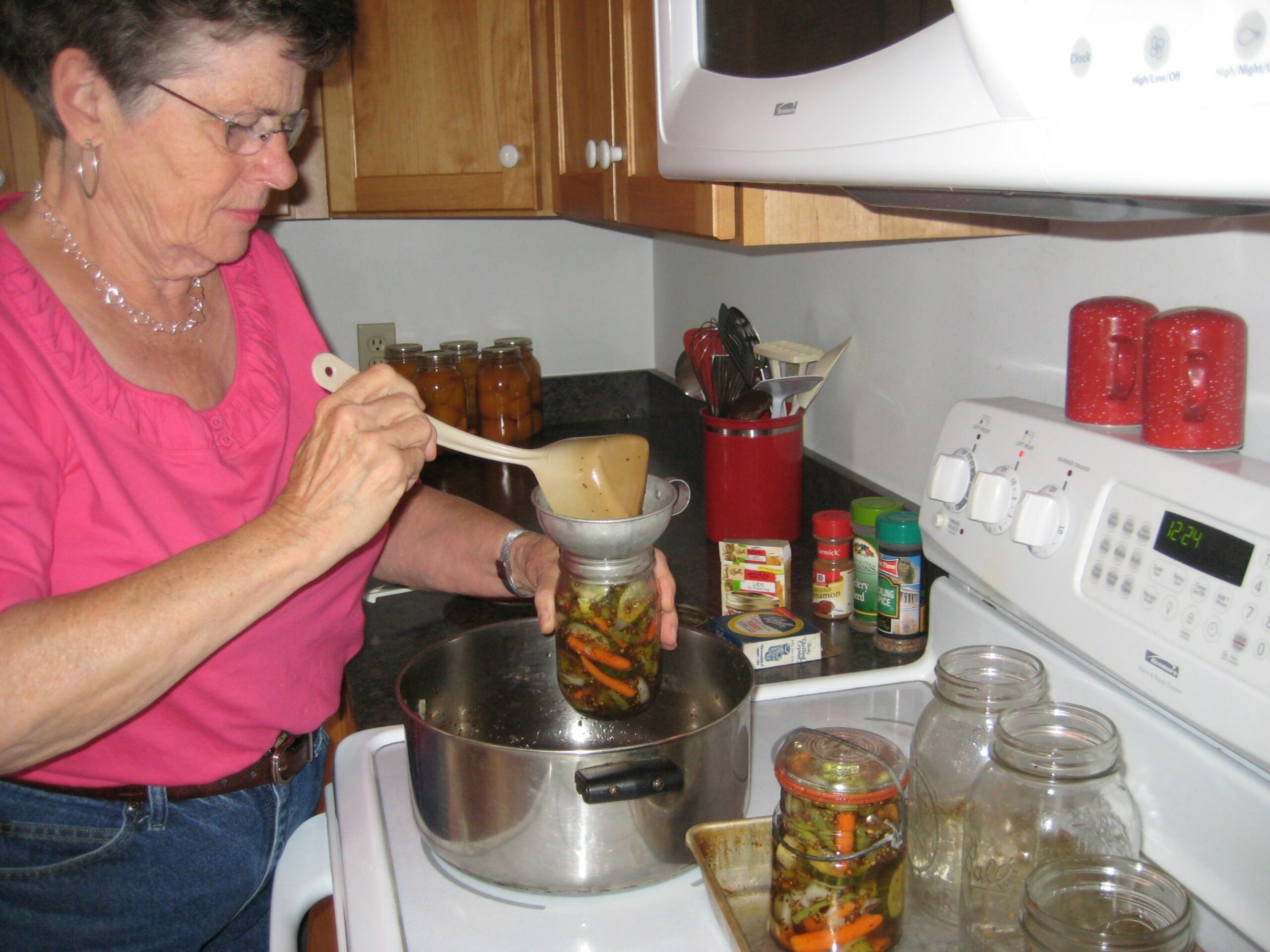 Caroline Craig, the most recent cook/housekeeper for the Littles (from 1973 until their passing in 1993), remembers preserving up to 800 jars of garden produce a season, including vegetables, pickles, and at least 100 jars a year of homemade fruit jams and jellies. She baked ten loaves of homemade bread a week for the household, five dark and five white. The favorite summer lunch was Caroline’s homemade bread with fresh grown tomatoes and a bit of mayonnaise.
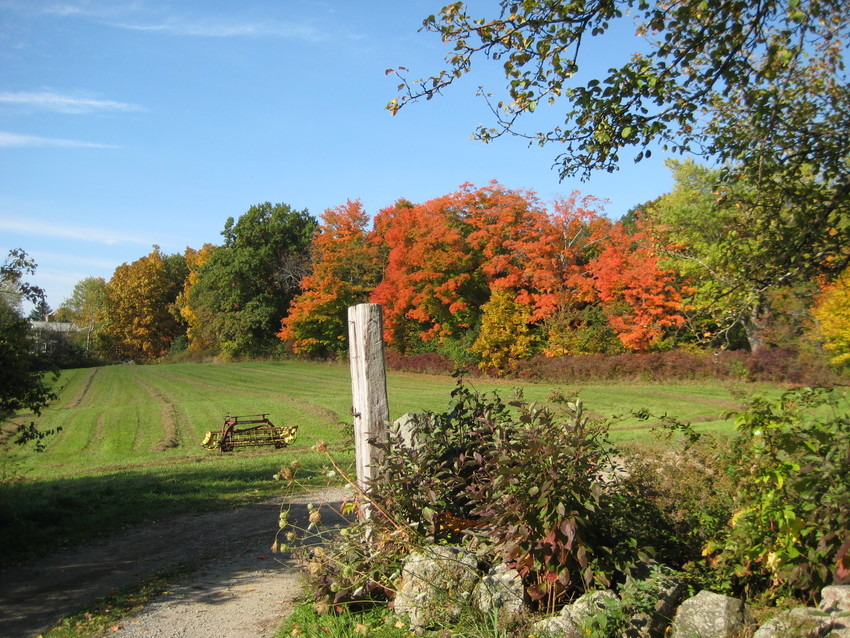
Visitors to the landscape are invited to walk the grounds year-round, from dawn until dusk. Leashed dogs are welcome as long as owners respect wildlife and other visitors, and remove all waste. Please also be aware of farm activities while here, keeping a safe distance from tractors. A variety of public programs and events take advantage of the extensive landscape at Cogswell’s Grant, including birding walks, historic walking tours, plein air painting, and other outdoor activities which can be found on our Events and Programs page.
Learn more about Historic New England’s approach to landscape management at Cogswell’s Grant.
Sign up to our newsletter for our latest news and events