
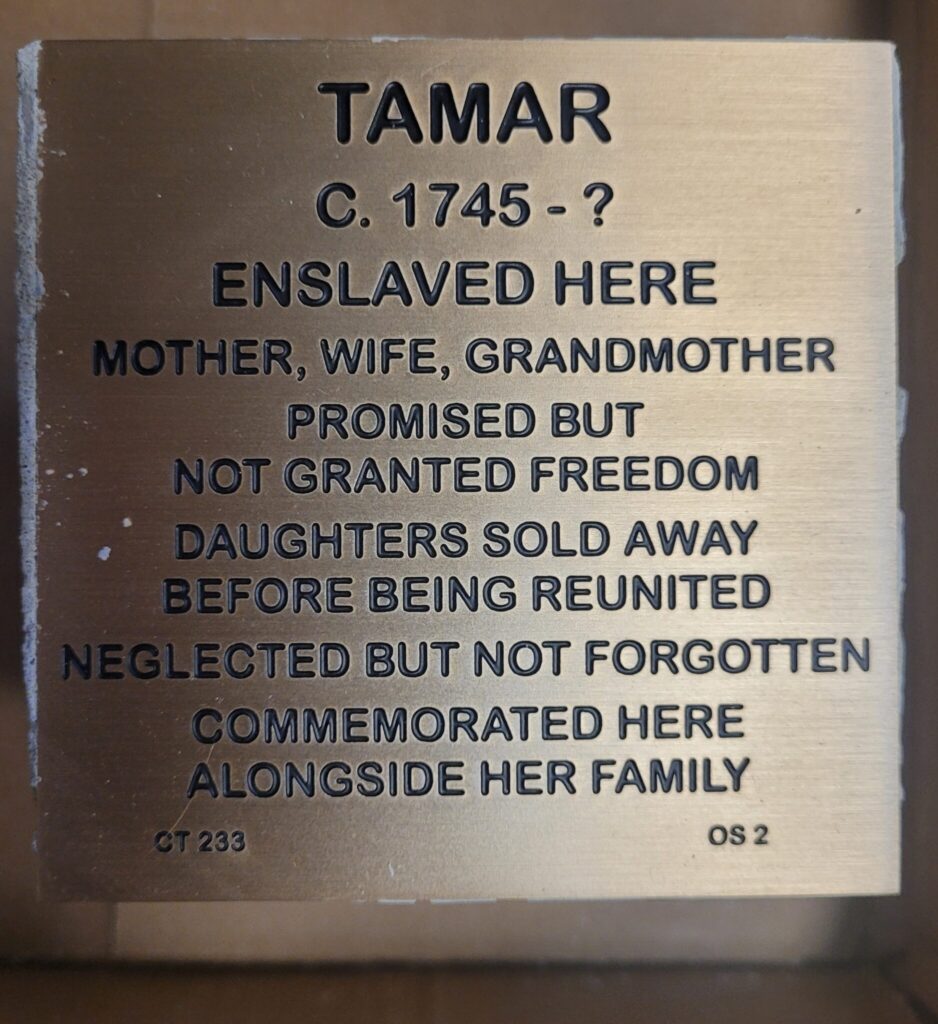
Last November, a group of eighth graders in Old Saybrook, Connecticut, stood around a small stone marker and said a name out loud: Tamar. They wanted her remembered not as a name in a legal record, or solely as an enslaved woman, but as someone’s mother, someone’s daughter, someone’s friend. In the ceremony they designed and led, the students imagined what Tamar’s life might have held without the violence that defined it—the grip of her hand nurturing her children, the warmth of her voice protecting them. What I watched that day was not just a history lesson. It was an act of empathy, reaching back two centuries to carry Tamar’s story forward.
The Witness Stones Project is the youth education arm of Historic New England’s Stopping Stones project. Witness Stones partners with students, educators, and communities to research and honor with a commemorative marker the lives of enslaved people who lived, worked, and worshiped in their neighborhoods. Through its educational work, including teacher development trainings, students participate directly in recovering history—digging into archival records, uncovering names, and committing to make sure those names are never forgotten again. Using the curriculum provided by Stopping Stones School and Youth Programs Manager Liz Lightfoot, students learn the historical context of slavery in colonial New England, especially in their town.
In Old Saybrook, students recovered Tamar’s story. Within the context of enslavement in their community in reference, students researched Tamar’s life through archival records in which she appears, mostly legal records. Together in the classroom and sometimes teaching each other, students came to understand firsthand the vulnerabilities of being human property in eighteenth-century New England.
Tamar spent most of her life working as a domestic servant to a wealthy merchant, John Kirtland, in Old Saybrook. In 1774, when she was twenty years old, a legal dispute arose between Kirtland and Samuel Whittelsey over rights to Tamar’s labor. As part of the court proceedings, Tamar and her young daughter Phillis were temporarily seized by a court constable while the dispute was resolved. Kirtland ultimately retained or regained control over Tamar and Phillis, but his ongoing financial troubles continued to shape their lives. Within a few years, Kirtland sold Phillis to Samuel Hart, and in 1785 he sold Tamar’s daughter Rose to General William Hart. Although Kirtland promised Tamar her freedom in 1784 on the condition that she care for his wife after his death, that promise was never fulfilled. When Kirtland died in debt in 1787, his executors sold Tamar and her young son Cato to General Hart to help settle the estate. Tamar’s life was filled with broken promises and unreachable dreams, and the student empathized with the tiers of inequality in her life.
After learning about the injustices suffered by Tamar and her children Phillis, Rose, and Cato, the students commemorated her in a way that felt most immediate and reparative to them: acknowledging her as a mother and remembering her family as one. Young people often approach history through personal, familiar experiences already woven into their lives. One of the students imagined life through the perspective of Tamar writing a letter to her daughter Rose, whom Kirtland sold in 1785. The student poignantly wrote, “I love you so much even though we have not had the best experiences.” In that single line, they reached across two centuries and found something true—that love and loss do not belong to any one era, and that unfairness, wherever it lives, demands to be felt.
I have worked in public history long enough to know that we underestimate what this kind of encounter does to a young person. What these students were practicing was the full arc of historical thinking: gathering evidence, sitting with the silences, and drawing meaning from both. But they also developed something harder to measure and more urgent to cultivate among young minds. Critical thinking and analysis are tools of historians, but emotional intelligence and empathy are the tool of the advocate. When student learn how to hold space for someone else’s suffering with care, to ask why it happened, and who allowed it, they are building strength to recognize injustice when it wears an unfamiliar face—in a pattern, in a room they are standing in, in how they choose to navigate the world. That is not a small thing. A student who has once measured a stranger’s pain against their own deepest love does not easily shy away from suffering. They have already practiced the hardest part through their engagement with history.
These students will move through a world that is still deciding whose stories matter and whose do not. They will sit in classrooms, in lecture halls, and in community meetings where that question is being negotiated in real time. And they will carry forward not only Tamar’s name, but the knowledge attached to it, the resilience she embodied, and the capacity to engage critically and empathetically with the narratives of others.
Written by Mikayla Harden, Stopping Stones Assistant Program Director
Visit StoppingStones.org to learn more about the program.
Sign up to our newsletter for our latest news and events