
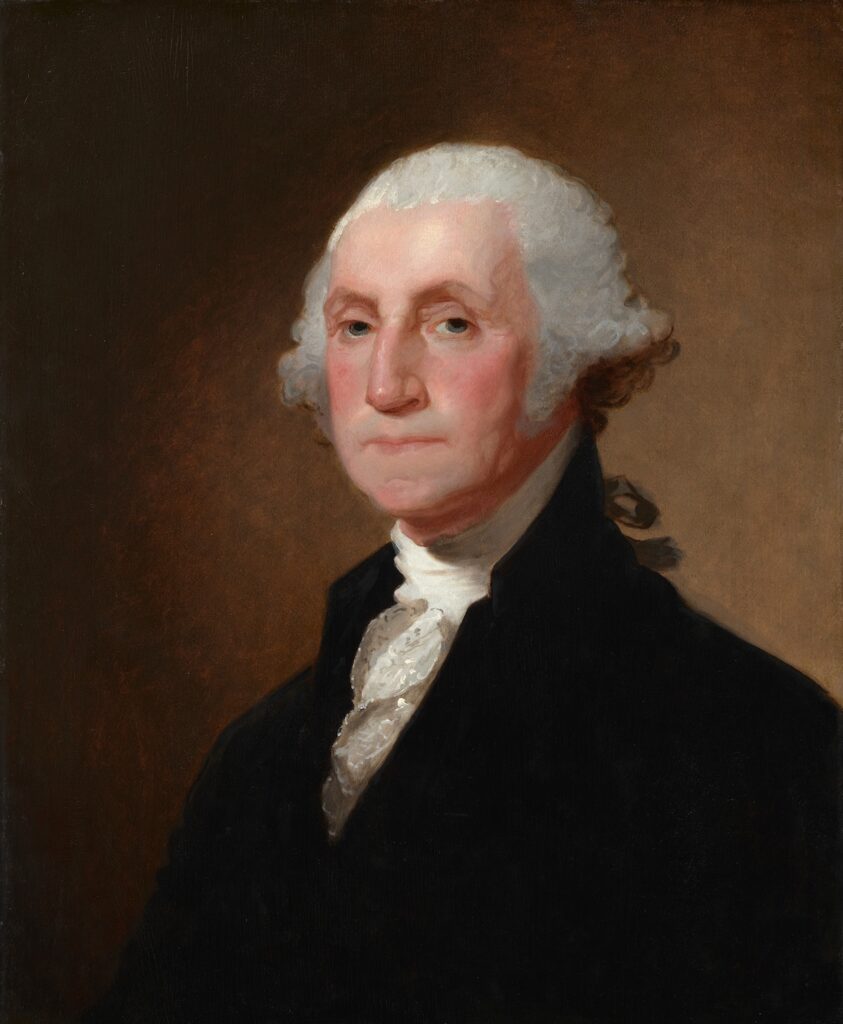
The death of President George Washington in 1799 sent the nation into a period of mourning that never quite ended. In the immediate aftermath of his passing, Americans honored the Founding Father by creating and consuming objects like memorial needlework, commemorative medals, and miniature portraits of Washington.
Starting in the late eighteenth century, it was tradition for family and friends to give and receive locks of hair from a deceased loved one. These pieces of hair were often fashioned into jewelry and worn as mementos.
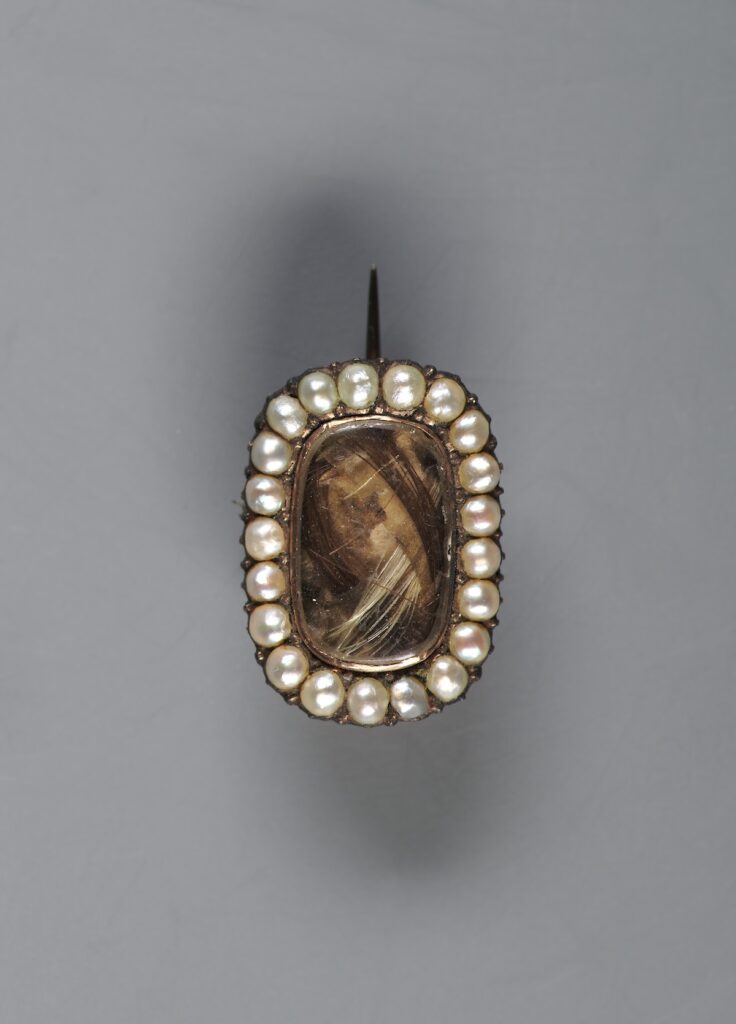
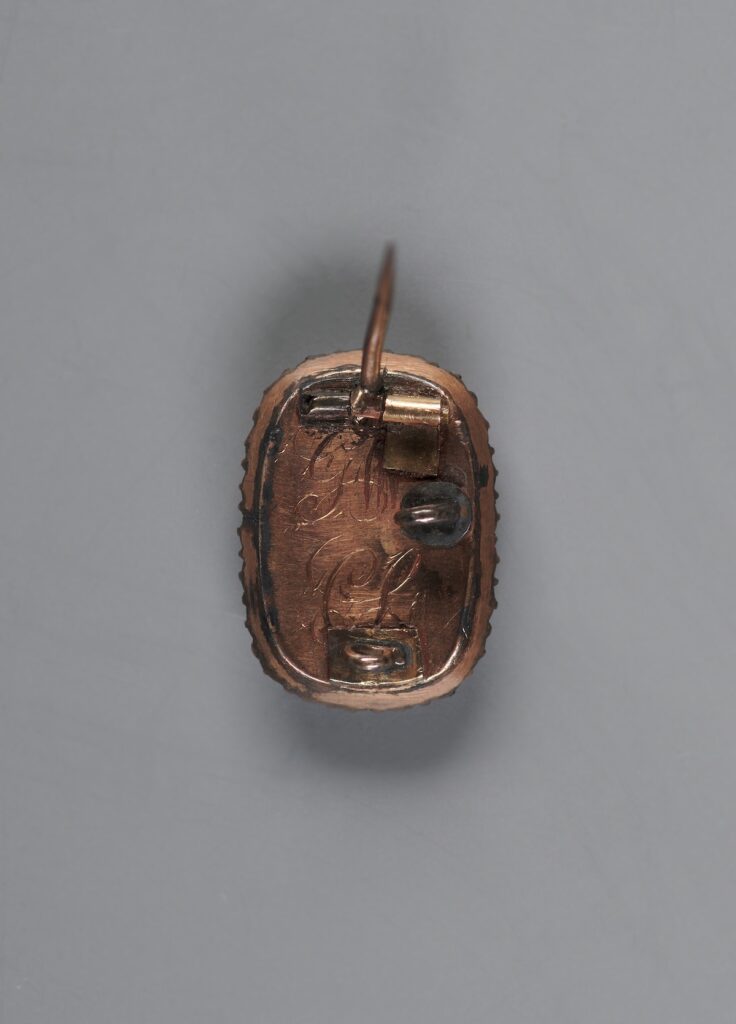
Such was the case for a small rectangular brooch in Historic New England’s collection, containing intertwined gray and brown hair under glass and surrounded by a row of seed pearls. On the back are two engraved initials: “G. W.” and “C. S.”
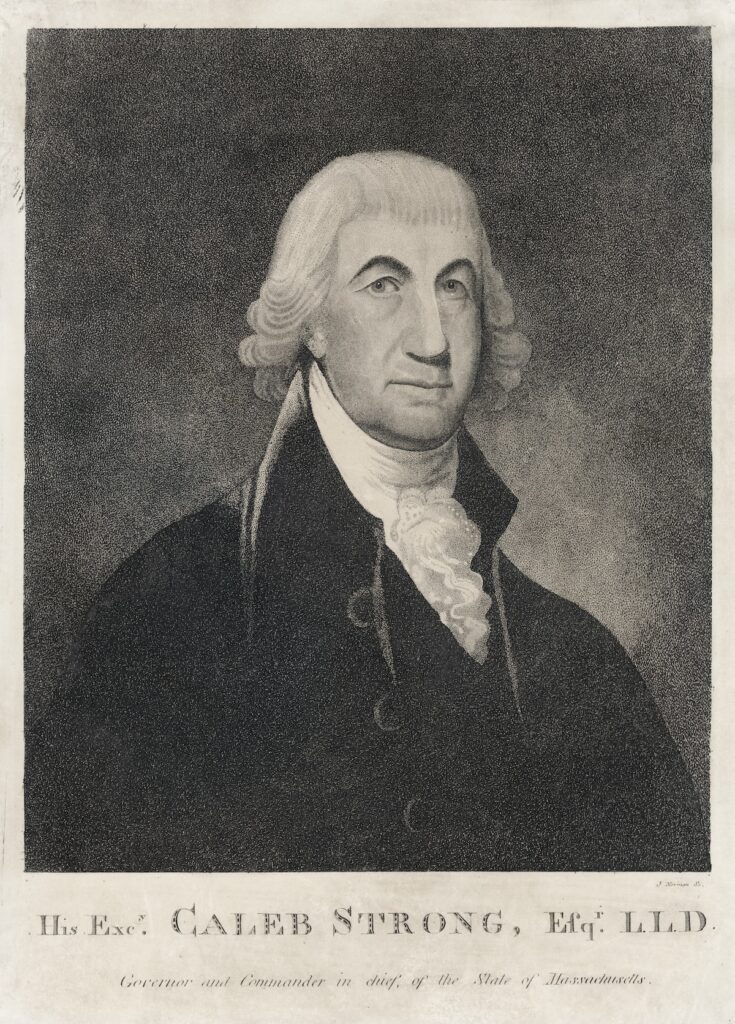
According to its donor, this brooch contained a lock of hair from George Washington and Governor Caleb Strong of Massachusetts (1745—1819).
Mrs. Edmund Bridge (Lidian E. Jackson Bridge) donated this brooch to Historic New England in 1922 and shared the story that Washington’s hair was obtained from Martha Washington by Josiah Bartlett (of Charlestown, Massachusetts), Paul Revere, and Joseph Warren. Bartlett, Revere, and Warren were all members of the Grand Lodge of Massachusetts, part of the fraternal order of Freemasons.
In 1800, they wrote to Martha Washington to express their grief at the passing of the “Chief who had lead their armies to victory, and their country to glory.” Their letter also contained a request:
“. . . the Grand Lodge have (sic) subjoined an order that a golden Urn be prepared as a deposit for a lock of hair, an invaluable relique of the Hero and the Patriot whom our wishes would immortalize . . .”
Martha Washington acquiesced to their proposal. According to her response, penned by secretary Tobias Lear, she “views with gratitude, the tributes of respect and affection paid to the memory of her dear deceased husband . . .”
The Masons were not the only ones to request this favor; friends as well as strangers wrote to Martha Washington, but she was only donated to a handful of institutions. Today, the lock of hair remains in the golden urn made by Paul Revere.
So, how did a lock of Washington’s hair make its way into this brooch alongside one from Caleb Strong? Historic New England’s object record contains a note from the accession book speculating the hair in the brooch may have been obtained at the same time the Grand Lodge received theirs. This would make some sense, given that the donor was the great-granddaughter of Josiah Bartlett. However, when I contacted the Massachusetts Grand Lodge, they had no records of additional hairs being given away.
Even more curious was the connection to Caleb Strong—or, that is, the absence of a connection. Caleb Strong did know George Washington, as he served in the United States Senate from 1789-1796 before becoming Governor of Massachusetts. However, he was never a Freemason. Additionally, I could find no family connection between the Strongs and the Bartletts, nor could I find anyone else in that family lineage with those two initials.
So, the question remains: Is this really Washington and Strong’s hair? If so, how did this brooch come to be made? It certainly is period appropriate, and close analysis from our conservators shows that the back of the brooch has been repaired a few times, with the latest fastening mechanism slightly obscuring the engraved initials. The brooch was clearly worn by someone who took good care of it.
Of course, one option is to open the brooch and conduct a forensic analysis on the hair with one known to have belonged to George Washington. But this kind of DNA testing would be too invasive, permanently altering the object in our collection.
Could an extra lock of Washington’s hair have been given to the Bartlett family, off the record? Was there a connection to Caleb Strong that went undocumented? Was the power of memorialization so strong that New Englanders would weave together the hair of two American statesmen, encrust its enclosure with pearls, and keep it as a family heirloom to be worn close to the heart?
We’ll continue to search for the answers.
Written by Erica Lome, Curator of Collections
Exhibitions like this are made possible by the generous support of Historic New England’s members and friends. Support Myth and Memory and help preserve our shared stories.
Sign up to our newsletter for our latest news and events